
Throughout history, humanity has relied on books, most of which are ancient and religious, to regulate collective life through principles held out as divine.
Yet these texts, revered across civilisations, have not always provided the moral compulsion needed for people to live as a just community.
They have also been invoked as justification for conflict, killing and destruction. One reason some have failed to prevent violence is that, in some of these books, killing can be interpreted as justified, sometimes even demanded under certain circumstances in their historical context.
Another is that, in some traditions, the rewards and punishments are postponed to the afterlife. This deferral can remove accountability from the present and absolve rulers, clerics and institutions from responsibility in this life.
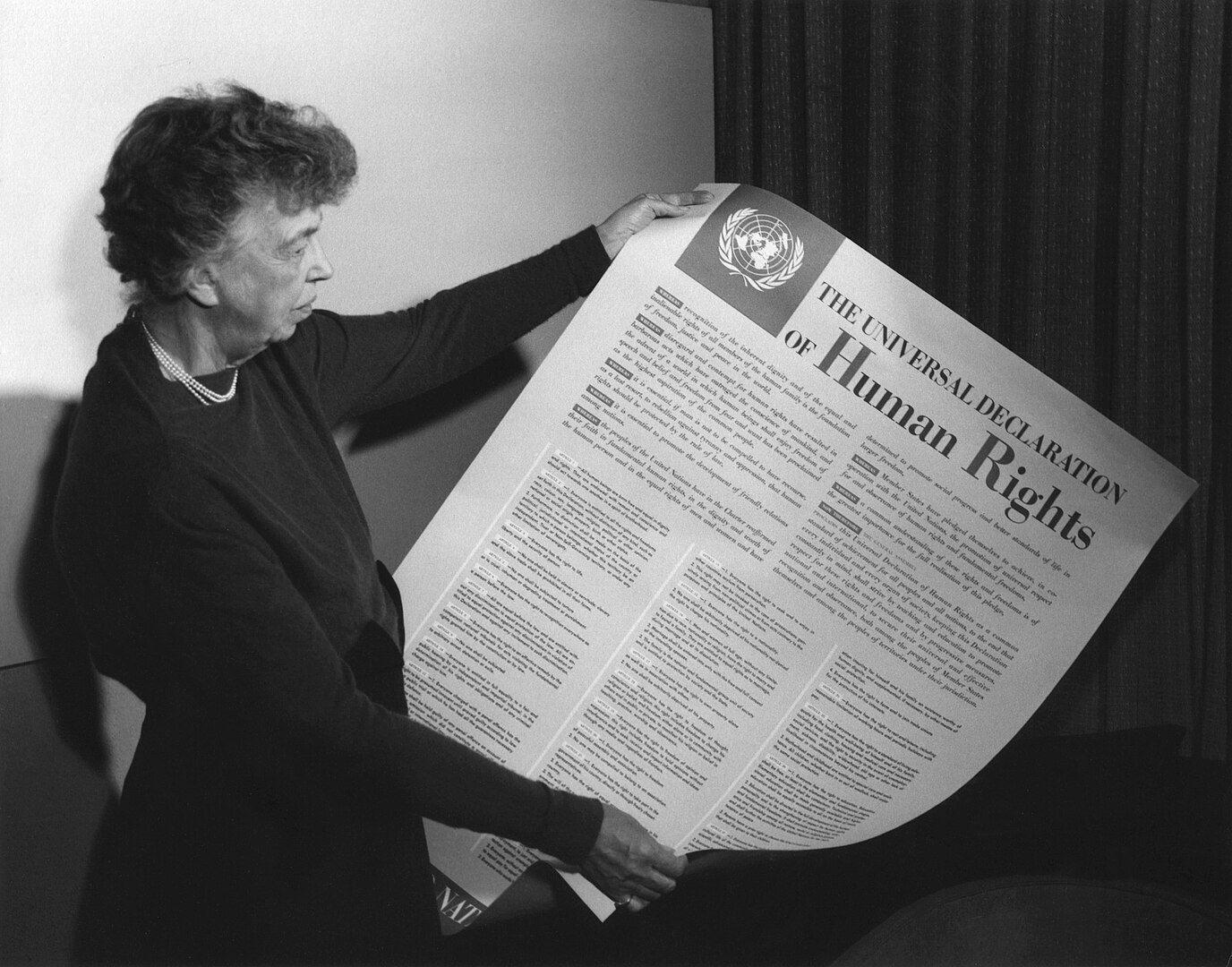
In contrast, the Universal Declaration of Human Rights (UDHR), adopted in 1948, offers a universal framework that has an essential message: all human beings are born free and equal in dignity and rights.
- Sign up for Aliran's free daily email updates or weekly newsletters or both
- Make a one-off donation to Persatuan Aliran Kesedaran Negara (ALIRAN), Maybank a/c 507246118995 or CIMB a/c 8004240948
- Make a pledge or schedule an auto donation to Aliran every month or every quarter
- Become an Aliran member
Its preamble says they are endowed with reason and conscience and should act towards one another in a spirit of brotherhood.
There is no condition to adopt a religion or creed. The UDHR applies to all human beings, universally, immediately and without exception.
Blueprint for peace
The UDHR was born from the ashes of World War Two. In the aftermath of genocide, totalitarianism and colonial collapse, the nations of the world came together to articulate shared moral values that would recognise the dignity of humanity and avert wars.
The result was a declaration, not a treaty, nor a law, but a solemn declaration and promise we all make to those living and to future generations.
The UDHR, as proclaimed by the General Assembly of the United Nations, “is a common standard of achievement for all peoples and all nations, to the end that every individual and every organ of society, keeping this Declaration constantly in mind, shall strive by teaching and education to promote respect for these rights and freedoms and by progressive measures, national and international, to secure their universal and effective recognition and observance, both among the peoples of Member States themselves and among the peoples of territories under their jurisdiction”.
It laid out 30 articles affirming the right to life, liberty, education, equality before the law, freedom of thought and religion, and protection from torture, slavery and arbitrary detention.
It was, in essence, a blueprint for peace: not merely the absence of war, but the presence of justice.
Power of principles
Yet more than 75 years later, the world remains ravaged by war, inequality and systemic cruelty. The principles of the UDHR have been honoured more in their breach than in their observance.
Governments, like that of Israel, become rogue, escape censure, and, if censured, ignore it with impunity. But principles like those laid down in the UDHR lose their meaning if they rely solely on force for enforcement.
Their true power lies in their moral force. In how they capture the hearts and minds of people.
These principles were never meant to be imposed from above but adopted by everyone. They call on our shared humanity, not on coercive authority.
Their enforcement depends not on weapons or tribunals, but on the will of the people. When people understand and embrace these rights, they become guardians of dignity in both public and private life.
Why the UDHR failed in Palestine
The tragedy unfolding in Palestine is probably the most devastating failure of the UN.
The UDHR proclaims that all human beings are entitled to life, dignity and protection from persecution. Yet in Gaza, these rights have been systematically denied.
The International Court of Justice ruled that it is plausible that Israel has committed acts that meet the criteria of genocide under international law, including mass killing, destruction of living conditions and dehumanising rhetoric.
This failure is not due to the weakness of the UDHR’s principles, but the abdication by nations to compel the rogue state to observe the UDHR. The UDHR depends on the moral and political commitment of states.
When powerful nations shield violators from consequences, and when international institutions are paralysed by vetoes or geopolitical interests, the rights enshrined in the UDHR become empty vacuous words.
In Palestine, decades of occupation, blockade, and impunity have culminated in full-blown genocide. The international community, despite having the Genocide Convention and the UDHR, has failed to act decisively.
This tragedy reveals a deeper truth: human rights cannot survive without human responsibility.
Secular scripture of conscience
The UDHR is not of religious origin. It does not invoke divine authority or sacred texts.
Instead, it emerges from humanity’s own understanding of what is needed to preserve humankind with dignity.
Its aspirations are rooted in a human conception of peace that can only be fulfilled by our shared moral responsibility. It is a secular scripture of conscience, born from the ashes of war and the yearning for peace and justice.
Resisting authoritarianism
Today, as authoritarianism rises across continents, cloaked in nationalism, surveillance and populist rage, we must return to the principles of the UDHR.
We must make the UDHR a living document. It must be taught in every school, embedded in every curriculum, and affirmed at every graduation. The completion of any level of education must be accompanied by a solemn commitment to uphold these principles, not as abstract ideals, but as daily practices.
Legitimacy and will of the people
What is needed are greater participatory rights in government. The legitimacy of any government must be rooted in its observance of the UDHR.
As affirmed in a recent High Court judgment, the people must see their governments as legitimate. That legitimacy cannot be manufactured through propaganda or procedural formality.
It must be earned through the consistent protection of human rights, the transparent exercise of power, and the inclusion of all voices in public life.
Restoring the UDHR through education
To restore the UDHR is to embed its principles into the moral architecture of society. This begins with education.
Integrate human rights into core curricula from primary school onwards. Frame rights as daily practice, not abstract ideals. Make graduation a civic rite of passage, with a pledge to uphold human dignity. Train educators to be mentors of conscience, not just transmitters of knowledge. Create rights-conscious institutions that model the values they teach. Foster global solidarity through student exchanges and civic campaigns.
Only education can restore the UDHR and raise generations who see dignity not as doctrine, but as a living responsibility.
Let’s rise to the challenge
We must reclaim the UDHR as a living document of moral resistance. We must teach it, live it and demand its implementation, not only in international forums, but in our schools, our streets and our statutes.
We must hold our governments accountable, not only for what they say, but for what they do. And we must confront the deeper truth: that human rights are not merely legal entitlements, they are ethical obligations.
The UDHR shows us what we could be. But it also reveals what we have failed to become.
Let us not walk away from the principles it declares. Let us instead rise to its challenge.
AGENDA RAKYAT - Lima perkara utama
- Tegakkan maruah serta kualiti kehidupan rakyat
- Galakkan pembangunan saksama, lestari serta tangani krisis alam sekitar
- Raikan kerencaman dan keterangkuman
- Selamatkan demokrasi dan angkatkan keluhuran undang-undang
- Lawan rasuah dan kronisme
