
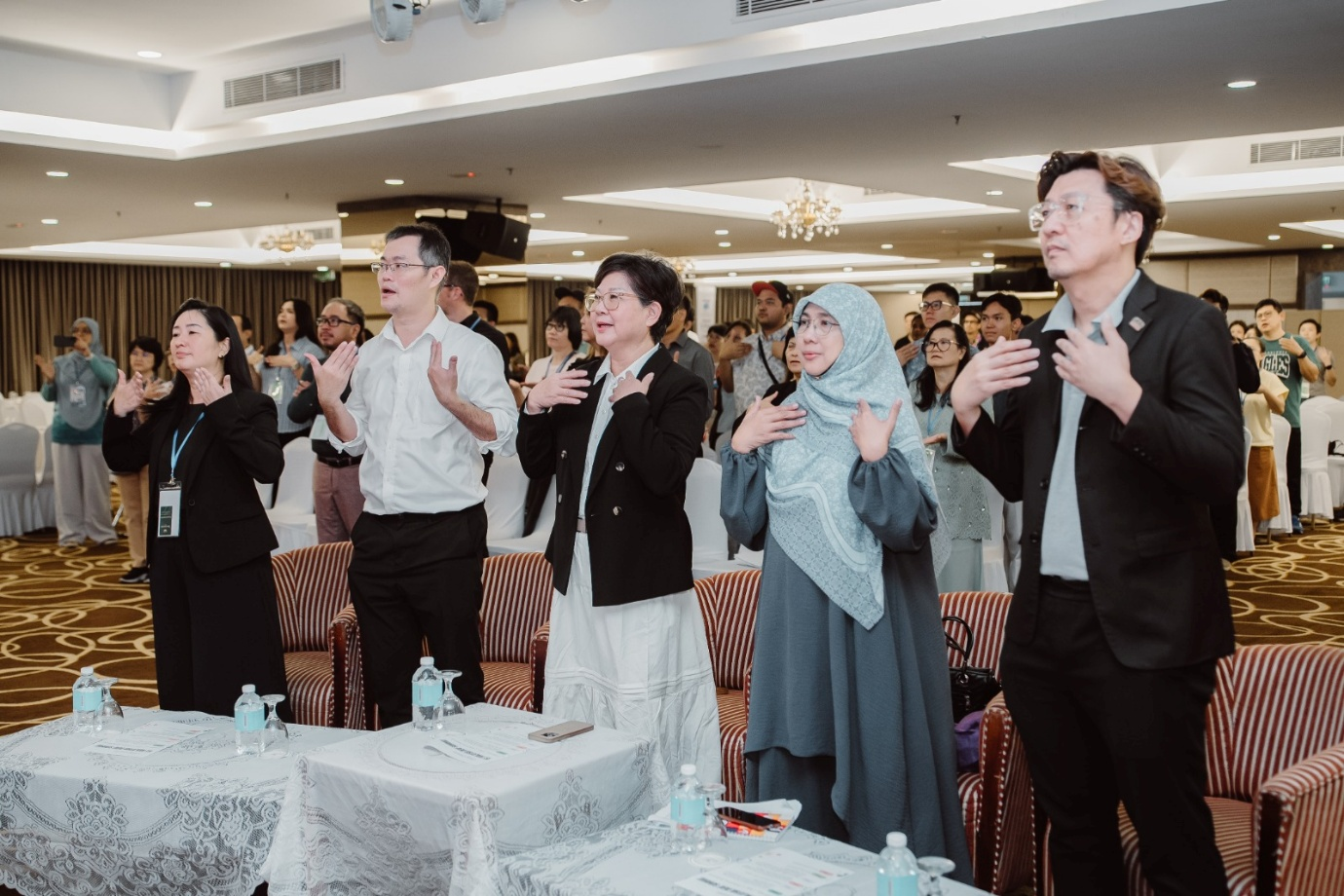
By Ali Azmi
Many people overlook the fact that the Deaf community is diverse. There is a crucial distinction in the term “d/Deaf”, which distinguishes between those who are audiologically “deaf” and those who are culturally “Deaf”.
While most culturally Deaf individuals were born deaf or became deaf early in life and use their respective national or local sign language as their primary language, the distinction is fundamentally about linguistic and cultural identity rather than just the timing or the degree of hearing loss.
There are over 200 different sign languages in the world (for more information on sign language, refer to the UN ESCAP Sign Language Guide here). In Malaysia, the mother tongue of most Deaf individuals would be Malaysian Sign Language, or BIM.
BIM is its own distinct language with its own grammar and structure – it is not a manual code for languages like Malay or English. Just as with spoken Malay, BIM is an organic, living language and has ‘dialects’ that exist across different states.
- Sign up for Aliran's free daily email updates or weekly newsletters or both
- Make a one-off donation to Persatuan Aliran Kesedaran Negara (ALIRAN), Maybank a/c 507246118995 or CIMB a/c 8004240948
- Make a pledge or schedule an auto donation to Aliran every month or every quarter
- Become an Aliran member
However, any further comparison between Malay and BIM may produce a reflex to try and equate them.
Now, I am not a d/Deaf person, so I will not insert myself as a spokesperson for d/Deaf issues. However, I would like to bring attention to two ways we understand the relationship between the hearing and the Deaf.
A profound distinction is that between:
- Understanding hearing impairment as the lack of hearing and
- Understanding the difference between hearing persons and Deaf people as a language barrier.
Framing deafness as a lack of hearing is what’s often called the medical model. This problematises deafness as something ‘broken’ that needs ‘fixing’ – how do we bring the Deaf person as close as possible to the hearing world?
The medical model obscures the actual challenges faced by Deaf individuals.
For instance, imagine a deaf child who is born to hearing parents who don’t know BIM to communicate with this child. The most significant problem confronting the child would be their cognitive language development.
Being unable to perceive or experience spoken language, the child will experience complete linguistic isolation at a very young age. This results in language delay, social isolation and poor mental health.
The medical model would too easily associate these problems with some ‘inherent limitation’ due to being deaf. Of course, this misses the point completely – language delay and similar issues here are symptomatic of the root problem of linguistic isolation.
If we understand the problem as an issue of language, however, the same problems are viewed in a different light. In this case, we can analogise the deaf child to a hearing child who was in essence, never taught to speak.
Children, whether deaf or hearing, need rich, accessible language input from birth to develop cognitively, emotionally and socially.
For deaf children born to hearing families who do not know how to sign, they are starved of language and face these risks just as any hearing child who is linguistically isolated would be.
Similarly, the higher rate of mental health issues amongst the Deaf community has nothing to do with deafness itself. It is a result of systemic linguistic and social isolation.
So, what needs changing?
One of the insidious consequences of the medical model is how it evokes pity. The medical model of deafness makes people say things like “poor them, they can’t hear x, y or z”.
However well-intentioned, pity misses the point. What is needed is linguistic accessibility.
Again, pity sees some inherent lack or privation in the condition of deafness, whereas accessibility sees this in terms of justice: a fundamental right to all aspects of meaningful participation on an equal basis with others.
Under the medical model, many assume that all Deaf people want to, or surely would want to, hear. This ignores the fact that many in the Deaf community view deafness as a linguistic and cultural identity rather than a medical problem.
The language barrier framework reveals that hearing society systemically isolates the Deaf by failing to provide linguistic access.
The difference in these perspectives will matter for future advocacy and change.
Consisder, for instance, that the government has announced that BIM will be offered as an elective in schools from 2027.
Through a medical lens, this is accommodating for ‘disabled’ students to “not feel left out” (as is framed in this article in the Rakyat Post).
Through the language barrier lens, it’s about hearing people learning to bridge the communication gap.
This same shift in perspective applies to BIM interpreter services, accessible communication modes of emergency systems, and inclusive education.
None of these are charitable accommodations for ‘broken’ people, but basic linguistic rights for a language minority.
We understand that language barriers deny people access to education, healthcare, and civic participation. While BIM is officially recognised as a language in the Persons with Disabilities Act 2008, the real barrier is psychological.
As long as we view deafness only through the medical model, we position Deaf people as inferior. From that position, genuine advocacy becomes tainted.
We cannot genuinely advocate for people whose existence we pity. We must abandon the idea that deaf people need fixing and instead see that it is our society that needs changing.
This article was written after consultation with Yuenwah San (co-founder of the OKU Rights Matter Project) and Dr Anthony Chong (co-founder of the Malaysian Sign Language and Deaf Studies Association).
Ali Azmi is a research associate who focuses on finding better ways to support communities and improve their quality of life. His work explores new ideas for sustainable and inclusive development, challenging traditional economic models and putting people’s needs and aspirations first.
AGENDA RAKYAT - Lima perkara utama
- Tegakkan maruah serta kualiti kehidupan rakyat
- Galakkan pembangunan saksama, lestari serta tangani krisis alam sekitar
- Raikan kerencaman dan keterangkuman
- Selamatkan demokrasi dan angkatkan keluhuran undang-undang
- Lawan rasuah dan kronisme
