

Malaysia’s gig economy cannot be separated from its semi-peripheral position in global capitalism.
As an export-oriented country, Malaysia is highly dependent on foreign direct investment in its high-tech sectors, from semiconductors testing and assembly to AI and data centres and electric vehicles and batteries.
It remains reliant on foreign direct investment and global monopoly-finance capital, thereby reproducing Malaysia’s semi-peripheral dependency (Amin, 1976).
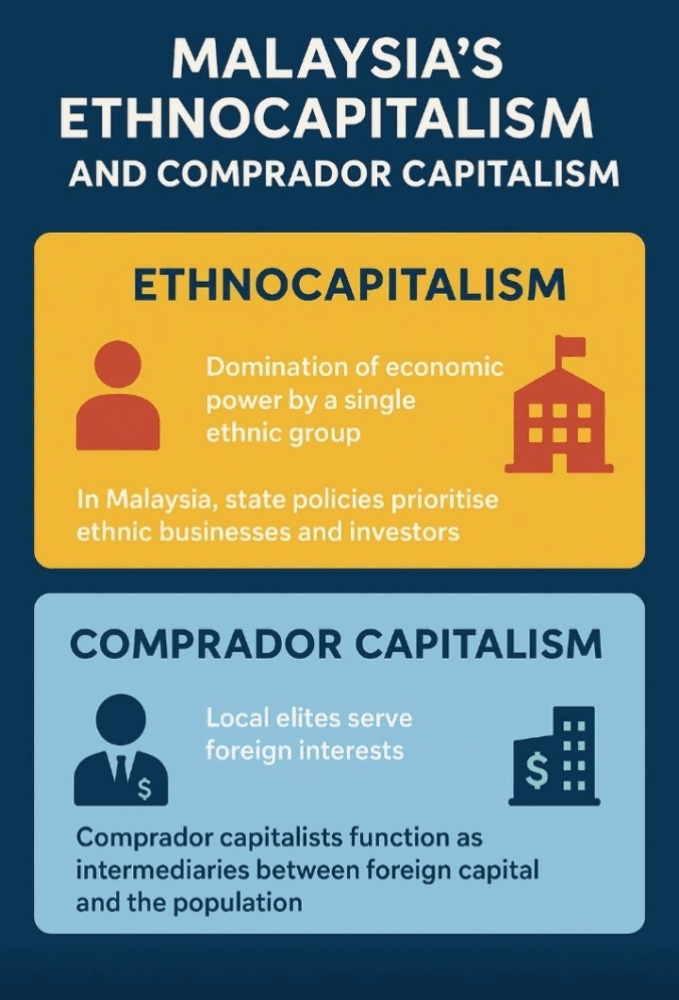
Under a comprador capital environment, local capital plays an intermediary function between local accumulation and global monopoly-finance capital. It is seen to have aligned with foreign digital monopolies, facilitating foreign direct entry of infrastructural platforms like Alphabet, Meta and and local domination (Grab’s merger and Foodpanda’s expansion).
Malaysia’s political economy is further shaped by ‘ethnocapitalism’, which is the allocation of economic rents and opportunities along ethnically mediated patronage networks.
- Sign up for Aliran's free daily email updates or weekly newsletters or both
- Make a one-off donation to Persatuan Aliran Kesedaran Negara (ALIRAN), Maybank a/c 507246118995 or CIMB a/c 8004240948
- Make a pledge or schedule an auto donation to Aliran every month or every quarter
- Become an Aliran member
The existence of ethnocapitalism allows licensing regimes and subsidies that channel benefits to select segments of the community, while precarious gig workers – the majority of whom are labouring people – remain excluded.
The third dimension is the existence of a dependency syndrome in which Malaysia’s digital labour force is trapped in low-wage, high-risk segments of global value chains.
The brain drain (as documented by the World Bank and by Emir Research studies) reflects how high-skilled labour migrates, leaving behind a ‘precariat’ (Khazanah Research Institute, 2020) – a large pool of low-skill workers who are marginally paid.
In such a dependency environment, for high-tech industries like those in semiconductors, AI servers and data centres, Malaysia offers subsidies, cheap land and low energy tariffs to foreign capital, while intellectual property, platform rents and dividend repatriation are siphoned abroad.
This is also where platform colonialism – the ownership by Big Tech (entities like Alphabet, Amazon, Meta and Microsoft) – dominates Malaysia’s digital infrastructure.
The country is trapped in a dependency mode: paying recurring rents for cloud services, advertising and software without developing indigenous alternatives.
The Gig Workers Bill 2025, which was passed by Parliament in September, does not emancipate labour but reinforces Malaysia’s insertion into digital colonialism. In this framework, infrastructural platforms dominate and digital-dehumanised workers process raw data into capital flows for global monopoly-finance accumulation, giving rise to a digital exogenous empire within a national economy.
Critique of the bill
FollIowing the Gramscian hegemony concept, this Gig Worker Bill manufactures consent through regulation: presenting itself as ‘pro-worker’ while ensuring continued capital accumulation.
This is passive revolution – absorbing discontent into legal frameworks without altering class power.
Indeed, Antonio Gramsci’s theory of hegemony provides a critical lens for understanding Malaysia’s political-economic formation.
The ruling bloc maintains power not merely through coercion but by manufacturing consent.
In Malaysia, ethnocapitalist blocs – primarily the ethnic Malay bourgeoisie, buoyed by government-linked firms and rentier networks – anchor political dominance.
These elites foster a system of clientelism, distributing rents to secure loyalty, while portraying themselves as guardians of national development as elaborated by Weiss (2020) on relational clientelism.
Following Nicos Poulantzas’ thinking on state and class, this nation acts as a condensation of class forces, mediating between monopoly capital and labour.
Here, the law consolidates the hegemonic bloc of digital platforms and comprador elites while fragmenting workers’ ability to resist.
Through the expansion of dependency and unequal exchange (Samir Amin), Malaysia’s gig workers embody the global periphery: cheap, disposable labour subordinated to platforms with headquarters in the Global North or Singapore, with value siphoned out through digital colonialism.
Malaysia’s bourgeoisie is not an independent capitalist class capable of leading autonomous development. Instead, it functions as comprador capital, mediating between domestic accumulation and global monopoly-finance capital.
Partnerships with US semiconductor firms, Big Tech companies establishing data centres, and World Bank-guided digital initiatives are celebrated as progress but in reality deepen dependency.
Malaysia is trapped in subcontracting roles, providing assembly and testing facilities while Global North firms dominate design, intellectual property and value capture.
With the financialisation of everyday life(Baran, Sweezy, Foster), the emergence of platform capitalism in the country embeds speculative finance into everyday transport and food services.
Workers are not only labourers but also micro-investors, financing their own exploitation through vehicles, mobile phones and data plans.
Toward an alternative framework
To move beyond the perversities of the Gig Workers Bill, Malaysia must embrace a radical rethinking of digital labour governance:
- Algorithmic transparency: Mandate disclosure of fare-setting and assignment algorithms, subject to independent audits.
- Fair commission caps: Limit platform commissions to less than 15% to restore income stability.
- Universal social security: Mandate automatic contributions to the Employees Provident Fund and Social Security Organisation (Socsco) by platforms, proportional to worker earnings.
- Data democracy: Recognise data generated by workers as collective labour property, ensuring revenue-sharing from monetised data streams.
- Worker co-operatives: Encourage platform co-operatives where drivers own and manage digital infrastructures, resisting monopoly enclosures.
What needs to change
The Gig Workers Bill is not a step toward justice but a regulatory codification of exploitation.
It entrenches the hegemonic power of netarchical capitalism – where those who control digital networks and platforms extract value from users and workers – disguising worker disenfranchisement as formal recognition.
By failing to address algorithmic exploitation, commission abuse and social insecurity, the bill ensures Malaysia’s gig workers remain trapped in digital servitude.
Civil society groups and think tanks have warned that the bill is “unjust and perverse”, a “tax on precarious work” and “surrendering the ecosystem to monopolies” while normalising their status as second-class digital labourers.
As Malaysia deepens its digitalisation agenda, it must confront the structural contradictions of platform capitalism: capital’s control of infrastructures, labour’s precarisation and the siphoning of value to global monopoly-finance.
Without a radical and progressive reorientation – grounded in labour empowerment, social protection and co-operative ownership – digitalisation will not liberate but subjugate.
AGENDA RAKYAT - Lima perkara utama
- Tegakkan maruah serta kualiti kehidupan rakyat
- Galakkan pembangunan saksama, lestari serta tangani krisis alam sekitar
- Raikan kerencaman dan keterangkuman
- Selamatkan demokrasi dan angkatkan keluhuran undang-undang
- Lawan rasuah dan kronisme
