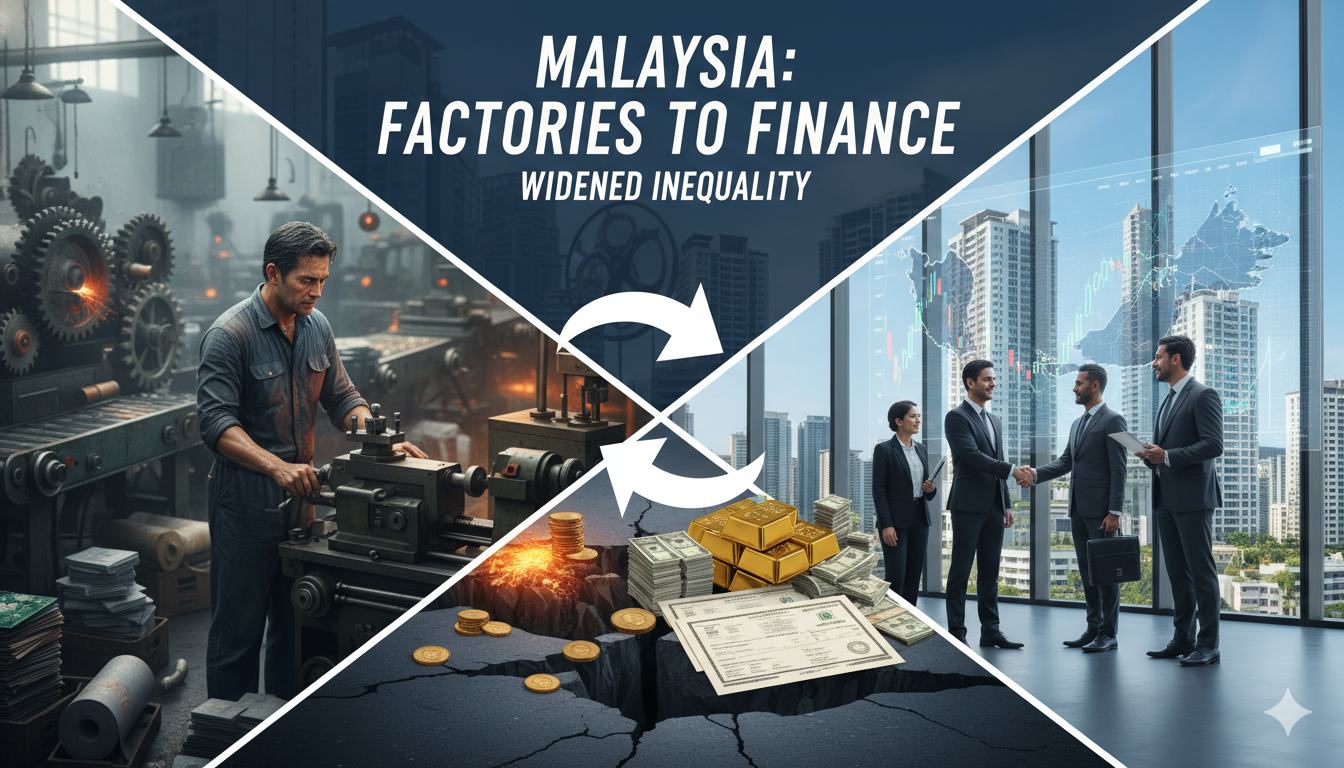
Malaysia’s economy has undergone a profound structural transformation since the 1990s – a shift from an economy driven by industrial and export manufacturing to a financialised, service-oriented model.
This process, termed financialisation capitalism, describes the increasing dominance of financial motives, markets and institutions over the productive economy (Epstein, 2005; Krippner, 2011).
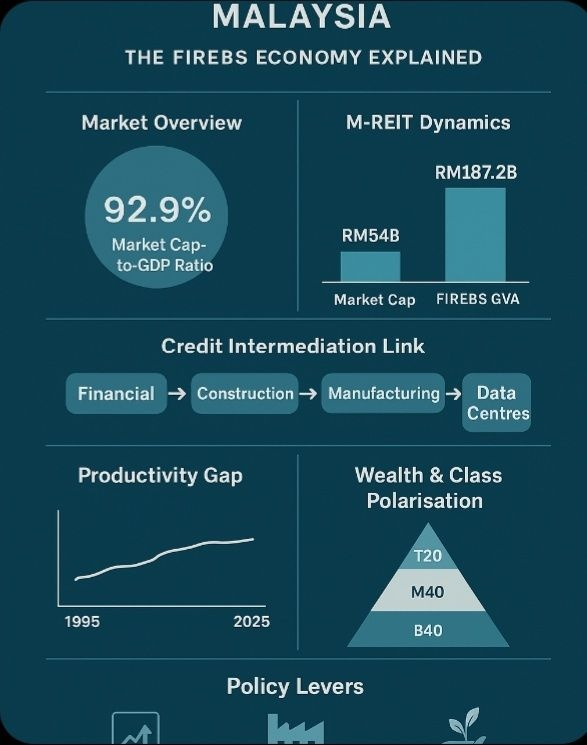
By 2023, Malaysia’s total market capitalisation reached 92.9% of nominal gross domestic product (GDP), indicating deep integration of financial market activities into the national economy.
While such ratios are often celebrated as signs of maturity, they equally suggest an economy increasingly oriented towards asset accumulation rather than productive reinvestment.
Property trusts and financial services
Malaysia’s real estate investment trusts (REIT) sector exemplifies this financialisation trend.
- Sign up for Aliran's free daily email updates or weekly newsletters or both
- Make a one-off donation to Persatuan Aliran Kesedaran Negara (ALIRAN), Maybank a/c 507246118995 or CIMB a/c 8004240948
- Make a pledge or schedule an auto donation to Aliran every month or every quarter
- Become an Aliran member
As of mid-2025, the top 20 REITs held a combined market capitalisation of about RM54bn, outperforming the broader FBM KLCI index and reflecting strong investor confidence in rent-yielding assets.
However, the RM54bn in Malaysia’s REIT assets only partially represents the real economic value derived from the broader finance, insurance, real estate, and business services sector (FIREBS), which contributed RM187bn in gross value-added in 2024 (Department of Statistics, 2025).
The financial ecosystem generates value in several ways.
Management and trustee fees are extracted from rent and property deals rather than from producing anything new.
Rental incomes expand property-based revenues but don’t create new productive capacity.
Bank lending by commercial banks underpins property purchases and development. Credit given to the private non-financial sector expanded by 5.2% in the fourth quarter of 2024 (Bank Negara Malaysia, 2025).
All this creates a structural dependency on income from assets (rentier returns) and asset-based growth — linking the financial system’s growth to the country’s physical expansion in construction, industrial real estate and emerging data centre corridors, especially in the Johor–Singapore Special Economic Zone.
Stagnant productivity
While Malaysia’s new industrial masterplan up to 2030 and national semiconductor strategy aim to revive advanced manufacturing, both remain critically dependent on a services-dominant ecosystem.
Since deindustrialisation in the 1990s, total factor productivity has stagnated. This has burdened the services sector with the responsibility of sustaining growth without corresponding gains in innovation or labour efficiency (World Bank, 2024).
This imbalance between financial expansion and productive output epitomises what might be called the “rentier–industrial disconnect”.
As industrial capacity weakened, capital increasingly circulated through financial channels – through equities, REITs and speculative property markets – rather than through reinvestment into physical production or wage growth.
The result: a financialised GDP composition that masks structural underemployment, wage stagnation and a deepening wealth gap.
The rentier trap
The social consequences of Malaysia’s financialisation are profound.
A growing segment of middle and upper-class households now depends on asset-based income – dividends, REIT yields and capital gains – rather than productive labour.
This reinforces class stratification between rentier capital and wage-dependent classes – a phenomenon described as “fictitious capital accumulation” (Marx, 1894; Sweezy, 1997).
For the working and lower-middle classes, however, this shift manifests in rising costs of living, housing unaffordability, and limited wage mobility.
The dominance of financial capital also redirects state policy towards protecting capital markets and asset prices, rather than redistributive taxation or industrial upgrading.
This explains the political reluctance to reform Malaysia’s tax base, which continues to depend heavily on consumption-based taxes rather than progressive wealth or capital gains taxes.
Global capital dependence
Geoeconomically, Malaysia’s financialisation deepens its semi-peripheral dependence on global capital flows.
The integration of Malaysian financial assets into regional investment circuits – particularly through Singaporean, Japanese and US funds – creates both liquidity and vulnerability.
Foreign holdings in domestic bonds and equities can easily reverse during external shocks, amplifying volatility.
Meanwhile, Malaysia’s participation in data centre investment booms and semiconductor value chains reflects a new form of digital financialisation. Here, global Big Tech firms extract value through infrastructure financing and leasing arrangements, often backed by REIT-style financial vehicles.
This further entrenches Malaysia within global monopoly-finance capitalism (Foster & McChesney, 2012), where domestic assets serve as collateral for transnational capital accumulation rather than engines of national productivity.
Reclaiming productive capital
To navigate beyond the rentier trap, Malaysia’s 13th Malaysia Plan must prioritise productive reinvestment over speculative finance.
Policy recommendations include:
- Reorient fiscal incentives toward industrial upgrading and technological innovation rather than financial asset accumulation.
- Reform taxation to include progressive capital gains and REIT income taxes to redistribute asset-based wealth.
- Develop a sovereign developmental fund dedicated to reindustrialisation, using financial surpluses from government-linked investment companies and REIT earnings.
- Enhance financial governance under Bank Negara to curb speculative lending and align credit growth with productive investment.
Finance dominance entrenches inequality
Malaysia’s financialisation represents not merely an economic phase but a structural political economy transformation.
The dominance of financial over productive capital entrenches inequality, limits industrial renewal, and exposes Malaysia to volatile global capital movements.
Without confronting the ideological and institutional roots of financialisation capitalism, Malaysia risks perpetuating a system where growth is abundant, yet real economic development remains elusive.
AGENDA RAKYAT - Lima perkara utama
- Tegakkan maruah serta kualiti kehidupan rakyat
- Galakkan pembangunan saksama, lestari serta tangani krisis alam sekitar
- Raikan kerencaman dan keterangkuman
- Selamatkan demokrasi dan angkatkan keluhuran undang-undang
- Lawan rasuah dan kronisme