
Ahmad Ibrahim
Imagine a world where your old mobile phone doesn’t languish in a drawer or leak toxins into a landfill, but is instead the source of materials for a new generation of devices. A world where a worn-out car tyre is reborn as a playground surface, and food waste powers the very cities it came from.
This isn’t a far-fetched utopia – this is the tangible promise of the circular economy. According to a comprehensive new review by researchers Sangoremi, Abosede and Adeleke, it is the most critical precursor to achieving genuine global environmental sustainability.
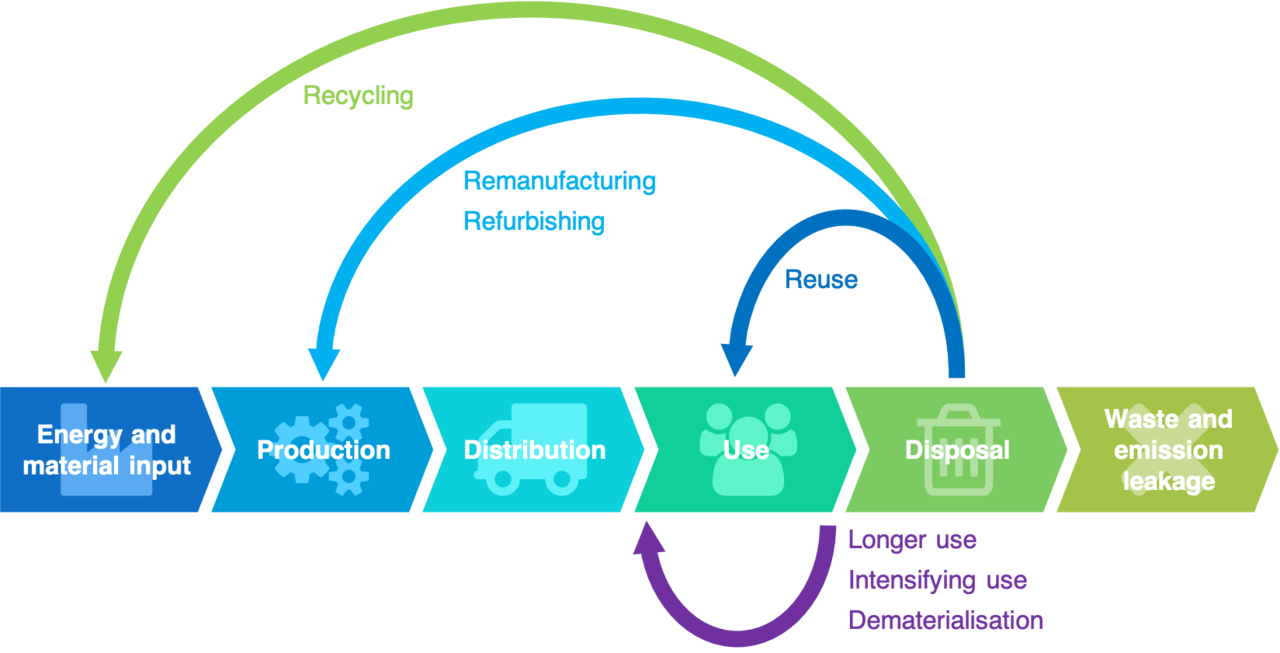
For decades, our global operating system has been linear: take, make, dispose and discard. We extract finite resources, transform them into products with often shockingly short lifespans, and then discard them, creating a mounting crisis of pollution, biodiversity loss and climate-changing emissions.
The review, published in the Asian Journal of Current Research, posits that this “end-of-life” model is not just broken – it is fundamentally obsolete. The circular economy offers a system-wide upgrade, shifting the paradigm from waste management to waste elimination. Repeat, waste elimination.
- Sign up for Aliran's free daily email updates or weekly newsletters or both
- Make a one-off donation to Persatuan Aliran Kesedaran Negara (ALIRAN), Maybank a/c 507246118995 or CIMB a/c 8004240948
- Make a pledge or schedule an auto donation to Aliran every month or every quarter
- Become an Aliran member
The core finding of this research is that a circular economy is not merely an environmental strategy but an economic and social imperative. The authors move beyond the popular, yet limited, concept of recycling to illuminate a more profound systemic redesign.
Three crucial shifts
The review highlights three transformative shifts that a true circular model requires.
Designing for longevity and regeneration: The first and most crucial finding is that circularity begins at the drawing board. Products must be designed from the outset to be durable, repairable and modular.
This challenges the prevailing culture of planned obsolescence, suggesting that the most sustainable resource is the one we never need to extract because the product we already have is built to last. It also calls for the use of regenerative materials – those that can safely re-enter the biosphere or be perpetually circulated in the industrial system.
Unlocking trillions in economic value: The review powerfully argues that the circular economy is a massive economic opportunity, not a cost. By keeping materials in use, businesses can decouple growth from resource extraction, insulating themselves from volatile commodity prices and creating new, resilient revenue streams.
Think of a world where companies sell ‘performance’ instead of products—lighting as a service instead of light bulbs, mobility instead of cars. This incentivises durability and creates a closed-loop system where manufacturers have a vested interest in the entire lifecycle of their goods.
The imperative of systemic collaboration: Perhaps the most challenging finding is that circularity cannot be achieved in silos. The transition requires unprecedented collaboration across entire value chains – from miners to manufacturers, retailers to consumers, and policymakers to waste managers.
The review suggests that governments must lead with ‘carrots’ and ‘sticks’: implementing extended producer responsibility laws that hold companies accountable for their post-consumer waste, while offering tax incentives for circular business models and funding for the necessary innovation in material science and logistics.
What holds us back
What is holding us back? The review identifies the inertia of the linear system as the primary barrier. Our infrastructure, financial markets and even consumer habits are wired for disposability. Overcoming this requires a conscious and collective effort.
The analysis by Sangoremi and colleagues is a clarion call. It frames the circular economy not as a niche environmental concern, but as the foundational framework for building a resilient, prosperous and sustainable global society.
The question is no longer whether we should transition to a circular model, but how fast we can mobilise the political will, corporate innovation and public engagement to make it happen. The blueprint for a world without waste is here. The findings of this review make it clear that our future depends on our courage to finally close the loop.
Malaysia’s challenge
Malaysia’s decision to mainstream the circular economy is laudable. But we must recognise the struggle ahead. Business has over the years become addicted to the linear economy. Getting them to change is not easy. Consumers have also grown comfortable with the convenient throwaway culture.
Changing such waste accumulating behaviour will require more than just regulations – failure to migrate can spell trouble for the country’s export business.
The world market has shown a strong preference for products which comply with the circular economy criteria. Not to mention foreign investment.
Circularity is one of their key criteria for investment.
As Malaysia is highly dependent on the export business and a healthy flow of foreign investment, it makes good sense to effectively embrace the circular economy. The 13th Malaysia Plan clearly articulated that direction for the country’s economy.
Professor Dato Ahmad Ibrahim is affiliated with the Tan Sri Omar Centre for STI Policy Studies at UCSI University. He is also an adjunct professor at the Ungku Aziz Centre for Development Studies, University of Malaya.
AGENDA RAKYAT - Lima perkara utama
- Tegakkan maruah serta kualiti kehidupan rakyat
- Galakkan pembangunan saksama, lestari serta tangani krisis alam sekitar
- Raikan kerencaman dan keterangkuman
- Selamatkan demokrasi dan angkatkan keluhuran undang-undang
- Lawan rasuah dan kronisme
