
Malaysia’s semiconductor ecosystem sits at a pivotal inflection point.
As Khazanah Nasional Berhad channels capital into power system strengthening and selectively supports local firms in the face of an AI-driven investment cycle, the nation’s aspiration to climb the semiconductor value chain – particularly into advanced packaging – deserves rigorous reassessment.
While cheap, reliable energy and grid resilience are widely recognised as foundational to competitiveness, Malaysia’s broader structural deficits in labour, technology absorption and strategic co-ordination risk undermining its mission vision.
This essay critically examines whether Malaysia’s immense goals are viable, identifying the key deficiencies and the tasks that remain imperative for success.
The power challenge
At the heart of the semiconductor industrial push is energy. Advanced packaging and high-performance computing facilities feeding AI workloads are energy-intensive.
- Sign up for Aliran's free daily email updates or weekly newsletters or both
- Make a one-off donation to Persatuan Aliran Kesedaran Negara (ALIRAN), Maybank a/c 507246118995 or CIMB a/c 8004240948
- Make a pledge or schedule an auto donation to Aliran every month or every quarter
- Become an Aliran member
Malaysia’s existing generation mix – historically reliant on fossil fuels – has been under stress from rising demand, weather variability and infrastructural bottlenecks (Tenaga Nasional Berhad Annual Report, 2024). Grid instability translates directly into production risk. Voltage fluctuations and outages can cost semiconductor fabs millions in yield losses (Bush, 2023).
Khazanah’s capital injections into power infrastructure signal recognition of this constraint.
However, resilience is more than capacity expansion. It encompasses redundancy, distribution automation, microgrids and rapid restoration capabilities.
Global peers such as Taiwan and South Korea have integrated sophisticated grid management systems that allow fab clusters to maintain near-continuous operations – essential for advanced packaging where thermal precision and process stability are paramount (Chen & Lin, 2022).
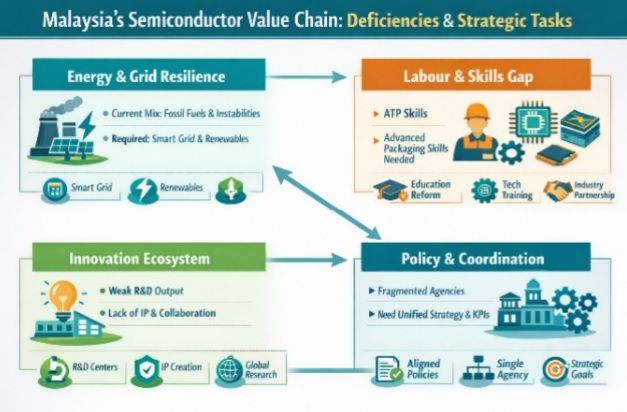
Malaysia’s ongoing grid upgrades must therefore prioritise not just generation but smart grid technologies and renewables integration to ensure energy cost competitiveness over time
The skills deficit
Malaysia’s semiconductor labour force has traditionally excelled in back-end assembly, testing and packaging.
This foundation is valuable but insufficient for advanced packaging, which demands higher cognitive skills, precision engineering and cross-disciplinary capabilities (Humphrey & Schmitz, 2021).
Advanced packaging technologies – such as 2.5D/3D IC integration, fan-out wafer-level packaging and system-in-package solutions – require engineers trained in micro-electromechanical systems, materials science and thermal management, alongside production teams skilled in ultra-precise process control.
Current educational and vocational pathways are misaligned with these demands. While Malaysia’s technical universities produce competent graduates in electronics and electrical engineering, industry-specific competencies for advanced packaging are underdeveloped.
This skills gap cannot be bridged solely through short-term training programmes. It requires a curriculum redesign, industry–academy partnerships and direct placement programmes with global leaders in advanced packaging.
Advanced packaging straddles the divide between hardware and innovative design for manufacturability. Simply importing equipment is not enough. Firms must be able to absorb, adapt and innovate upon these technologies.
In this domain, Malaysia has yet to build a robust ecosystem of R&D centres, intellectual property creation and internationally collaborative research that feeds into domestic firms’ competitive offerings.
Singapore’s success in packaging has hinged on institutions such as the Institute of Microelectronics, a research institute focused on semiconductors and advanced packaging, and the Agency for Science, Technology and Research.
These operate with explicit mandates to co-create patents, proprietary technologies, designs and other intellectual property with industry partners and spin out firms capable of global competitive engagement.
Malaysia’s research ecosystem remains fragmented, with agencies duplicating efforts and limited pathways for research outputs to scale commercially (Emir Research 2025).
The policy gap
Khazanah’s funding for energy and semiconductors is necessary but insufficient without a co-ordinated industrial policy that aligns fiscal incentives with long-term capability building.
Tax incentives and grants can attract investment, but without performance-linked conditions – such as local R&D commitment, export orientation and workforce development – capital inflows risk perpetuating low-value activities.
In contract, countries that have successfully upgraded their semiconductor segments have employed mission-oriented policy frameworks with measurable milestones and accountability (Mazzucato, 2018; Vietnam & Malaysia, op cit).
Malaysia’s policy apparatus also suffers from institutional fragmentation. Multiple agencies have overlapping roles, diluting strategic focus and increasing transaction costs for firms.
A consolidated semiconductor strategy under a single co-ordinating body – with clear key performance indicators tied to capability progression from assembly, testing and packaging to advanced packaging – would streamline policy implementation.
From vision to viability
Malaysia’s aspiration to move up the semiconductor value chain towards advanced packaging is technically feasible but politically and institutionally underpowered in its current form.
While Khazanah’s investments in energy infrastructure acknowledge a crucial enabler, the broader success of this mission depends on addressing:
- Grid resilience and smart energy systems that undergird high-uptime operations
- Skills ecosystem transformation to generate advanced packaging talent
- Innovation systems that enable technology absorption and the creation of patents, proprietary technologies, designs and other intellectual property
- Policy coherence and strategic co-ordination that aligns incentives with capability upgrading.
Without these structural reforms, Malaysia risks stagnating at the mid-value stages of semiconductor production, missing the economic and geopolitical dividends of fully participating in the AI investment cycle.
AGENDA RAKYAT - Lima perkara utama
- Tegakkan maruah serta kualiti kehidupan rakyat
- Galakkan pembangunan saksama, lestari serta tangani krisis alam sekitar
- Raikan kerencaman dan keterangkuman
- Selamatkan demokrasi dan angkatkan keluhuran undang-undang
- Lawan rasuah dan kronisme
