
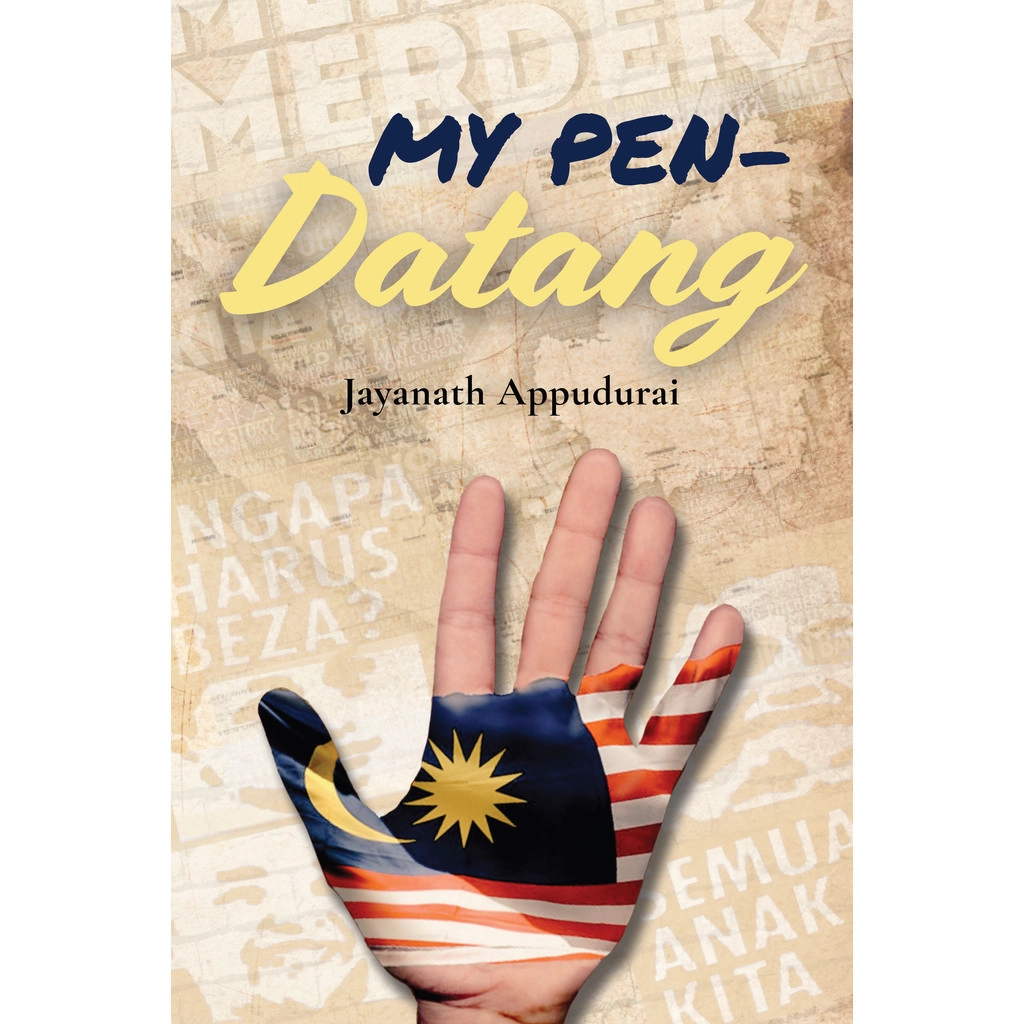
My Pen-Datang
Author and publisher: Jayanath Appudurai
Price: RM25
Book review by Ravindran Raman Kutty
My Pen-Datang by Jayanath Appudurai is a heartfelt, accessible and quietly powerful memoir that invites people of Malaysia to rediscover their roots and reclaim a shared national story beyond ethnicty and religion.
It is not just a personal journal. It is a mirror held up to the nation, asking each of us who we are, how we got here and what kind of Malaysia we are prepared to build for the next generation.
Everyone who cares about this country’s soul, not just its slogans, will find something deeply resonant within its pages.
Capturing roots, memory and belonging
- Sign up for Aliran's free daily email updates or weekly newsletters or both
- Make a one-off donation to Persatuan Aliran Kesedaran Negara (ALIRAN), Maybank a/c 507246118995 or CIMB a/c 8004240948
- Make a pledge or schedule an auto donation to Aliran every month or every quarter
- Become an Aliran member
The narrative opens in Batu 15, Brickfields, where the author’s childhood world becomes the canvas on which he paints the larger story of a young nation finding its feet.
Through these recollections of kampung life, neighbourhood friendships and small-town routines, Jayanath shows how ordinary experiences are the building blocks of our identity.
He reminds us that our story is not written only in Parliament or Putrajaya, but also in fields, classrooms, five-foot ways and crowded family homes.
The decision to write the journal was sparked by the birth of his only grandchild in July 2018, turning the book into a time capsule of love and responsibility. He wants her to understand the nation’s journey “through the lenses of her grandpa”, and that intention gives every chapter a tender, inter-generational warmth.
For readers, that framing is powerful: it makes us ask what story we will one day tell our own children and grandchildren about Malaysia, and whether we will be able to tell it with pride.
In a time when many young people feel disconnected or disillusioned, this rooted, intimate perspective is invaluable. It says that this land, with all its wounds and wonders, is yours too – if you claim it and care for it.
Football, Merdeka and the making of a nation
One of the most memorable strands of this journal is the Merdeka football tournament, especially finals involving Malaysia and South Korea that the young Jayanath witnessed with awe.
Football here is more than sport. It was the vehicle through which Tunku Abdul Rahman brought a diverse, fragile federation together, allowing the people to cheer as one under a single flag.
The roar of the crowd, the shared tension, the collective joy and heartbreak – these moments captured in the journal become symbols of a time when the idea of Malaysia felt hopeful, generous and inclusive.
For readers who grew up in that era, these chapters will trigger powerful nostalgia: packed stadiums, iconic players and an uncomplicated sense of belonging.
For younger people, they offer a vivid glimpse of a period when national unity was not a seminar topic or campaign tagline, but something felt in the bones on a Saturday afternoon in a stadium. In an age of polarisation and identity politics, these scenes gently remind us that shared experiences and shared dreams are what hold us together.
This is one reason why everyone in Malaysia should read My Pen-Datang: it helps us remember that unity is something we have already tasted before. It is not an impossible ideal. It is a lived memory we can choose to revive.
Politics, betrayal and shattered dreams
Jayanath does not shy away from politics, but he approaches it through a moral and historical lens rather than partisan rhetoric. He uses the evocative language of “bendahara” (statesperson) and “pretender”, drawing on classical imagery to assess contemporary leadership and its failures.
This framing allows readers to think about power, duty and betrayal in a way that transcends party lines, asking instead what ethical leadership should look like in any era.
His reflections on the “Sheraton move” in 2020, unfolding against the backdrop of Covid, are searing yet deeply human. He captures not just the political manoeuvres but the emotional aftermath: the sense of broken trust, the collapse of hope among the ordinary people who had dared to believe in a new politics after 2018.
By weaving this episode into his personal timeline, he shows how national decisions ripple into the lives of ordinary people – eroding faith, fuelling cynicism and testing our commitment to stay and fight for change.
Readers come away with a clearer sense of how fragile democratic gains can be, and how easily dreams of reform can be shattered. Yet the journal also suggests that facing these betrayals honestly is the first step towards rebuilding a healthier political culture.
Those who want to understand not just what happened, but how it felt on the ground, will find this section particularly compelling.
Love for country, comradeship and quiet courage
Running through the journal is a steady, unwavering love for Malaysia – critical, yes, but never cynical. Jayanath writes with the tough tenderness of someone who refuses to give up on the country, no matter how many times it disappoints him.
His activism and concern for justice echo the broader civic engagement that he and his peers have pursued over decades without fanfare.
The extended section from pages 59 to 99, devoted to his dear comrade Haris Ibrahim, is especially moving. Here, the journal becomes both tribute and testimony: a record of deep affection and utmost respect for a friend who embodied courage and selflessness in the struggle for a better Malaysia.
In honouring Haris, Jayanath honours a generation of activists, lawyers, writers and ordinary people who chose to stand up rather than stand aside.
For readers, these pages are a call to action wrapped in remembrance. They ask: what does it mean to be loyal to a country? Is it blind allegiance to those in power, or committed loyalty to the principles of justice, fairness and human dignity?
Everyone who has ever felt the tug between leaving and staying will recognise themselves in these tensions.
Style and readability
Stylistically, My Pen-Datang is a simple, straightforward read. The language is clear, the chapters are relatively short. The conversational tone makes complex political and historical events easy to follow.
Most baby boomers will probably breeze through it in about three hours, recognising landmarks, names and turning points that shaped their own growing-up years. The familiarity of the setting makes the book feel like sitting down with an old friend over coffee and listening to stories that were never fully told.
For Gen Y and Gen Z, the journal may demand a little more patience as they navigate unfamiliar political milestones and older cultural references.
But the reward is rich. My Pen-Datang functions as a living archive that can bridge generations. It is the kind of book a grandparent can pass to a grandchild, or a parent can discuss with a teenager, using its stories as a springboard to talk honestly about ethnicity, religion, citizenship and courage.
Why everyone should read it
Everyone who cares for Malaysia should read this journal, because it does something our public discourse rarely manages. It connects the personal and the political, the intimate and the national, without preaching or lecturing.
It reminds us that Malaysia is not just a place on a map or a brand to be marketed, but a fragile, evolving home made up of countless ‘pen-datang’ stories – people who came, stayed, struggled and chose to belong.
In the end, My Pen-Datang is less a memoir than an invitation – to remember, to question and, above all, to imagine a Malaysia where every child, regardless of ethnicity or faith, can claim the nation as home with pride and hope.
For anyone who calls this country tanah air (homeland) and means it, this is not just a journal to read. It is a journal to share, discuss and carry into our conversations about what kind of Malaysia we want to create.
Ravindran Raman Kutty is a dedicated social worker, environmental advocate and prolific columnist. A close friend and former colleague of Jayanath in a government-linked company, he has worked alongside him on youth initiatives and social reform programmes.
AGENDA RAKYAT - Lima perkara utama
- Tegakkan maruah serta kualiti kehidupan rakyat
- Galakkan pembangunan saksama, lestari serta tangani krisis alam sekitar
- Raikan kerencaman dan keterangkuman
- Selamatkan demokrasi dan angkatkan keluhuran undang-undang
- Lawan rasuah dan kronisme
