
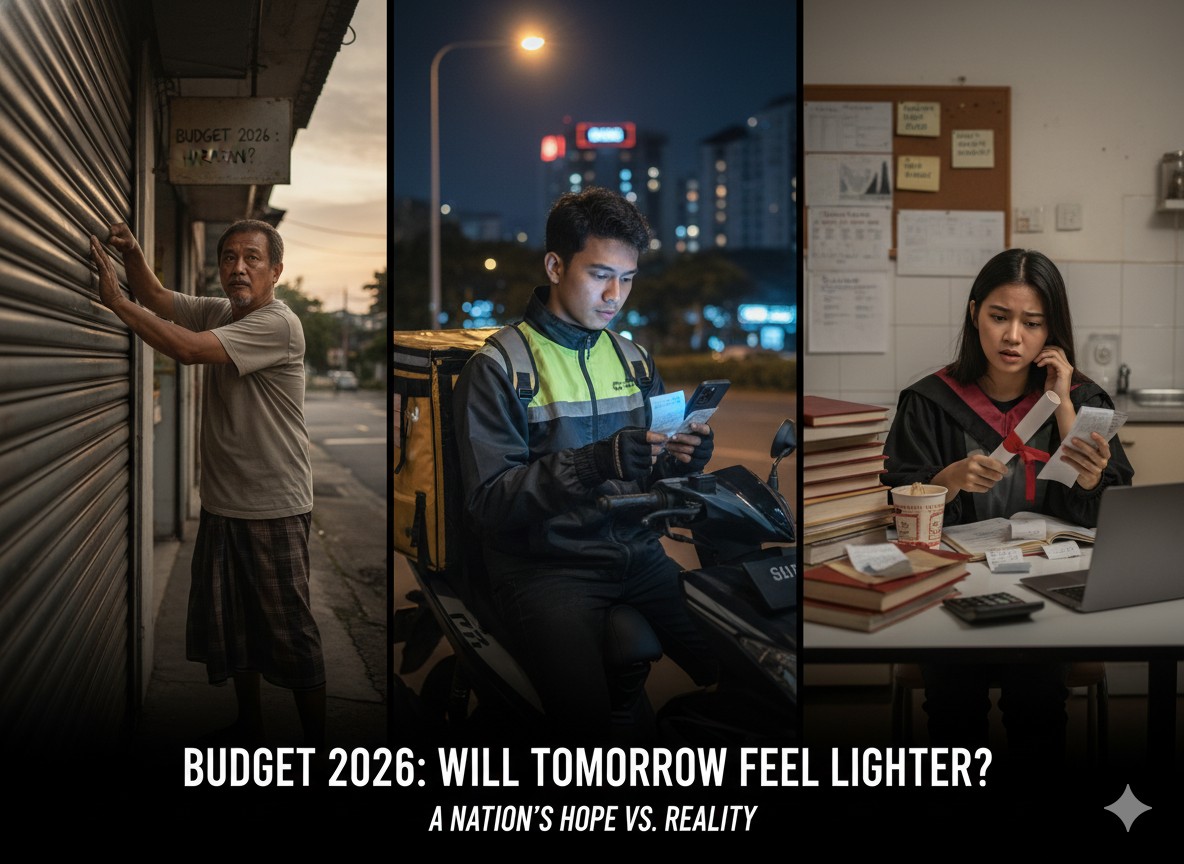
It is not the politician or the economist who will judge this budget. It will be the shop ‘uncle’ lifting his shutters at dawn, the delivery rider counting his orders at night, and the graduate wondering why a degree cannot cover basic costs.
For them, Budget 2026 is not about percentages projected on screens in Putrajaya. It is about whether tomorrow feels lighter than today.
The Malaysian economy is not collapsing. The government forecasts growth of 4% to 4.5% for 2026 – broadly in line with 2025 estimates – with inflation “manageable” and unemployment relatively low. These figures sound reassuring. They are also incomplete.
Growth that looks stable at the macro level can feel slow on the ground. When wages lag behind living costs, when rent rises faster than income, and when food prices creep up while salaries stay still, economic growth becomes something you read about – not something you feel.
Middle-income economies like Malaysia face a difficult mix: slowing global demand, tighter financial conditions, labour mismatches, and splintering supply chains.
- Sign up for Aliran's free daily email updates or weekly newsletters or both
- Make a one-off donation to Persatuan Aliran Kesedaran Negara (ALIRAN), Maybank a/c 507246118995 or CIMB a/c 8004240948
- Make a pledge or schedule an auto donation to Aliran every month or every quarter
- Become an Aliran member
For an export-dependent nation, this translates to reduced factory shifts and vanishing overtime. Small suppliers feel it before anyone else. Shopkeepers do not need a Davos economic report to confirm this: they see it in fewer orders and reduced incomes.
But Prime Minister Anwar Ibrahim and his team appear to be working harder than any other previous administration during these uncertain times to achieve better days ahead.
Global headwinds only explain part of the pressure. Many nations navigate the same storms. Malaysia’s vulnerability lies in its structure.
For decades, the economy has relied on low-value manufacturing, cheap labour, subsidies and government-driven demand. This model delivered growth until the 1990s apart from periodic blips.
Today, it delivers limits. Productivity has not kept pace with aspirations. Young people in Malaysia are more qualified than ever – and more uncertain than ever.
Bank Negara Malaysia data shows wage growth remains modest despite years of economic expansion. That gap between effort and reward is where public frustration festers.
Budget 2026 speaks of reform, fiscal discipline and targeted assistance. These are the ‘right’ words. But words do not carry groceries home. Execution does.
There is another cost that budgets rarely confront directly, yet everyone feels it: governance ‘leakage’.
Corruption is often discussed as a moral failure. On the ground, it is experienced as a cost-of-living issue. Every ringgit lost to inflated contracts or procurement failures is a ringgit not spent on schools, transport or healthcare.
Analysts estimate Malaysia has lost hundreds of billions of ringgit to corruption and economic crime in recent years. The exact figure is disputed. The impact is not.
One economist describes corruption as a silent tax – paid not equally, but by those with the least buffer. When governance fails, ordinary people pay twice: once through taxation and again through higher prices and poorer services.
Budget 2026 promises efficiency and accountability. The question is whether systems are being fixed, or whether investigations merely follow the damage. A nation cannot audit its way to prosperity. It must build systems that prevent leakage and corruption before they occur.
The most troubling signal is not economic growth. It is youth anxiety. Young people are working harder, switching jobs faster and delaying life decisions. Housing feels unreachable. Savings feel theoretical. Gig work fills gaps but rarely builds futures.
When a country educates its youth yet cannot absorb their energy productively, it risks more than an economic slowdown. It risks social fatigue.
Budgets often try to please everyone. That is their weakness. Real reform requires choosing direction – even when it is unpopular. Subsidies must be targeted, not political. Procurement must be transparent, not convenient. Spending must be measured by outcomes, not announcements. Productivity must matter more than optics.
As economist Peter Drucker noted, “The best way to predict the future is to create it.”
Budget 2026 cannot control global markets, geopolitics or commodity prices. But it can decide whether Malaysia continues patching symptoms or finally repairs the underlying system.
For the shopkeeper opening at dawn, for the graduate sending another CV into the void, for the family recalculating expenses at the kitchen table, the budget will not be judged in Parliament. It will be judged at the end of each month, when the numbers either add up or fail to cover basic expenses.
Economic recovery is not built on slogans. It is built on trust, productivity, discipline and courage. And courage, unfortunately, does not come with a line item.
AGENDA RAKYAT - Lima perkara utama
- Tegakkan maruah serta kualiti kehidupan rakyat
- Galakkan pembangunan saksama, lestari serta tangani krisis alam sekitar
- Raikan kerencaman dan keterangkuman
- Selamatkan demokrasi dan angkatkan keluhuran undang-undang
- Lawan rasuah dan kronisme
