
Yong Adilah Shamsul Harumain
For decades, transport planning has been guided by a seemingly neutral idea: if a system works for the ‘average commuter’, it works for everyone.
This gender-blind approach assumes that travel needs are uniform and that neutrality ensures fairness. Yet growing evidence suggests otherwise.
When transport systems are designed around a narrow definition of mobility, they risk overlooking real and measurable differences in how people move and why.
My earlier studies from 2017 and 2021 provide insights into how established transport planning approaches may overlook certain everyday travel needs. The findings reveal that women’s mobility is shaped less by the conventional home-work commute and more by complex, everyday travel needs.
- Sign up for Aliran's free daily email updates or weekly newsletters or both
- Make a one-off donation to Persatuan Aliran Kesedaran Negara (ALIRAN), Maybank a/c 507246118995 or CIMB a/c 8004240948
- Make a pledge or schedule an auto donation to Aliran every month or every quarter
- Become an Aliran member
Women tend to make shorter but more frequent trips, travel at varied times of the day and combine multiple purposes within a single journey – including caregiving, household responsibilities and accompanying dependents.
Complex patterns overlooked
These patterns are evident not only in travel behaviour but also in how women experience the built environment. Walkability, personal safety, lighting, continuity of pedestrian routes and access to everyday facilities consistently emerge as critical factors influencing women’s mobility decisions.
When transport systems and urban design prioritise speed, peak-hour efficiency and vehicular movement, these realities are overlooked.
Women’s mobility needs become structurally invisible – not because they are marginal, but because prevailing planning models remain anchored to a narrow and outdated definition of urban mobility.
Malaysia reflects similar trends. In the Klang Valley, women form a substantial share of public transport users, particularly rail passengers during peak hours.
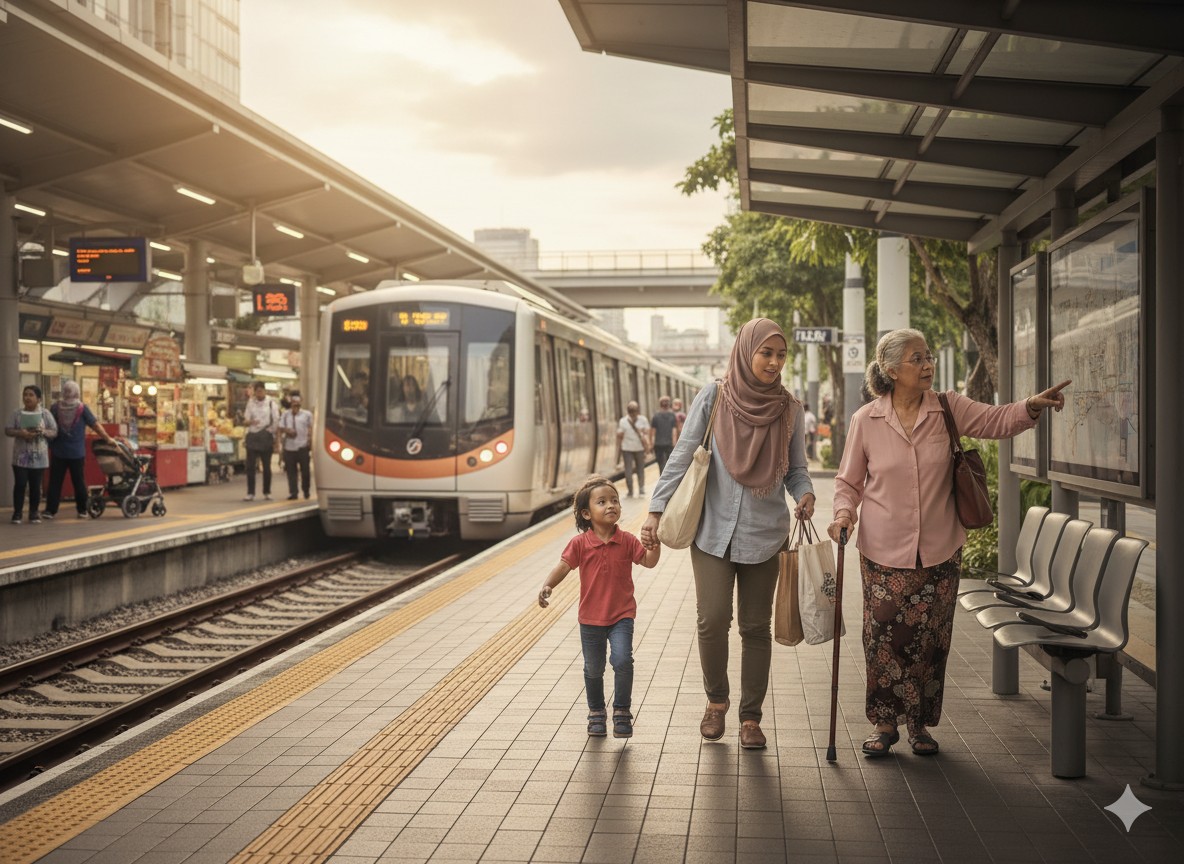
Studies on women’s mobility and trip chaining in Malaysian cities show that women’s travel behaviour is strongly shaped by caregiving responsibilities and time-space constraints. Daily journeys frequently involve accompanying children, managing household errands and supporting older family members alongside paid work.
Mobility decisions, therefore, are influenced not only by distance or cost, but also by considerations of safety, accessibility, reliability and the capacity to manage multiple obligations within limited time windows.
In related work examining women’s experiences of safety in urban environments, I have also found that perceptions of safety at transport nodes, walking routes and public spaces significantly influence women’s travel choices.
These factors affect whether women choose to walk, use public transport or rely on private vehicles – even when services are technically available.
Dependency, not gender
At this point, it is worth asking a deeper question: is gender really the central issue? Or is the more fundamental issue – dependency?
Women’s travel patterns differ not simply because they are women, but because they continue to carry a disproportionate share of caregiving responsibilities.
Who accompanies children to school? Who checks on ageing parents? Who adjusts daily schedules when dependants need care?
When transport systems fail to account for dependency, those managing it – still largely women – bear the hidden cost. Seen this way, the debate should move beyond gender alone and towards dependency-based mobility.
If children could move safely and independently through walkable neighbourhoods and reliable public transport, caregivers’ travel burdens would be reduced.
If older people had access to barrier-free transport, seating and clear information, they could remain mobile without constant assistance.
If public transport nodes were designed with safety, dignity and comfort in mind, caregiving trips would no longer feel like logistical challenges.
This reframing shifts the discussion from ‘women versus men’ to how cities support independent mobility across the life course. A dependency-aware transport system benefits everyone: women, men, children, older people and people with disabilities.
It supports shared caregiving roles, reduces reliance on private vehicles and strengthens social inclusion. Recognising dependency and designing systems that promote independence rather than reliance is not a radical departure from tradition.
It is, in fact, a return to the core purpose of planning: creating cities that work for people as they are, not as simplified averages.
Dr Yong Adilah Shamsul Harumain is an associate professor at the Faculty of Built Environment, University of Malaya.
AGENDA RAKYAT - Lima perkara utama
- Tegakkan maruah serta kualiti kehidupan rakyat
- Galakkan pembangunan saksama, lestari serta tangani krisis alam sekitar
- Raikan kerencaman dan keterangkuman
- Selamatkan demokrasi dan angkatkan keluhuran undang-undang
- Lawan rasuah dan kronisme
