
Amar-Singh HSS
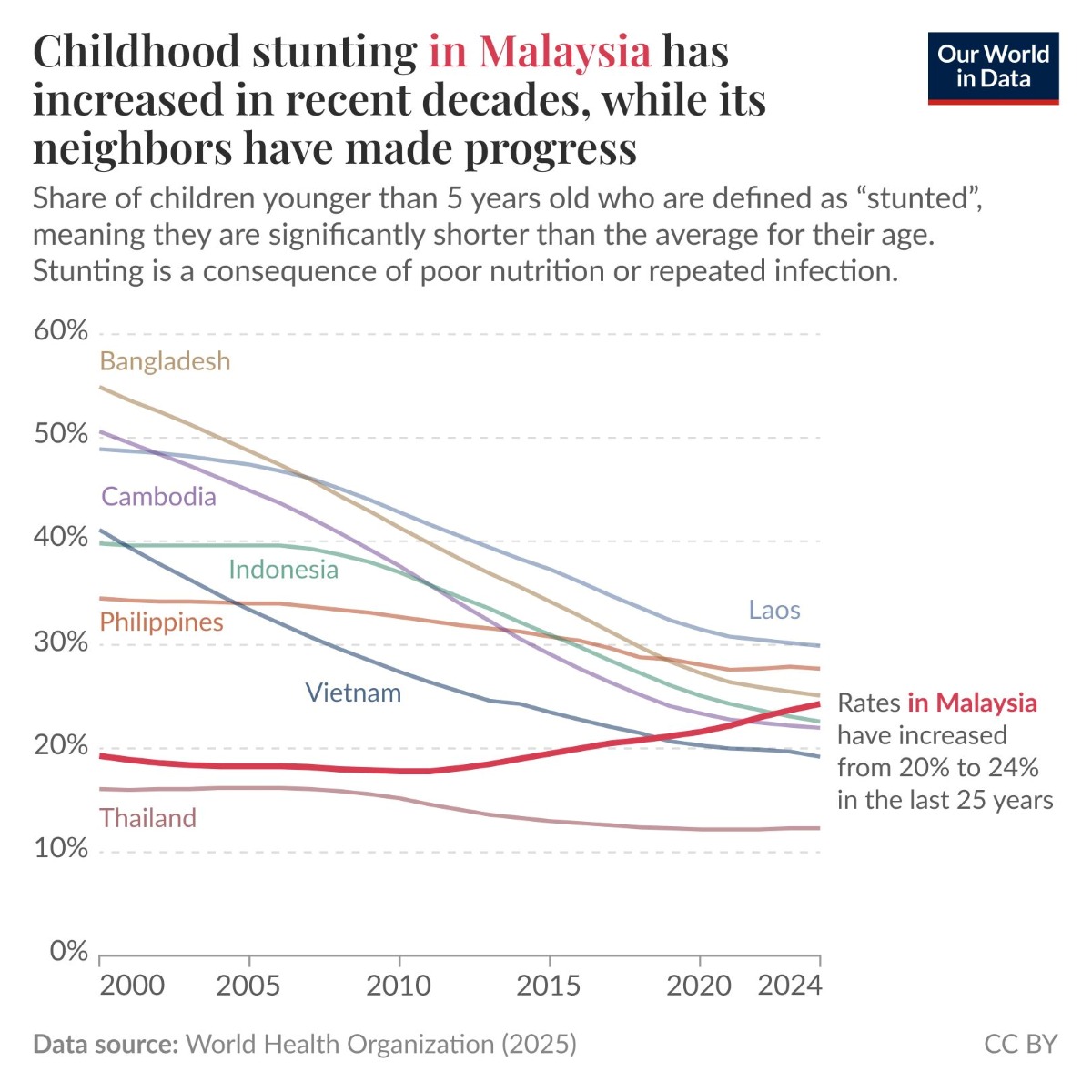
It is embarrassing that the problem of stunting in our children has to be highlighted by international data organisations before it can gain more attention locally – the recent tweet by Our World in Data.
The fact that stunting has worsened in children in Malaysia has been known for the past 15–20 years. We have had good national data from the national health and morbidity surveys to show that stunting in children under five years has increased from 16.6% in 2011 to 21.8% in 2022.
The World Health Organization (WHO) currently estimates that the stunting rate of children in Malaysia has increased to 24%.
Stunting rates in much of the world are coming down. But ours is worsening.
- Sign up for Aliran's free daily email updates or weekly newsletters or both
- Make a one-off donation to Persatuan Aliran Kesedaran Negara (ALIRAN), Maybank a/c 507246118995 or CIMB a/c 8004240948
- Make a pledge or schedule an auto donation to Aliran every month or every quarter
- Become an Aliran member
Countries poorer than us – Laos, Cambodia and Bangladesh – are doing better with a decline in stunting rates.
We have now reached a childhood stunting rate close to that of Bangladesh.
As a comparison, the 2024 childhood stunting rates in Singapore and South Korea were less than 3%.
Why does stunting happen?
The main reason for stunting among children in Malaysia is due to a lack of food security ie a lack of adequate nutrition in childhood, as well as nutrition issues in pregnancy.
Stunting is not something that happens just after you are born. It often happens before you are born.
The 2022 national survey data shows a fairly high anaemic rate among pregnant women – a sign of nutrition issues and a major risk for low birth weight and stunting in the newborn.
Data shows that stunting was higher among Sarawak and Sabah natives, and those with household incomes of less than RM1,000.
Due to a lack of disaggregated data, we do not see that Orang Asli children have stunting rates of between 60% and 70%.
We have no meaningful data on stunting rates for children in detention, refugees, stateless people and migrants.
All this points to poverty as a major factor for stunting. Over 1.2 million children are living in poverty in our country.
In addition, we have many children who are eating enough calories to feel full, but are lacking essential nutrients – protein, iron, calcium and Vitamin D – required for brain and height growth.
Recent Southeast Asian nutrition surveys and Malaysia’s own 2024 health and morbidity survey show that 50% of Malaysian children do not eat a diverse diet, lacking a sufficient intake of fruits, vegetables and dairy.
The ubiquity of cheap, processed and sugar-laden foods has created an environment for malnutrition.
Have we taken any action?
We had a ‘national children’s policy’ and a ‘national children’s action plan’ for 2009–15.
In 2018, the government developed a ‘national children’s well-being roadmap’ to address the malnutrition issue, but we are unaware of its impact.
In the recently launched ‘national children’s policy and action plan’ the government has planned to address “the double burden of malnutrition among children and pregnant mothers” (under strategic priority 3 for 2026–30).
There have not been any published, evidence-based data on the effectiveness of these policies and plans. I am not aware whether an independent external audit was conducted.
The fact that our stunting rate has worsened is a clear indication that these plans have not worked. All government policies require an external audit of their effectiveness – especially if they have not achieved their targets.
Remember, stunting is not primarily a medical problem or a failure of parenting. It is a failure of the many governments we have had in the past 20 years to act effectively in the face of good, national data showing that the problem has worsened.
What will it take to act?
Resolving the crisis does not seem to be a national priority.
Right now, one in four children is stunted. The implications of this are staggering. The most tragic aspect of this crisis is its permanence – a window that closes forever.
Stunting indicates a permanent effect of malnutrition. This means the child will not be able to attain the potential adult height.
Stunting also implies smaller brains and potentially poorer cognitive development and reduced productivity. This means a lifetime poverty trap.
There is also data to show an increased risk of adult obesity, childhood infections, premature deaths and stunting in the next generation.
What the government should do
We cannot continue with ‘business as usual’. The fact that past plans have failed means that current plans may not work.
We must address the lack of accountability of government ministries and agencies tasked with stunting prevention.
We need to have an urgent, external audit of plans and programmes to address malnutrition implemented over the last past 20 years.
The critical window for preventing stunting is the first 1,000 days – from conception to a child’s second birthday. This must be our focus.
A key to reducing stunting in children is structural reform – working on poverty reduction.
We need to commit to ending child poverty and malnutrition (achieving sustainable development goals 1 and 2). This is especially important for targeted groups – Indigenous people, rural Sabah folk, inner-city communities, stateless people and refugees.
We need to focus on the social determinants of health. We should disaggregate health determinants data – by income, location, ethnicity, etc – to identify those with inequities and target support for them.
If we are serious about dealing with stunting in our children, we need a national bipartisan committee with all stakeholders involved. This committee needs strong civil society involvement and should be chaired by the prime minister.
Stunting steals a child’s future possibilities before they even have a chance to realise them. We cannot afford to let another generation grow up in the shadow of what they could have been. The impact of a 24% childhood stunting rate will harm the nation for decades into the future.
Dato’ Dr Amar-Singh HSS is a consultant paediatrician and child-disability activist.
AGENDA RAKYAT - Lima perkara utama
- Tegakkan maruah serta kualiti kehidupan rakyat
- Galakkan pembangunan saksama, lestari serta tangani krisis alam sekitar
- Raikan kerencaman dan keterangkuman
- Selamatkan demokrasi dan angkatkan keluhuran undang-undang
- Lawan rasuah dan kronisme
