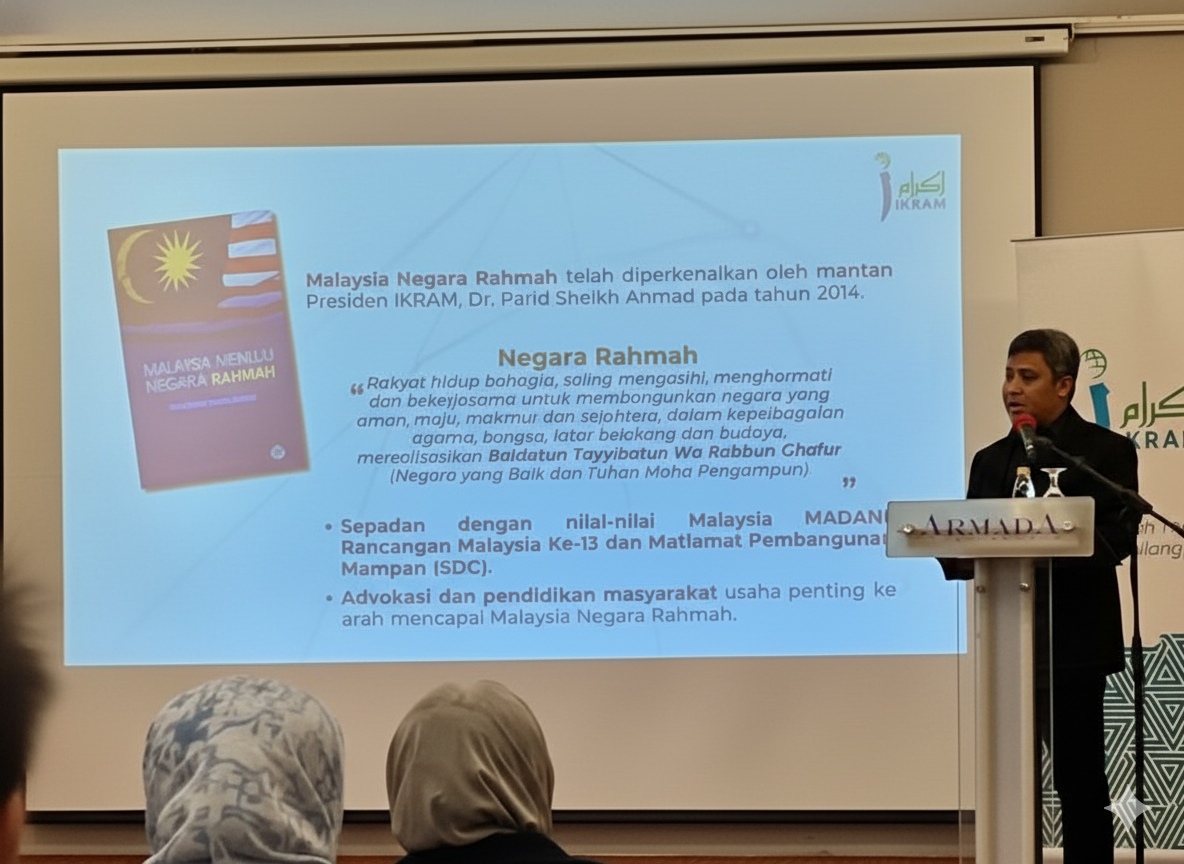
Do you see Malaysia as a ‘negara rahmah’, a caring and compassionate nation that safeguards the people’s wellbeing and ensures they can have just, peaceful and prosperous lives?
What is the perception of ordinary people regarding the government and its various policies?
This is what Pertubuhan Ikram Malaysia, an Islamic organisation focused on community development and social research, has tried to measure since 2021 through its Malaysian Rahmah (Compassionate) Nation Index.
This index measures public perception of Malaysia as a caring, compassionate nation in three main areas – the political, economic and social dimensions – using 40 indicators.
The index was developed and improved over the years after extensive engagement with multiple government agencies, civil society organisations (CSOS), academics, and ethnic and faith groups.
- Sign up for Aliran's free daily email updates or weekly newsletters or both
- Make a one-off donation to Persatuan Aliran Kesedaran Negara (ALIRAN), Maybank a/c 507246118995 or CIMB a/c 8004240948
- Make a pledge or schedule an auto donation to Aliran every month or every quarter
- Become an Aliran member
The 3,030 respondents in the most recent survey were selected through a cluster sampling method. The aim was to be representative of age, gender, ethnicity, income level and region.
Steady improvement in scores
According to Ikram, the index has shown steady improvement since its inception in 2021, with an overall score of 7.42 out of 10 in 2025, although this is categorised as a moderate score.
The social dimension scored highly at 8.03, with moderate scores of 7.13 and 7.08 for the economic and political dimensions respectively.
High scores were recorded for perceptions of strong family institutions (8.51), a caring society (8.22) and harmonious inter-ethnic and interfaith relations (8.04).
Lower scores were recorded for effective checks and balances (6.95), a sustainable economy (6.94) and a fair distribution of wealth (6.78).
Ikram should be applauded for tracking this index since 2021.
It has successfully engaged with government agencies and other stakeholders in providing feedback and input that could be useful, especially for policymakers.
CSOs as third force
This is something that other CSOs can emulate, especially those with grassroots reach and involvement.
CSOs should take advantage of the increased avenues for engagement with policymakers, while at the same time speaking truth to power and holding it accountable.
Yes, CSOs can and must play an important role as a ‘third force’ in Malaysian politics, as proposed by John Fong in his recent newsletter.
But this should not necessarily be limited to participation in general elections as candidates vying for electoral votes.
Being a third force can also involve being credible and legitimate stakeholders in the actual policy process, by engaging continuously with policymakers and legislators.
This can be done at the agenda-setting stage or even at the evaluation stage by providing feedback from the grassroots about actual policy outcomes.
Some may see engagement and collaboration by CSOs with the government as mere window dressing with no real impact on policymaking – or worse, as manipulative co-optation by those in power.
But we can already see some success in this area and we must continue to build on it.
Ikram has suggested that its index could serve as a feedback mechanism to assess the effectiveness of policy implementation and to identify gaps in planning and actual impact.
Perhaps it could also serve as baseline research that can be built upon by others, especially those involved in policy evaluation.
Limitations of perception studies
However, perception studies have their limitations, even if they claim to be ‘representative’ of the population being studied.
Although a survey such as this gives many ordinary people a chance to give feedback and share their views, it is still subjective, based on the respondents’ lived experiences and their limited information or misinformation. It is basically a snapshot reflecting their present circumstances and reality.
But it does not prove or measure causality between their circumstances and their probable determinants. In other words, it does not answer the ‘why’ question.
Uneven benefits
The present Madani (compassionate) government has introduced and implemented a number of initiatives to improve the wellbeing of the people, especially the low-income group, even if fundamental structural reforms promised in the Pakatan Harapan election manifesto have not yet materialised.
For sure, the increases in financial assistance and targeted subsidies together with price controls would have had some positive impact on many people.
However, these positive outcomes may not benefit everyone uniformly or equally. Many communities or groups of people remain excluded or unable to access these benefits. Some communities have experienced discrimination and unfair treatment, not just at the hands of the government but also by society.
Many continue to experience a lack of compassion, double standards, abuse of power or just sheer inefficiency in government policy implementation and law enforcement. These include the urban poor, the homeless, the LGBTQ community, the stateless, forcibly evicted villagers and farmers, the Bajau Laut community, migrant workers and refugees.
Would the good index score of 7.42 reflect the everyday experience of members of such vulnerable and marginalised groups in Malaysia? Perhaps the study could be replicated to calculate the rahmah index score for these groups.
Compassionate approach needed
The minister responsible for religious affairs, Zulkifli Hassan, who launched the latest Ikram report, said the index could serve as a useful reference in assessing whether policies and practices are aligned with the rahmah concept.
For a start, with reference to his recent remarks on LGBTQ people in Parliament, perhaps he could engage in a compassionate manner with CSOs working with the LGBTQ community in Malaysia to better understand their lived experiences.
The LGBTQ community in particular has increasingly been the target of policy failure, discrimination, verbal abuse and even physical violence.
What would be more useful and necessary is a more systematic and scientific evaluation of policies and laws affecting especially individuals and groups who do not experience much compassion in Malaysia – one that measures actual outcomes of policies and laws, not just perception.
What is needed is targeted sampling where representativeness or generalisability is not the objective. Instead, collection of data that accurately captures the reality experienced by vulnerable individuals and groups should be the aim. While this is ultimately the responsibility of the government, CSOs with grassroots involvement can provide valuable support.
Ultimately, rahmah or Madani will just be meaningless catchphrases or, worse, subjects of ridicule, if the most vulnerable communities fail to see significant improvement in their everyday lives.
That would be the test of a true democracy.
Mary Magdaline Pereira
Co-editor, Aliran newsletter
9 February 2026
AGENDA RAKYAT - Lima perkara utama
- Tegakkan maruah serta kualiti kehidupan rakyat
- Galakkan pembangunan saksama, lestari serta tangani krisis alam sekitar
- Raikan kerencaman dan keterangkuman
- Selamatkan demokrasi dan angkatkan keluhuran undang-undang
- Lawan rasuah dan kronisme