
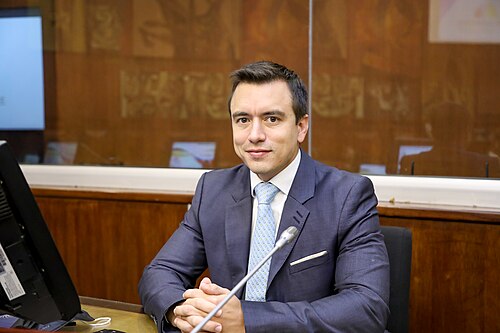
Pilar Troya Fernández
The situation in Ecuador under Daniel Noboa’s government is one of authoritarianism advancing on several fronts simultaneously to consolidate neoliberalism and total submission to the US international agenda.
These are not isolated measures, but rather a coordinated strategy that combines job insecurity, the dismantling of the welfare state, unrestricted access to mining, the continuation of oil exploitation without environmental considerations, the centralisation of power through the financial suffocation of local governments, and the systematic criminalisation of all forms of opposition and popular organisation.
Abandonment of the public sphere
Noboa lost all four questions in the November 2025 referendum: there will be no Constituent Assembly, no foreign military bases will be installed – at least officially, although in practice several secret agreements with the United States allow the presence of US security personnel on Ecuadorian soil – political parties will continue to receive public funds, and the number of assembly members will not be reduced.
With the democratic facade fallen, the government is seeking to impose the agenda it lost at the polls by other means – reduction of public spending, legal reforms, decrees and ministerial agreements, but also militarisation.
- Sign up for Aliran's free daily email updates or weekly newsletters or both
- Make a one-off donation to Persatuan Aliran Kesedaran Negara (ALIRAN), Maybank a/c 507246118995 or CIMB a/c 8004240948
- Make a pledge or schedule an auto donation to Aliran every month or every quarter
- Become an Aliran member
Since coming to power in 2023, Noboa has been cutting state spending. Two examples of the current effects: patients are dying in public hospitals where they cannot receive dialysis because these hospitals have only 30% of the supplies they need, and the budget for universities has been cut by $128m million or 12.7%.
Public health and education, which are essential for a minimally democratic society, are being systematically dismantled.
The year 2025 was the most violent since statistics have been kept: 51 homicides per 100,000 inhabitants, six coastal cities among the 10 most dangerous in the world, and 183 people killed in prisons, with a total of 500 since 2021.
Ecuador, which was one of the safest countries in the region until 2017, is now one of the most dangerous not only in Latin America but in the world. The economic crisis that has been dragging on since the pandemic, the reduction in public spending, and collusion with drug trafficking explain these figures.
Job insecurity
On 19 February, the Ministry of Labour issued a ministerial agreement establishing 12-hour workdays. This measure represents a historic setback in terms of workers’ rights and continues the series of measures to increase job insecurity determined in the agreements signed with the International Monetary Fund (IMF), favoiring the interests of capital over the wellbeing of workers.
Defunding of local governments
Decentralised autonomous governments (GAD), in some cases the only safeguard for public policies aimed at the population and not at capital, will be hit by a recently approved law that requires them to allocate a minimum of 70% of their budget to infrastructure.
It sounds good, but it is a trap: it seeks to force them to stop investing in education, culture and other social programmes and to lay off staff.
The bill imposes central government control over the decentralised autonomous governments, undermining their autonomy and contradicting the principle of decentralisation. If they fail to comply, a penalty reduces their transfers to the constitutional minimum, which would paralyse their operations.
There is also obvious cynicism in this area: the Association of Municipalities of Ecuador has reported that the central government itself owes $543m to the decentralised autonomous governments, suffocating their finances.
Extractivism without environmental controls
Noboa also managed to pass, as an urgent economic measure, the Law on Strengthening Strategic Mining and Energy Sectors.
Among its most dangerous provisions: the environmental licence will be replaced by a simple ‘environmental authorisation’; private military protection in mining projects will be legalised; prior consultation with indigenous peoples will be eliminated; and the fragmentation of mining concessions and mining in the Galapagos Islands, a supposedly protected nature reserve, will be allowed.
Complemented by Executive Decree 273 of December 2025, this law paves the way for the reopening of the Mining Registry and the massive expansion of concessions without environmental regulation or respect for the rights of the affected populations.
Noboa and his family have links to mining companies that have already received licences or are in the process of obtaining them.
Criminalisation of politics
Judicial persecution is a systematic tool of the regime.
In the 2023 referendum, people voted to stop oil exploitation in the Yasuní ITT, but the government has done nothing to comply with that mandate.
The response to environmentalists’ demands has been repression and lawfare.
The attacks against the Citizen Revolution (Correísmo) that began in 2018 continue unabated. On 4 February 2026, the homes of four leaders of the movement were raided for an alleged case of corruption.
They attempted to revoke the mandate of the mayor of Quito, Pabel Muñoz, against whom they fabricated a false case of corruption, and imprisoned the mayor of Guayaquil, Aquiles Hervas, also of the Citizen Revolution, on the basis of another fabricated case.
The repression also affects the indigenous movement.
Leonidas Iza, former president of the Confederation of Indigenous Nationalities of Ecuador (CONAIE) and current president of Ecuarunari (an organisation of indigenous peoples of the Sierra), faces multiple investigations and reports of covert police surveillance.
Nayra Chalán, former vice president of Ecuarunari, and the Kitu Kara people denounced the deactivation of their bank accounts.
During the 2025 national strike, the accounts of 21 social organisations were frozen without a court order. Unfounded proceedings have been brought against them for financing terrorism and illicit enrichment, using a narrative of narco-terrorism similar to that of US President Donald Trump, who, without any evidence, extrajudicially executed more than 80 people on boats in the Caribbean.
Corruption in the entourage
While criminalising the opposition, Noboa’s entourage is riddled with scandals.
Six people are being prosecuted after 2.6 tons of cocaine were found in a container belonging to Blasti SA, a company linked to the presidential circle.
This case, one of several, highlights the strategy of a government that prosecutes social leaders and political opponents while coexisting with drug trafficking networks in its inner circle, as well as several other cases of corruption.
Submission to US imperialism
At the time of writing, the Noboa government has just expelled the Cuban ambassador and all Cuban diplomats from Ecuador, declaring them persona non grata and giving them 48 hours to leave the country.
The reason? Nothing more than obedience to the orders of the Trump administration and its illegal hybrid war against Cuba.
At the same time, the US Southern Command said in X that Ecuadorian and US military forces “launched operations against designated terrorist organizations”, setting an example of cooperation for the region in the fight against narco-terrorism.
This concept is the same label that Noboa uses against all social movements that oppose his policies.
The analogy with Trumpism is not rhetorical: like his US counterpart, Noboa governs for capital, seeking to destroy the public sector and reduce the state to its bare minimum, using militarisation and political violence as instruments to achieve this, and submitting absolutely to US dictates.
The difference is the context: in Ecuador, this model is applied to a society already battered by violence, poverty, precariousness and a lack of basic services, which multiplies its capacity for harm.
Stopping these attacks is a necessary condition for Ecuador’s survival as a democracy. – Globetrotter
Pilar Troya Fernández, an Ecuadorian, is an anthropologist with a master’s degree in gender studies, and a researcher at the Tricontinental Institute for Social Research. She was an advisor to the National Secretariat of Planning, an advisor to the National Secretariat of Higher Education, Science, Technology and Innovation, and deputy secretary general of higher education in Ecuador. She currently resides in Brazil.
AGENDA RAKYAT - Lima perkara utama
- Tegakkan maruah serta kualiti kehidupan rakyat
- Galakkan pembangunan saksama, lestari serta tangani krisis alam sekitar
- Raikan kerencaman dan keterangkuman
- Selamatkan demokrasi dan angkatkan keluhuran undang-undang
- Lawan rasuah dan kronisme
