
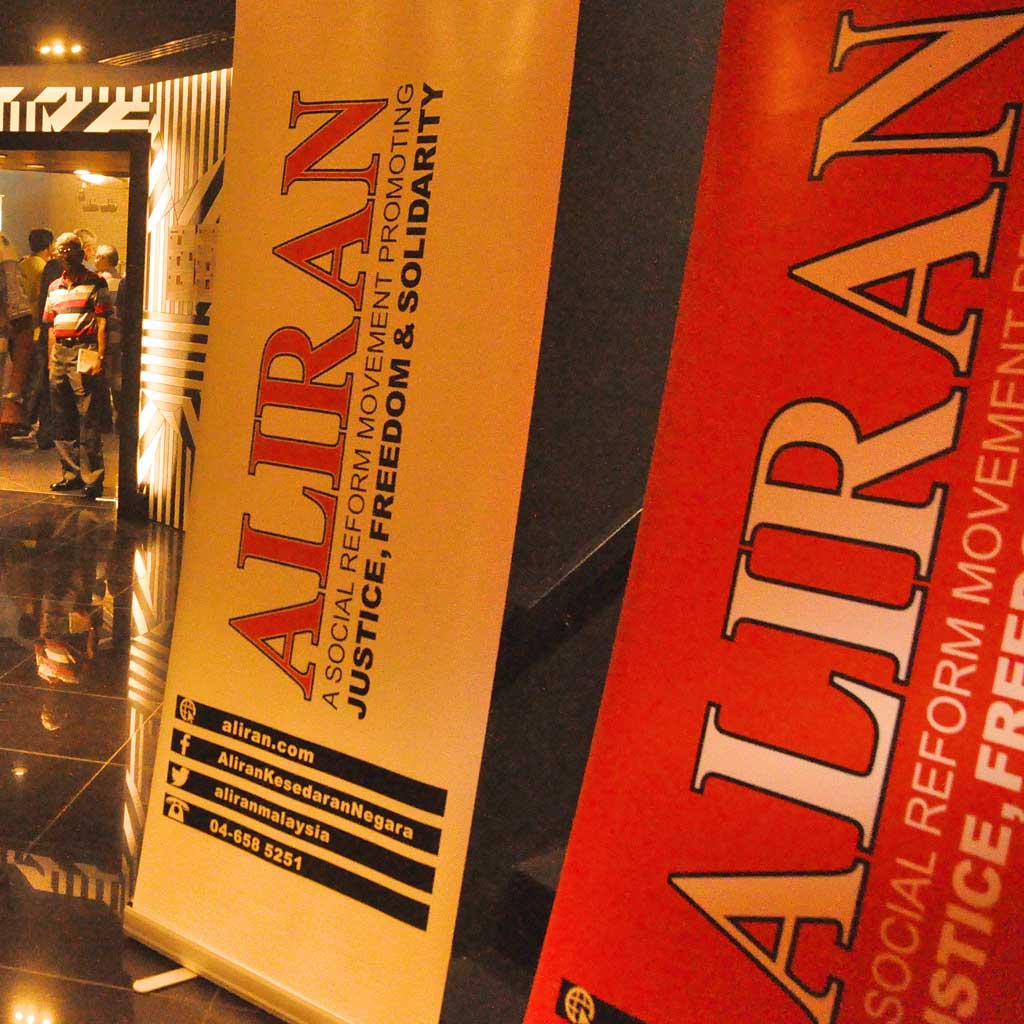
In late January, Aliran was invited to judge a poster competition for tertiary students at a private college in Penang.
Coincidentally, around the same time, a volunteer artist offered her services to help spruce up Aliran’s website visuals. With a collaborator on board, we readily accepted the role of independent judge.
The competition was open to psychology and sociology undergraduate students of the college on the theme of rights, security and the path to wellbeing.
Each group researched a different social issue and designed an informative poster highlighting critical problems and proposing solutions. Topics included child marriage and the plight of foreign labour in Malaysia.
It is commendable that the lecturers used this competition to deepen students’ social awareness and help them empathise with victims of injustice and unequal power relations.
- Sign up for Aliran's free daily email updates or weekly newsletters or both
- Make a one-off donation to Persatuan Aliran Kesedaran Negara (ALIRAN), Maybank a/c 507246118995 or CIMB a/c 8004240948
- Make a pledge or schedule an auto donation to Aliran every month or every quarter
- Become an Aliran member
Our artist collaborator delivered a guest lecture on the arts as a catalyst for social change. She made a compelling case that art – in words, images, sculptures or drawings – can trigger us to think differently and move us to act.
She quoted Ursula K Le Guin: “Resistance and change often begin in Art, and very often in our art – the art of words.”
We were also given a slot to introduce Aliran – and to invite students to get involved in the cause.
Who we are
As a civil society group, Aliran is Malaysia’s oldest human rights and multi-ethnic reform movement. We were founded in 1977, when Malaysia – then just 14 years old – was a young nation still grappling with the legacies of colonial divide-and-rule policies.
The scars of the ethnic riots of 13 May 1969 were healing, but perhaps the wounds have never fully healed.
The Aliran constitution states that our aims are to promote a common sense of nationhood and a holistic understanding of development in accordance with the aspirations of the Rukun Negara (National Principles).
When we mentioned the Rukun Negara, most students could confidently recite its five principles: Belief in God, loyalty to king and country, the supremacy of the Constitution, sovereignty of the rule of law, and good behaviour and morality.
Memorising theses five principles is a good start. But the pertinent question is: after 63 years since the formation of Malaysia, have we as a nation fully lived up to those aspirations? The jury is still out. We have made progress, but many issues continue to divide rather than unite us.
Temple tensions and the three Rs
One hot-button issue in recent months that has caused much anxiety and angst among many Hindus is the call to demolish “kuil haram” (illegal temples).
Based purely on legality, many of these temples sit on land where the temple management does not have legal ownership.
But taking into account the history of why a particular temple was built on a specific site often reveals that the previous landowner may have not only allowed but even encouraged its construction.
If this issue were handled through dialogue and consultation, there would be far less protest and pushback.
Instead, controversial Islamic preachers Zamri Vinoth and Firdaus Wong appeared to fan dissent rather than promote unity. Zamri heads a so-called ‘anti-illegal temples’ movement, and tensions escalated when calls were made to demolish a Hindu temple located in front of Bukit Mertajam Hospital.
Aliran calls for restraint and dialogue. In a recent article, Joseph Masilamany urged the relevant authorities to ensure that enforcement is administered with procedural fairness and cultural sensitivity.
In Aliran, we consciously try to shift discussions away from the ‘three R’ narratives of race, religion and royalty.
Major political parties use these narratives to win support – and the effect is to deepen division and disharmony. The three R playbook also distracts the public from focusing on key issues like injustice, inequality and poverty.
Job security, housing, education and affordable healthcare ought to be the focus. So should anti-corruption efforts and challenging abuse of power and misgovernance.
The case for institutional reform
To build a just and fair society, Aliran believes Malaysia is in need of important institutional reforms. One example – long advocated alongside other NGOs – is the separation of the roles of attorney general and public prosecutor.
The urgency of this reform became starkly obvious during the years when Najib Razak was Prime Minister and details of the 1MDB scandal began to surface. Then attorney general Gani Patail, who was reportedly preparing to charge Najib, was removed and replaced with Apandi Ali in July 2015. Apandi then cleared Najib of any misconduct in January 2016, saying no criminal offences had been committed.
Had the Barisan Nasional government not been defeated in the watershed 2018 general election, Najib might still be Prime Minister and the 1MDB and other related corruption and abuse-of-power scandals might have been conveniently swept under the carpet.
The Pakatan Harapan coalition formed the government in 2018 and Dr Mahathir Mohamad, at 92, was appointed Prime Minister. Tommy Thomas, a senior lawyer from private practice, was appointed attorney general — the first local ethnic minority person to hold that position. He wasted little time in re-examining the 1MDB files and the SRC International case.
SRC International had taken a loan of RM4bn from Kumpulan Wang Persaraan (KWAP) – the Retirement Fund Incorporated – a fund set up for retired civil servants. Instead of adhering to its stated objectives, the company ended up as a vehicle and victim of fraud and misappropriation.
Najib was charged with misappropriation of RM42m and was subsequently found guilty of criminal breach of trust and abuse of power. The case dragged on for years, but the Court of Appeal and the Federal Court both affirmed the High Court’s guilty verdict.
An analysis of the SRC International scandal makes clear that the misappropriation and abuse of power were made possible because of the absence of checks and balances on the authority of the prime minister. Throughout the relevant period, Najib held both the prime minister’s post and the finance portfolio.
Separating those roles may have made a difference – but it would only be effective if the appointment of the prosecutor general was independent of the executive.
A special select committee of eminent public figures, retired judges and senior lawyers could vet candidates. Once appointed, the prosecutor general should have independent powers – but with clear parameters and an oversight committee of MPs, ex-judges and senior lawyers to guard against abuse.
In practice, too much power remains concentrated in the hands of the prime minister. The recent motion to amend the Federal Constitution to limit the prime minister’s tenure to a maximum of 10 years was defeated — partly because some opposition members argued it would usurp the king’s prerogative to appoint a prime minister.
That argument is a smoke screen. As a constitutional monarch, the king’s role is to appoint the elected representative who commands the confidence of the majority of the House. Limiting a term does not diminish that role.
On accountability, Aliran has taken note of a Bloomberg report on Malaysian Anti-Corruption Commission (MACC) Chief Commissioner Azam Baki’s acquisition of shares in listed companies in excess of what a civil servant is entitled to. The government has set up a task force to investigate.
More alarming are Bloomberg’s allegations that MACC officers colluded with certain businesspeople to intimidate senior officials of targeted companies, pressuring them to sell at below-market valuations. Aliran has called for a royal commission of inquiry to get to the bottom of this.
We are also concerned about what appears to be a possible tit-for-tat reaction by the MACC against former economy minister Rafizi Ramli and his former associate James Chai.
The MACC has launched an investigation into alleged misconduct related to a RM1.1bn government deal with ARM Holdings. Rafizi had previously spoken at a Tangkap (arrest) Azam Baki rally and called for Azam to be suspended. The optics are not good – and Aliran has supported calls not to weaponise the MACC.
There is still much room for improvement if the people of Malaysia desire a country where good governance reigns. We have not done enough to ensure that our diversity is fully appreciated or that inclusivity becomes a hallmark of our identity.
There is still much work to be done – and we hope the younger generation will step up to the challenge and work together, regardless of ethnicity or religion, to build a Malaysia that is united and progressive.
Henry Loh
Co-editor, Aliran newsletter
12 March 2026
AGENDA RAKYAT - Lima perkara utama
- Tegakkan maruah serta kualiti kehidupan rakyat
- Galakkan pembangunan saksama, lestari serta tangani krisis alam sekitar
- Raikan kerencaman dan keterangkuman
- Selamatkan demokrasi dan angkatkan keluhuran undang-undang
- Lawan rasuah dan kronisme
