
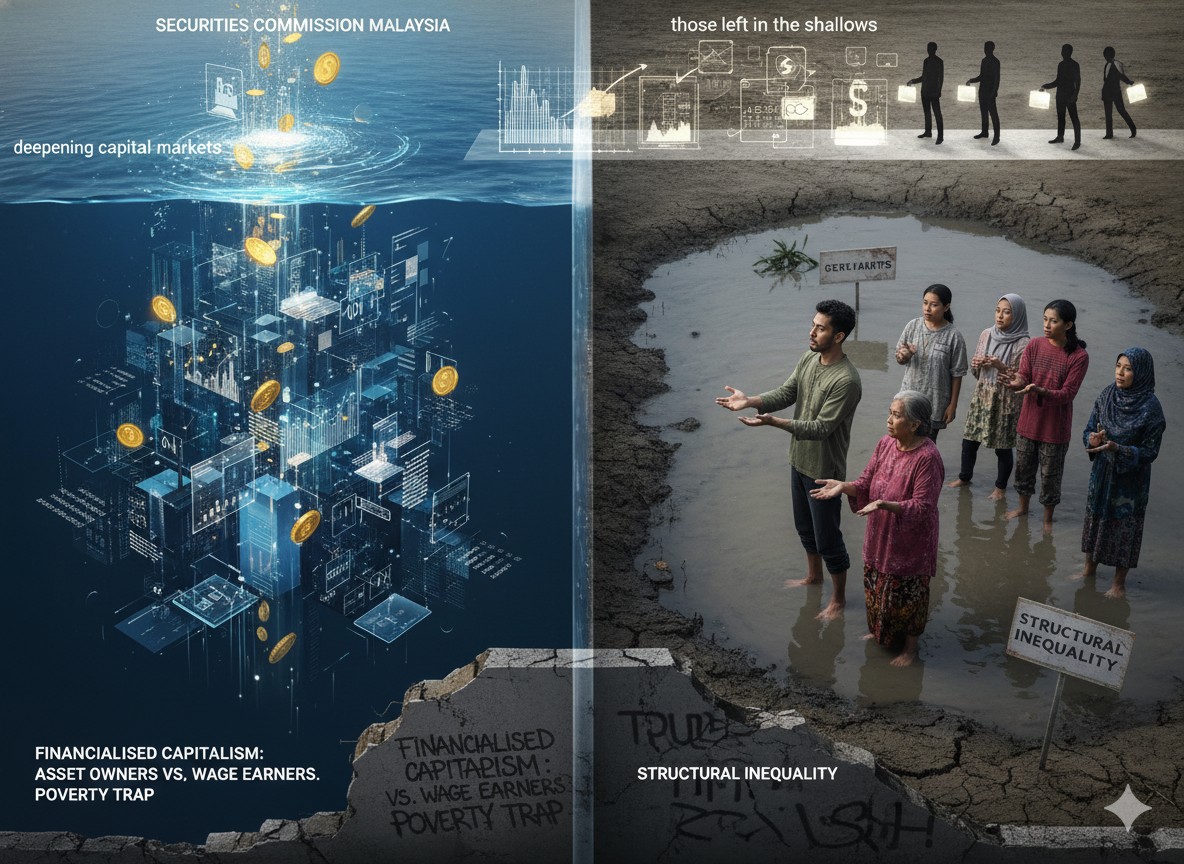
When governments talk about deepening capital markets, they rarely mention who gets left in the shallows.
The Securities Commission Malaysia’s Capital Market Masterplan – the latest version of which covers 2026–30 – aims to unlock value across multiple asset classes: equities, bonds, private markets, waqf assets, infrastructure funds, digital assets and retirement savings.
The goal is to deepen Malaysia’s capital market as a way to gather, mobilise and increase domestic savings.
But from a political economy perspective, this initiative risks deepening financialised capitalism without improving the lives of those in poverty or the working class.
Financialised capitalism describes the increasing dominance of financial motives, markets and institutions over the productive economy (Epstein, 2005; Krippner, 2011).
- Sign up for Aliran's free daily email updates or weekly newsletters or both
- Make a one-off donation to Persatuan Aliran Kesedaran Negara (ALIRAN), Maybank a/c 507246118995 or CIMB a/c 8004240948
- Make a pledge or schedule an auto donation to Aliran every month or every quarter
- Become an Aliran member
Malaysia’s economy has undergone a profound structural shift since the 1990s – moving away from industrial and export manufacturing towards a financialised, service-oriented model where financial processes drive capital formation.
By 2023, Malaysia’s total equity market capitalisation had reached roughly 95% of nominal gross domestic product (GDP) – a figure that signals deep integration of financial markets into the national economy.
While such ratios are often celebrated as signs of maturity, they also point to an economy increasingly oriented towards asset accumulation rather than productive reinvestment for the common good.
Financial market expansion may generate wealth. But it does not automatically reduce poverty or narrow structural inequality.
Structural flaws
The master plan prioritises capital market expansion as a growth engine – through private equity and venture capital, infrastructure funds and real estate investment trusts (REITs), tokenised assets and digital exchanges, and retail participation via investment platforms.
All of this aligns Malaysia tightly with what economists call global monopoly–finance capitalism (Foster & McChesney, 2012), where domestic assets serve as collateral for cross-border capital accumulation rather than as engines of national productivity. In short, wealth is generated through asset ownership, not labour income.
Households without savings or investable capital cannot participate meaningfully.
The result is a widening divide between asset owners – who accumulate wealth through capital gains – and wage earners who depend on stagnant wages. People living in poverty are effectively shut out of asset markets, where gains flow to investors, not to those at the bottom.
Another major theme of the masterplan is “unlocking value” from underused assets – government land and national infrastructure, government-linked company holdings, waqf and Islamic social finance assets, and institutional funds such as Khazanah Nasional and the Employees Provident Fund (EPF).
While these institutions are expected to play a catalytic role in wealth creation, “unlocking value” in practice often means packaging assets into market instruments, building up infrastructure investment funds, or converting properties into REIT-style vehicles.
The effect is that public assets become financialised, with revenue streams directed towards investors rather than public welfare.
Malaysia already shows features of rentier capitalism – where wealth is derived from property ownership, concessions and financial instruments with monopolistic licensing.
Aggressively deepening the capital market only entrenches rent extraction further, through infrastructure funds charging user fees, property trusts monetising urban land, and financial intermediaries collecting management fees.
The poor end up as fee-paying consumers rather than wealth participants.
Who really controls the market?
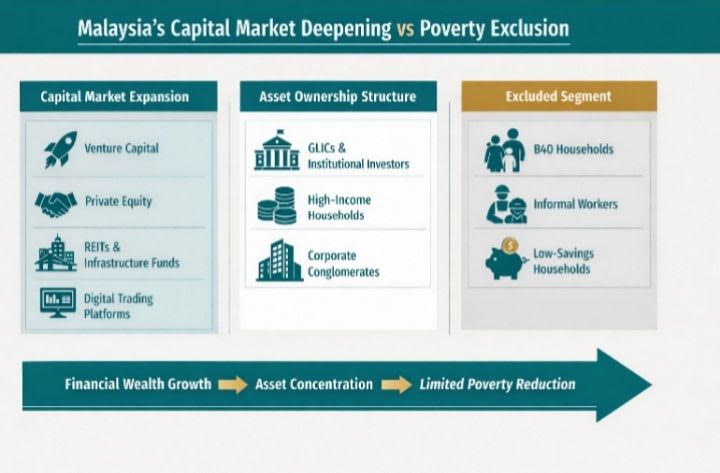
Malaysia’s capital markets have historically operated through politically mediated ownership structures involving government-linked companies, government-linked investment firms and politically connected conglomerates, including entities tied to Permodalan Nasional Berhad (PNB) and Khazanah Nasional.
While these institutions aim to broaden wealth distribution, critics argue that they can reproduce elite asset concentration through politically mediated investments, privileged access to capital market deals and preferential initial public offering allocations.
This structure risks reproducing ethnocapitalist patronage networks – a system where economic resources flow through specific groups to consolidate power and maintain social structures – rather than genuinely democratising capital ownership.
This pattern has persisted through successive policy frameworks, from the New Economic Policy (NEP), which morphed into the National Development Policy, the National Vision Policy and the New Economic Model.
Although the master plan emphasises retail participation, encouraging people to invest through digital brokerage platforms and Islamic investment funds, structural constraints remain.
The bottom 40% of households have minimal surplus savings and, with rising living costs, have little real capacity to invest.
Data from the Department of Statistics shows that the majority of financial assets are held by upper-income households.
What is often described as “financial inclusion” risks being more symbolic than transformative.
Poverty trap
For people living in poverty, the main barriers remain: low wages, precarious employment, lack of productive assets and inadequate access to education and skills. Capital market expansion does not address these structural problems.
Instead, it may reinforce a two-tier economy – high returns for high-income investors on one side, and slow wage growth with persistent marginalisation within the real economy.
The fundamental contradiction is that the master plan reflects a development strategy built on financial deepening rather than productive transformation.
Capital markets can generate wealth, but they do not automatically generate fairer development.
Without parallel reforms – wage growth strategies, industrial upgrading, land redistribution and universal social protection – capital market expansion risks enriching asset holders while bypassing those in poverty.
There is also the question of Malaysia’s semi-peripheral role in global finance. Deeper capital market integration pulls Malaysia further into global financial circuits dominated by major asset managers and institutional investors.
While foreign capital inflows may provide liquidity, they also expose Malaysia to capital flow volatility and financial contagion – constraints that global investors can impose on domestic policy, more so in an era of geopolitical uncertainty.
Illusion of shared prosperity
So, yes, the Capital Market Masterplan may deepen financialised capitalism in Malaysia, where value is increasingly extracted through asset markets and financial instruments rather than through broad-based productive development.
But the dominance of financial over productive capital entrenches inequality, limits industrial renewal and exposes Malaysia to volatile global capital flows.
Without confronting the ideological and structural roots of financialised capitalism, Malaysia risks perpetuating a system where growth is abundant, yet real economic development remains elusive – and where the poorest continue to be left behind.
AGENDA RAKYAT - Lima perkara utama
- Tegakkan maruah serta kualiti kehidupan rakyat
- Galakkan pembangunan saksama, lestari serta tangani krisis alam sekitar
- Raikan kerencaman dan keterangkuman
- Selamatkan demokrasi dan angkatkan keluhuran undang-undang
- Lawan rasuah dan kronisme
