
Mazni Abdullah and Noor Sharoja Sapiei
As Malaysia’s economy continues its recovery from the Covid era, the survival and sustainability of micro entrepreneurs has become increasingly important.
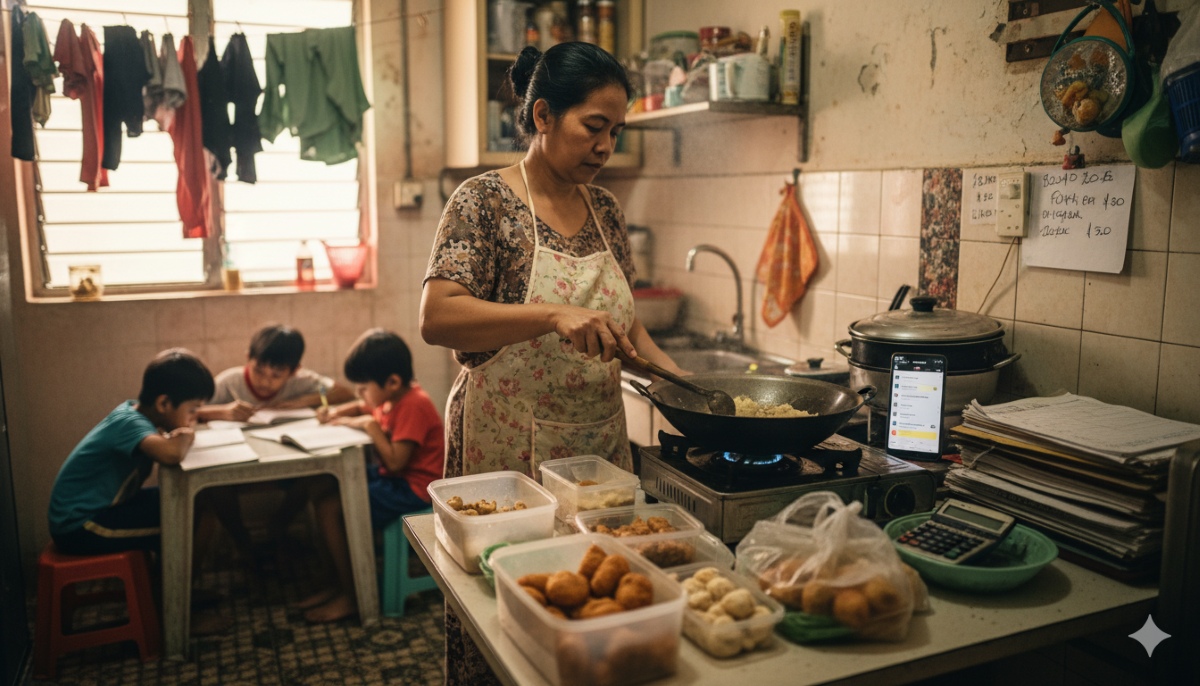
During the lockdowns and movement restrictions, many people who lost their jobs or saw their income fall turned to small businesses – home food production, catering services, street food vending and the sale of traditional snacks – to support their families.
These small businesses have become a vital source of livelihood for many households, particularly the low-income group. For many families, running a small business from home provides an important way to generate income and maintain financial stability.
Sustaining a small business over the long term, however, remains a significant challenge.
- Sign up for Aliran's free daily email updates or weekly newsletters or both
- Make a one-off donation to Persatuan Aliran Kesedaran Negara (ALIRAN), Maybank a/c 507246118995 or CIMB a/c 8004240948
- Make a pledge or schedule an auto donation to Aliran every month or every quarter
- Become an Aliran member
Micro, small and medium enterprises (MSMEs) account for nearly 97% of all business establishments in Malaysia, making them the backbone of the national economy.
Among these, micro enterprises represent the largest share – around 70% of businesses nationwide. They play an important role in generating employment, supporting household incomes and sustaining local economic activity.
Despite their importance, micro enterprises are often more vulnerable than larger businesses. Many operate with limited capital, informal business structures and minimal access to professional advice.
As a result, entrepreneurs frequently rely on trial and error when making decisions about pricing, marketing and financial management.
Hit hard
The challenges facing micro entrepreneurs became particularly evident during the Covid era.
Many micro businesses experienced a sharp decline in sales as movement restrictions disrupted operations. At the same time, many struggled with severe cash flow problems, exposing the financial vulnerability of micro enterprises during periods of economic uncertainty. While some businesses adapted, others were forced to temporarily suspend operations or close altogether.
For many people in Malaysia, however, the pandemic also marked the beginning of their entrepreneurial journey. People who lost their jobs or saw their household income fall began starting small businesses within their communities. Selling homemade cakes, traditional snacks, cooked meals and other food products became a practical way to generate income during a difficult period.
While starting a small business can provide immediate financial relief, sustaining it requires more than determination and hard work. Many first-time entrepreneurs begin without formal business training, and often lack the knowledge needed to manage finances, market their products effectively or plan for growth.
Government support insufficient
In Malaysia, the government has introduced various initiatives aimed at strengthening small businesses, particularly among the low-income community.
Agencies such as Tekun Nasional and Amanah Ikhtiar Malaysia provide micro-financing schemes that enable entrepreneurs to access capital that may otherwise be unavailable through traditional banking channels.
Programmes such as iTEKAD, established by Bank Negara Malaysia together with participating financial institutions, combine financial assistance with entrepreneurship training and financial management education. This integrated approach helps low-income entrepreneurs strengthen both their financial management skills and business capabilities.
During the Covid era, the government also introduced several economic stimulus packages designed to help micro and small businesses remain operational.
While these initiatives play an important role in helping entrepreneurs start or sustain their businesses, financial assistance alone may not be enough to ensure long-term sustainability. Many micro entrepreneurs face challenges related to limited business knowledge, weak financial management practices and a lack of strategic guidance.
This is where mentoring programmes and stronger financial management practices become increasingly important, helping entrepreneurs build the skills needed to sustain and grow their businesses.
Mentoring and peer learning
Mentoring allows entrepreneurs to receive practical guidance from more experienced peers who can offer advice on improving business operations, enhancing product quality and identifying new market opportunities.
For many small business owners – particularly those operating from home – mentoring also provides encouragement and confidence when navigating business challenges.
Mentoring programmes also encourage peer learning. Entrepreneurs who participate often share experiences, exchange ideas and learn from one another. These interactions create supportive networks where small business owners discuss common challenges and discover practical ways to improve their products or services.
Equally important is the adoption of stronger financial management practices. Many micro entrepreneurs operate without maintaining proper financial records. Instead, they rely on memory or bank account balances to estimate their earnings and expenses.
Without proper financial management, entrepreneurs may struggle to determine whether their business is actually generating a profit. This makes it difficult to manage cash flow, plan for expansion or make informed decisions about pricing and costs.
Simple practices – recording daily sales, tracking expenses, monitoring cash flow and separating personal and business finances – can significantly improve the way entrepreneurs manage their businesses. These practices give entrepreneurs a clearer picture of their financial position and enable better decision-making.
Supporting micro entrepreneurs also contributes to broader efforts to reduce poverty and strengthen economic resilience among vulnerable communities. When small businesses sustain their operations, they provide more stable sources of income for households, particularly within low-income community.
In this way, mentoring initiatives and financial capability programmes can play a meaningful role in improving livelihoods and building community resilience – closely aligned with the UN sustainable development goals. Goal 1 calls for equal access to economic resources and support for vulnerable populations in building sustainable livelihoods.
Micro entrepreneurs may operate on a small scale, but their collective contribution to the economy and society is significant. With the right support systems – including mentoring, stronger financial management skills and supportive business networks – these small businesses can become more resilient and sustainable.
Empowering micro entrepreneurs is not simply about supporting small businesses. It is about strengthening communities, improving household livelihoods and building a more inclusive and resilient economy for Malaysia’s future.
Dr Mazni Abdullah and Dr Noor Sharoja Sapiei are associate professors at the Faculty of Business and Economics, University of Malaya.
AGENDA RAKYAT - Lima perkara utama
- Tegakkan maruah serta kualiti kehidupan rakyat
- Galakkan pembangunan saksama, lestari serta tangani krisis alam sekitar
- Raikan kerencaman dan keterangkuman
- Selamatkan demokrasi dan angkatkan keluhuran undang-undang
- Lawan rasuah dan kronisme
