Ahmad Ibrahim
There is no denying the powerful role of technology in shaping the world order of business. Few would dispute that we live in an age of miraculous technology – slimmer phones, smarter watches, faster laptops.
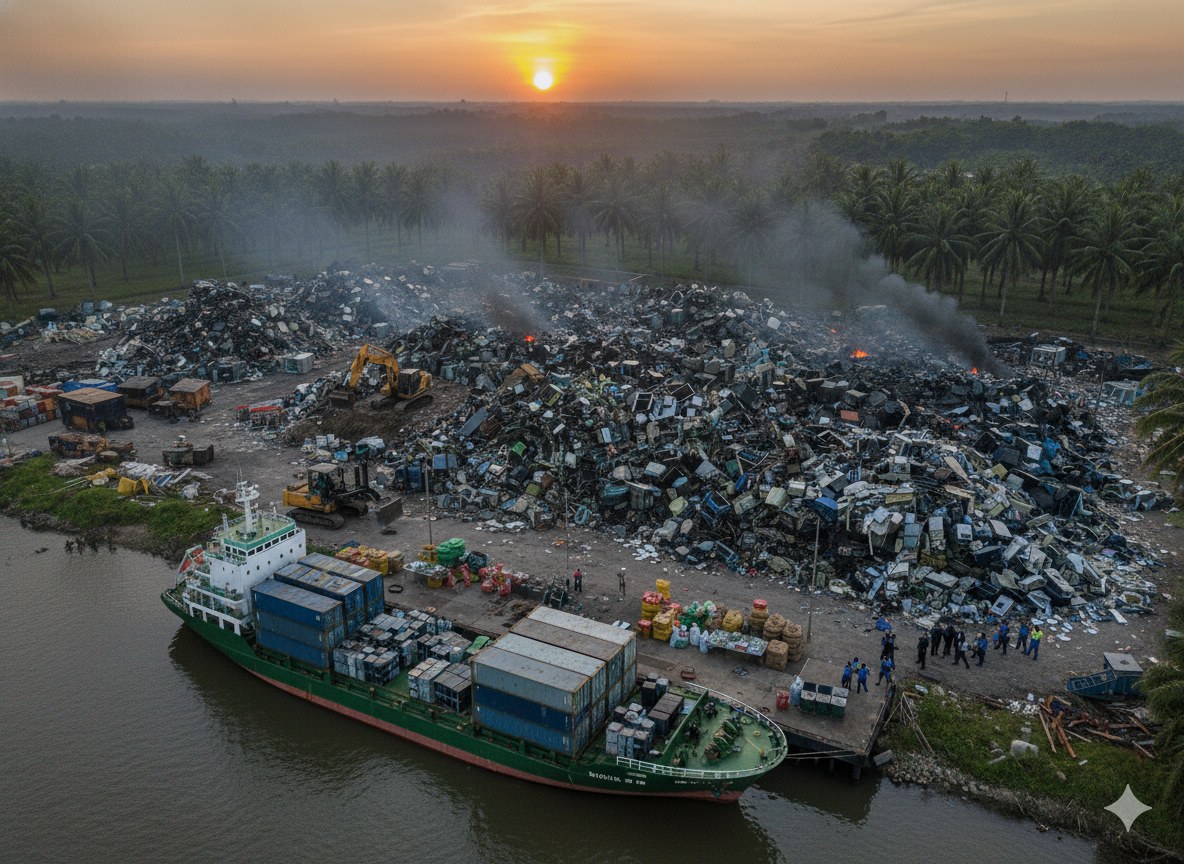
But behind this glittering cycle of upgrade and discard lies a growing mountain of toxic rubble that threatens the health of our planet and its most vulnerable communities.
A recent comprehensive study by researchers Muskan Jain, Deepak Kumar and colleagues (published in the Waste Management Bulletin in 2023) sheds stark light on this crisis. It frames e-waste not just as a logistical problem, but as a profound environmental and social justice failure.
A broken system
The central, chilling finding of their work is this: our current global system for managing electronic waste is fundamentally broken.
- Sign up for Aliran's free daily email updates or weekly newsletters or both
- Make a one-off donation to Persatuan Aliran Kesedaran Negara (ALIRAN), Maybank a/c 507246118995 or CIMB a/c 8004240948
- Make a pledge or schedule an auto donation to Aliran every month or every quarter
- Become an Aliran member
Rather than a circular economy of reuse and recycling, we have a linear pipeline of poison. The study details how a staggering share of the world’s e-waste – laden with lead, mercury, cadmium and brominated flame retardants – is illegally shipped or informally “recycled” in developing nations.
In impoverished neighbourhoods from Accra to Bangalore, it is dismantled by hand – often by children and women – using primitive, lethal methods like open-air burning and acid baths.
The environmental impact is catastrophic. The researchers document how these practices create sacrificial zones where soil and waterways are severely contaminated, ecosystems are destroyed and the toxic legacy seeps into the food chain.
This is not localised pollution. It is a creeping global contamination event.
E-waste is also loaded with high-value metals, including gold and copper. Recovering them can deliver significant fortunes.
But the cargo also contains toxic scheduled materials which, unless properly treated, become serious liabilities for the environment.
The human cost
The paper’s true power lies in how it links this environmental devastation to a profound human toll.
The authors move beyond statistics to highlight the real cost: chronic respiratory illnesses, neurological damage, cancers and shortened lifespans among informal waste-pickers.
This is not an accident. It is the direct result of a global system that externalises its true costs onto the poorest.
The study effectively argues that the consumption habits of the Global North are subsidised by the health and safety of communities in the Global South.
Yet the research is not without hope. It serves as a rigorous foundation for a call to action.
The authors advocate for a range of solutions. Manufacturers must be legally and financially compelled to design for longevity, repairability and non-toxic, easily recyclable materials. The “take-back” model needs teeth and global scale.
Rather than criminalising the informal recyclers who currently handle most of the world’s e-waste, the study urges their integration into the formal economy – with proper training, protective equipment and fair wages.
Malaysia’s bitter lesson
While the Basel Convention exists, loopholes and lax enforcement render it weak. Malaysia has witnessed one such bitter experience recently.
The massive influx of illegally imported e-waste went virtually unnoticed as some regulators, tasked to uphold the spirit of the convention, were found to have colluded with importers.
In early 2026, the Department of Environment’s director general, his deputy and another officer were remanded to assist investigations into alleged irregularities involving e-waste. This further eroded public trust in regulatory agencies.
The findings from the paper underscore the need for a binding, robust international framework. It calls, too, for consciousness over consumption.
Ultimately, the study places responsibility on us – the consumers. It challenges the very culture of planned obsolescence and relentless upgrading, pushing for a cultural shift towards repair, refurbishment and mindful consumption.
Breaking the toxic cycle
Jain, Kumar, Chaudhary and colleagues have delivered more than an academic review. They have issued a moral indictment.
Their work shows that e-waste is the dark shadow of the digital revolution. Solving it is not just a technical challenge. It is a test of our global equity, our environmental stewardship and our willingness to break the toxic cycle – where one person’s convenience becomes another person’s poison.
The time for quietly handing our old devices to a take-back programme and feeling virtuous is over. The paper demands we see the entire chain and act to break it.
As Malaysia gets serious about embracing the circular economy, there is hope for a more viable solution.
Professor Dato Ahmad Ibrahim is affiliated with the Tan Sri Omar Centre for STI Policy Studies at UCSI University. He is also an adjunct professor at the Ungku Aziz Centre for Development Studies, University of Malaya.
AGENDA RAKYAT - Lima perkara utama
- Tegakkan maruah serta kualiti kehidupan rakyat
- Galakkan pembangunan saksama, lestari serta tangani krisis alam sekitar
- Raikan kerencaman dan keterangkuman
- Selamatkan demokrasi dan angkatkan keluhuran undang-undang
- Lawan rasuah dan kronisme