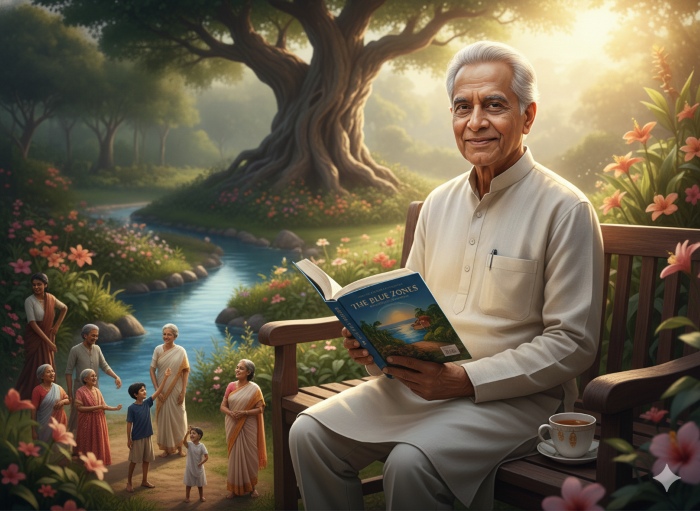
T Devaraj
Is longevity a secret?
Not really – it is an open secret. Its ingredients are known. They are genetic and environmental.
Until recently, the contribution from genes and ancestry was thought to be low, at 10–25%.
Recent research from the Weizmann Institute in Israel, the Karolinska Institute in Sweden and the Leiden University Medical Center in the Netherlands suggests the genetic contribution to how long a person lives is about 50%.
- Sign up for Aliran's free daily email updates or weekly newsletters or both
- Make a one-off donation to Persatuan Aliran Kesedaran Negara (ALIRAN), Maybank a/c 507246118995 or CIMB a/c 8004240948
- Make a pledge or schedule an auto donation to Aliran every month or every quarter
- Become an Aliran member
The environmental factors are a healthy lifestyle, a sense of purpose in life and luck.
Lifestyle relates to a balanced and moderate diet, exercise and physical activity, being social and generous.
Excessive food intake leads to obesity, diabetes, cardiovascular diseases and even cancer, all of which shorten lifespans.
Harmful behaviour includes smoking, vaping, drug use, excessive alcohol and irresponsible sex, which can lead to disease.
Many adults in Malaysia are unhealthy, as shown in the 2023 National Health and Morbidity Survey. More than half are overweight or obese, close to one in three have hypertension or high cholesterol, and one in six have diabetes. Worse, an adult can have more than one of these, with some having all four.
Is living long a goal? Yes, probably not consciously, but perhaps unconsciously, arising from our survival instinct or what the Japanese call ikigai, a reason or reasons for living.
Ikigai is common in “blue zones” – communities where many people are centenarians, such as Sardinia in Italy (home to the highest concentration of male centenarians in the world), Okinawa in Japan, Loma Linda in California, Ikaria in Greece, and the Nicoya Peninsula in Costa Rica.
Studies of these communities have revealed common practices that may contribute to long, healthy lives:
- having a mainly plant-based diet
- monitoring calorie intake, which probably means regular meals and no snacking
- avoiding alcohol or drinking in moderation (wine)
- embracing a sense of purpose
- maintaining a lifestyle that encourages natural, vigorous movement
- ensuring adequate stress relief
- having religion or spirituality
- living in a stable and extended family
- maintaining a supportive social network of lifelong friends.
Such practices vary among different people and places.
People in Okinawa stress ikigai, that which makes life worth living.
In Costa Rica, the community has a strong sense of purpose and a strong faith, while Adventists in Loma Linda are vegetarians living a faith-centred life.
Dementia is also less common in all these groups. Dan Buettner explores this in his book The Blue Zones: Lessons for Living Longer from the People Who’ve Lived the Longest.
For the millions living outside blue zones, the last decade or two of life can be marked by many issues that are not in themselves life-threatening.
Physical decline is inevitable. Stooping is common and so is deterioration of the organs. Older people may experience loss of balance, hearing defects, poor vision, dry eyes, drowsiness, less tolerance of cold, poor memory, declining appetite, grumpiness, narrowing interests, and a reluctance to socialise.
Falls resulting in fractures are serious. Being bedridden often leads to bedsores. Loneliness and abuse can also manifest.
Our desire is for a healthy lifespan until the end, and not just a long life. This is unlikely, and the last decade of life can often be marked by ill health such as a stroke, cancer, dementia (Alzheimer’s disease), Parkinson’s disease or frailty.
As physiological functions decline, a person may require tube feeding, nappies or catheters and enemas. Living like this becomes a challenge for the person and the family. One can wonder: “What am I doing here?” or “How long will I have to wait to die?”
Lucky is the person who goes to sleep and does not wake up. This is uncommon, however. Many desire a long healthy life and a quick ending without much suffering.
Not all see this wish fulfilled, and some see living as a burden on themselves and their family. Thoughts of suicide may surface, or requests to help a person die.
Societal reactions to euthanasia or mercy killing vary. These are only legal in a handful of countries. Many societies are turning to physician-assisted suicide.
The ending of life strains the emotions of all stakeholders: the person who is ill, the family and the professionals providing care. Competent adults should be encouraged to make a living will.
Growing old, growing global
Globally, countries are aged or ageing rapidly, except for Africa. Those that are already aged tend to have higher incomes, while others are ageing rapidly before becoming rich.
Malaysia will become an aged society by 2040, with those over 65 making up 14.5% of the population.
Whatever the route, care is needed for the ageing: in their own homes, by family carers and with adequate funds. As this is a societal issue, the needed resources will have to come from all of us.
A circle of life exists – from microbe to humans. For humans, there is a time to be born and a time to die. Having tasted life, one may rebel at this. But from life’s point of view, this makes excellent sense. The tools that we make do not last for ever, and that is what life tells us. We are flesh and bones, not made for immortality.
Does nothing of “I” survive? A moot question, answered throughout history with a yes – that our soul or spirit does not die. It is remarkable how global this view is: Christian, Hindu, Muslim, Jewish, Taoist, Buddhist, pagan. Life is a mystery.
How long can we live?
Ageing is inevitable. So how long can we live? The oldest documented person in history was a woman: the Frenchwoman Jeanne Louise Calment, born 21 February 1875 and who died on 4 August 1997 at the verified age of 122 years and 164 days.
Other claims include Li Ching-Yuen, said to have lived 256 years (1677–1933), and Swami Sivananda, born on 8 August 1896 (reportedly now 129 years old), as well as Methuselah’s 969 years in the Bible.
Going further back, life expectancy about 10,000 years ago was 28–33 years, and by 1800 this had risen to 40 years.
Currently, the global average is 75–78 years for women and 70–73 years for men – similarly in Malaysia – while Hong Kong and Japan exceed 84 years. This extension has come about through fewer deaths from infectious diseases.
Animals, by contrast, can live far longer than humans. Glass sponges have been known to survive more than 10,000 years, black corals more than 5,000 years and Greenland sharks more than 400 years.
Closer to our lifespan are the giant tortoises, at 160 years. In the plant world, pine trees can live a few thousand years.
My view is that we are wired for a life span of about 90 years. The 2020 population census showed that there were almost 200,000 people in the age bracket of 80–84 years. Many will go into their nineties and some will become centenarians.
The quest to live longer
Beyond a healthy lifestyle, there are other measures that may extend human lifespans – though beware of charlatans out to make a quick profit.
Vaccines have a role. In older people, they can reduce the risks of some infectious diseases such as flu, shingles, respiratory syncytial virus, pneumonia and Tdap (tetanus, diphtheria and pertussis) as well as Covid.
The reasoning is that as we age, our acquired immunity wanes and we can pick up infections from people around us, including our grandchildren – and such infections are riskier in the elderly.
A recent study found that the shingles vaccine may reduce the risk of dementia by 20%, as well as reducing chronic inflammation.
Do not forget, however, that the process of ageing itself has not slowed.
New approaches are also being explored, including manipulating biological processes. These include severe calorie restriction (which most humans would not accept), metformin (a type 2 diabetic drug) and rapamycin, a drug that suppresses the immune system.
Drugs are being developed to destroy so-called senescent cells and rejuvenate cells and tissues. Ideas abound, but testing must surmount many regulatory hurdles and takes time and money.
Living longer has wide implications – an extension of working life, greater accumulation of capital and families spanning many generations.
The takeaway is this: see life as a gift, live it as fully as possible, and be thankful. Be good and do good.
We can look up to the sky and ask why. At present, the answer is: we do not know.
Dato’ Seri Dr T Devaraj, 102, is a veteran physician and pioneering figure in palliative and hospice care in Malaysia.
AGENDA RAKYAT - Lima perkara utama
- Tegakkan maruah serta kualiti kehidupan rakyat
- Galakkan pembangunan saksama, lestari serta tangani krisis alam sekitar
- Raikan kerencaman dan keterangkuman
- Selamatkan demokrasi dan angkatkan keluhuran undang-undang
- Lawan rasuah dan kronisme