
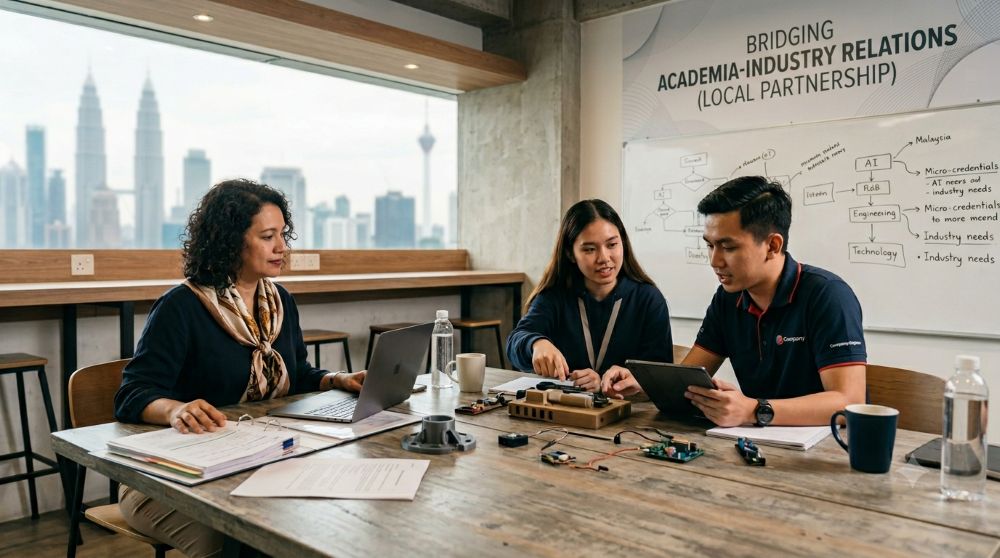
A recent seminar “Bridging Academia and Industry for the Future of Communications”, organised by the Public Relations Practitioners Society of Malaysia, marks an important milestone in academia-industry collaboration.
The organisers deserve high praise for this timely seminar, held on 18 June at IACT College. They set up a platform for a dialogue that is critical to higher education today.
Bringing together regulators, corporate agencies and universities created a forum for rare and much-needed discourse between the two sectors.
But the dialogue also brought to light deep frustrations and misunderstandings on both sides.
To bridge the gap between higher education and the modern workplace, these friction points need clear analysis. Both sides must move past mutual blame towards shared structured solutions.
The academic dilemma
- Sign up for Aliran's free daily email updates or weekly newsletters or both
- Make a one-off donation to Persatuan Aliran Kesedaran Negara (ALIRAN), Maybank a/c 507246118995 or CIMB a/c 8004240948
- Make a pledge or schedule an auto donation to Aliran every month or every quarter
- Become an Aliran member
During the panel discussions and the closing roundtable, educators spoke candidly about how lecture halls are changing. A key frustration was a decline in student engagement.
Educators noted that many students lean toward shortcuts, particularly by using generative AI tools to write essays and term papers. Over-reliance on AI causes cognitive offloading. This is when students skip the mental “struggle” needed to build strong neural pathways for problem-solving and critical thinking.
When students use AI for instant answers, they skip the reasoning step. They shift from active learners to passive consumers.
The seminar also revealed a consensus among academics: the traditional, multi-year degree structure needs urgent updating. Campus closures during the Covid pandemic showed that good education no longer needs a physical campus.
To match this shift, many educators called for a move towards flexible, career-focused micro-credentials. These short courses let people master specific market skills quickly.
But academics rightly pointed out that current regulations hold back their ability to design new courses. The Malaysian Qualifications Agency (MQA) sets rigid standards and slow approval times. A course can be outdated by the time it is approved. The digital tools and industry realities it covers may have already moved on.
This regulatory lag pushes courses into a uniform template. It limits institutional innovation and makes it harder to stay relevant to industry. Durability, not relevance, becomes the priority.
The discipline and balance debate
On the other side, corporate representatives shared ongoing frustration about recent graduate recruits. A common complaint was a shift in professional commitment.
Older executives noted that younger staff increasingly put a strict “work-life balance” ahead of full dedication to office hours. Many in the room read this as a lack of basic workplace discipline. Some speakers blamed this on changing family dynamics and a decline in strict parental discipline.
These frustrations are understandable from an employer’s point of view. But part of the audience applauded past strict methods, including the use of the cane. This points to a deep misunderstanding between generations.
Neither the modern university nor today’s workplace has fully grasped how digital life has changed human life and labour. Many workplace norms are still rooted in the shifts brought by the Industrial Revolution – tied to physical presence, rigid hierarchy and unquestioning compliance.
Wanting a work-life balance is not a sign of laziness. It is a sound, well-adapted response to a hyper-connected economy.
Older generations could switch off the moment they left the office. Today’s digital communication staff are tethered to work around the clock through mobile phones, Slack and endless notifications. They are expected to watch viral feeds and manage reputational risks at any hour.
Protecting personal boundaries is an act of self-preservation, not a lack of discipline. Job security is low and career paths keep shifting. Young professionals now see career progress as a flexible network, not a lifetime contract of blind obedience.
What the seminar missed
The seminar spent much time on the behaviour of young people. But it stayed largely silent on the bigger crises reshaping Malaysia’s media landscape. Only one participant from the floor raised these issues, leaving a real gap in the agenda.
The seminar did not address how the industry should handle the identity-driven crises that have recently held major businesses hostage. Social media fuelled all of these: the “Allah” socks controversy, boycotts targeting global fast-food chains and disputes over the national flag.
These are not standard public relations issues. They sit at an explosive crossing point between domestic ethnic politics and global sentiment. The usual crisis playbooks fall short here.
By leaving out these live issues, the seminar avoided discussing the very environments where future graduates will be tested.
The other clear gap was the absence of student voices in closing the industry-academia alignment gap. Throughout the day, students were talked about, but never talked with. They were treated as passive products of a pipeline rather than active stakeholders in their own education.
Some leading global universities, such as Cambridge, give students a real say. Student-led governance and participatory curriculum design are seen as key to institutional resilience.
Giving students a proper seat at the table would help. Course updates would then reflect the digital realities young people actually live in. By leaving student voices out, both academia and industry ignore the very insights needed to fix the alignment gap.
The way forward
Academia keeps blaming students for using new tools. Industry keeps blaming families for a lack of corporate submission. If this continues, both sectors will guarantee their own decline.
The answer is not once-a-year seminars or bureaucratic industry advisory panels that simply tick a compliance box.
What is needed is a permanent forum for dialogue between industry and academia.
This proposed council, ideally with statutory backing, would work outside rigid bureaucratic hierarchies. Crucially, either sector should be able to call an urgent dialogue whenever a major market disruption hits.
Say companies find that graduates lack advanced data skills, legal know-how on greenwashing, or real-time crisis management. They could trigger a forum session to co-design micro-credentials with university deans.
Say educators want to trial a new course inside a working corporate agency The forum could immediately help set up credit-bearing internship pilots, without years of regulatory paperwork.
The forum should also set up a student advisory council, drawing on global academic benchmarks. This would let students pitch ideas directly to industry heads and university deans. A generation that understands technology trends natively could become active co-designers of its own study courses.
A steady, balanced feedback loop like this would enrich the link between education and employment. Moving past mutual blame would help both sectors understand each other’s limits and realities.
Ultimately, this calls for a shift in mindset. Stop running higher education like an outdated factory line. Start cultivating it as an adaptive, shared ecosystem.
AGENDA RAKYAT - Lima perkara utama
- Tegakkan maruah serta kualiti kehidupan rakyat
- Galakkan pembangunan saksama, lestari serta tangani krisis alam sekitar
- Raikan kerencaman dan keterangkuman
- Selamatkan demokrasi dan angkatkan keluhuran undang-undang
- Lawan rasuah dan kronisme
