
Chang Teck Peng
Communication law (or media law) is a major subject, almost always compulsory, in university communication programmes worldwide, whether in Europe, the United States or Asia. Malaysia is no exception.
However, communication law courses should not only differ across regions. Even within the same region, such as Asia, they ought to vary according to the distinct contexts of individual countries.
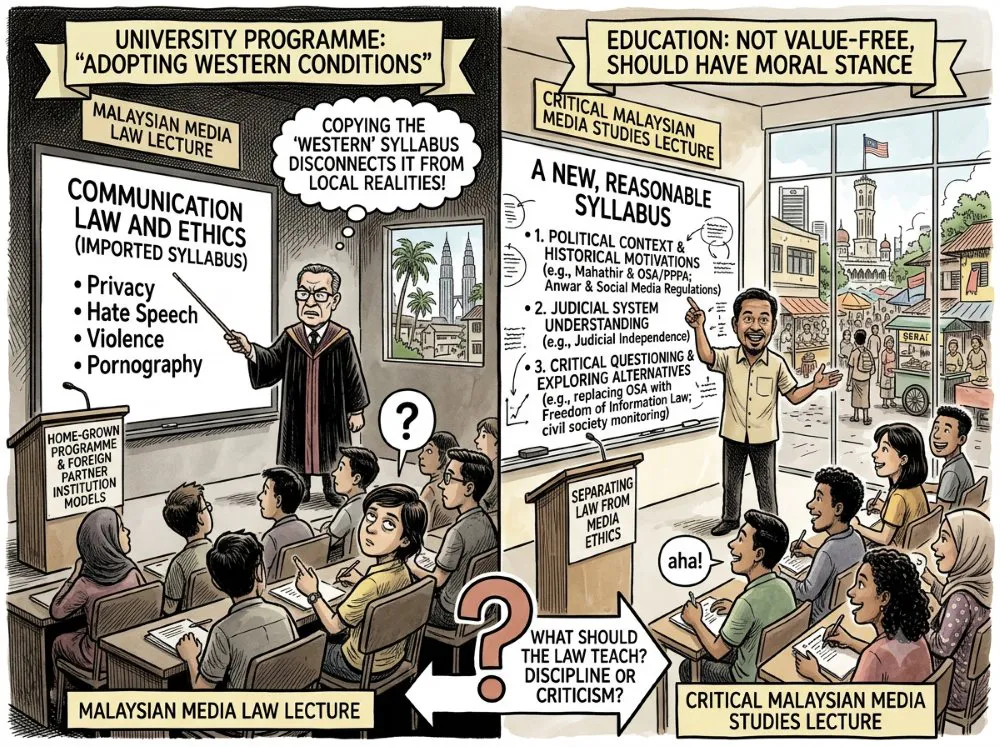
For example, communication law courses in Western countries commonly incorporate ‘ethics’, resulting in subjects such as Communication Law and Ethics.
This fits the Western context because in mature democracies press freedom is not only respected but protected by the constitution. The First Amendment to the US Constitution, for instance, explicitly prohibits the government from legislating against freedom of the press.
- Sign up for Aliran's free daily email updates or weekly newsletters or both
- Make a one-off donation to Persatuan Aliran Kesedaran Negara (ALIRAN), Maybank a/c 507246118995 or CIMB a/c 8004240948
- Make a pledge or schedule an auto donation to Aliran every month or every quarter
- Become an Aliran member
The media industry there is also highly commercial. So the main job of communication law is not to restrict press freedom. It is rather to deal with ethical issues such as privacy, violence, pornography and hate content.
Copying such syllabuses, designed for Western conditions, into Malaysia disconnects it from local realities, and may even look completely out of place.
Regrettably, even a brief search reveals that many local university communication faculties and departments, particularly in private institutions, likewise combine communication law and ethics into a single subject.
Some even adopt the title Communication Law and Ethics wholesale.
There appear to be at least two reasons for this.
- Universities that work with foreign partner institutions tend to structure their curriculums around those partners’ models.
- Home-grown programmes also adopt Communication Law and Ethics because curriculum planners lack independent judgement to design their own. They simply copy the curriculum designs of foreign communication schools to fulfil administrative requirements.
What should the law teach?
Education always carries certain values. In Malaysia’s political context, combining law and ethics into one subject risks turning the course into an ideological tool for ‘disciplining’ students.
After all, when ‘ethics’ is invoked, it refers to conduct widely recognised by society as morally desirable. Combining laws relating to communication with ethics therefore gives these laws a positive, righteous image, as though their main job were to protect public morals. This legitimises the existence and value of such laws.
Because ethics is linked to good conduct, it is hard to frame it as harmful. So “obeying the law” starts to feel like a moral duty rather than a choice.
In reality, some Malaysian communication laws do regulate public morality and pornographic content. The Communications and Multimedia Act 1998, for example, prohibits obscene content.
Yet their main purpose is political, not moral. The Sedition Act 1948, for instance, was amended following the May 13 incident in 1969. The Official Secrets Act 1972 was amended amid financial scandals during the administration of Dr Mahathir Mohamad.
Put differently, the key issues surrounding Malaysian communication laws are political interference, freedom of expression and press freedom. The harmful side of these laws therefore becomes hard to ignore.
If these are draconian laws, then obeying them should not automatically be treated as a moral duty. Teaching law and ethics as one subject therefore misses the point entirely.
Another problem in the local teaching of communication law may be the blind nurturing of students into becoming ‘law-abiding media practitioners’. They are rarely guided to question or challenge the legitimacy of such laws.
Whether we like it or not, law at its core sets out what people may and may not do. So lecturers tend to focus on compliance, obedience and avoiding legal trouble, teaching students what media practitioners can and cannot do.
Politics and money matter too
As noted, education is never neutral. A communication law syllabus should have a clear moral stance, rather than pretending to be value-free.
Communication faculties are not law schools. Studying statutes, procedures and case law is still necessary, but it does not need the same depth as a legal education.
Instead, the scope should be wider. It should cover the historical, political, social and economic forces behind these laws, not just their legal text and related case law.
Separating communication law from media ethics, then, is not just one option among many. Rather, it is the more sensible approach.
A well-rounded communication law syllabus in Malaysia should have three parts.
First, the historical, political, social and economic contexts, as well as the motivations, behind the enactment and amendment of each communication law.
For example, how were Mahathir’s amendments to the Official Secrets Act 1972 and the Printing Presses and Publications Act 1984 related to the political crises and financial scandals of the 1980s?
Why is the Anwar Ibrahim administration so eager to formulate additional regulations concerning social media?
Such discussions help students see that laws are not made in a political vacuum, but come from the ruling party’s own political interests. This should push students to ask whether such laws are reasonable at all.
Second, understanding key statutory provisions is indispensable. But before studying the laws themselves, students should first learn about Malaysia’s judicial system, including the appointment of judges and issues surrounding judicial independence.
Without this grounding in the judicial system, it is hard to see why a law may cause few problems in other countries. Yet in Malaysia, they become powerful tools for suppressing free expression and press freedom.
Third, studying communication law should not mean learning ‘obedience’ or ‘compliance’, but rather learning, after understanding the laws, how to question, criticise and pursue alternatives.
Communication law courses should therefore question whether existing laws are legitimate and guide students in exploring alternatives. Examples include replacing the Official Secrets Act with a freedom of information law, or replacing state surveillance with independent, civil-society-led media monitoring.
Associate Professor Chang Teck Peng, an alumnus of the USM School of Communication, is a former seasoned journalist who moved into academia. He is currently attached to the Faculty of Communication and Creative Industries at Tunku Abdul Rahman University of Management and Technology (TAR UMT).
AGENDA RAKYAT - Lima perkara utama
- Tegakkan maruah serta kualiti kehidupan rakyat
- Galakkan pembangunan saksama, lestari serta tangani krisis alam sekitar
- Raikan kerencaman dan keterangkuman
- Selamatkan demokrasi dan angkatkan keluhuran undang-undang
- Lawan rasuah dan kronisme
