More than a thousand job-seekers queued outside a hotel in Malacca in June 2026. Some arrived before 06:00.
They were all after one of several hundred operator and technician jobs at a chip-maker firm. The pay starts at RM3,500 a month.
To some, it is proof that a Western multinational’s name still carries weight in Malacca’s semiconductor industry.
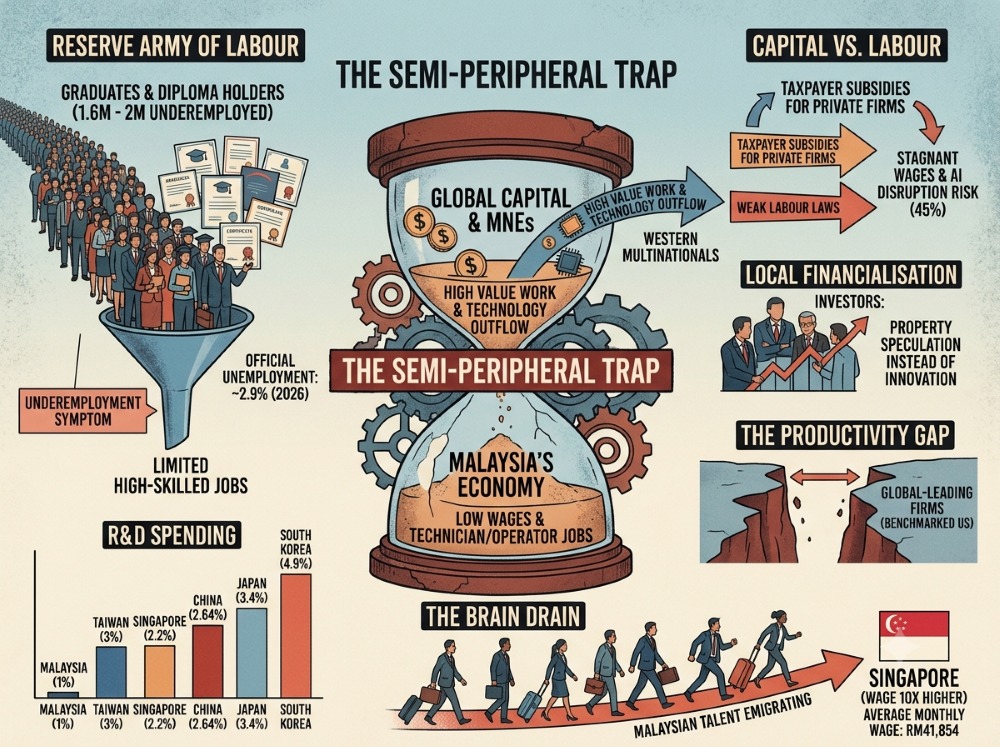
To others, it tells a different story. Official unemployment sits near a decade-low of 2.9% (Asia Pacific Career Development Association, 2026). Yet a third of graduates and diploma-holders are working in jobs that do not need a degree at all (Department of Statistics Malaysia, 2025).
Both readings are true.
- Sign up for Aliran's free daily email updates or weekly newsletters or both
- Make a one-off donation to Persatuan Aliran Kesedaran Negara (ALIRAN), Maybank a/c 507246118995 or CIMB a/c 8004240948
- Make a pledge or schedule an auto donation to Aliran every month or every quarter
- Become an Aliran member
That queue is a symptom of Malaysia’s deepening underemployment crisis.
To understand why educated people are chasing factory-floor jobs, we need to look at the deeper structure of the economy. The long queue in Malacca is not a sign of a booming economy. It is a symptom of a system that prioritises corporate profit over people.
The semi-peripheral trap
Malaysia sits in what economists call a “semi-peripheral” position in the global economy. The country is developed enough to attract big multinational companies, but it still depends on them for technology and capital.
Big firms set up factories here because it is cheaper than at home. They use Malaysia as an export hub to maximise their profits.
Cheap labour, land and energy flow to global capital, while the higher-value work, the technology and the profits mostly flow out.
At the same time, many local businesses have embraced ‘financialisation’. Rather than investing in deeper research, new technology or worker training, some local capitalists prefer the easier money of property speculation and financial trading.
This creates a two-tier economy: a foreign-owned sector with some decent jobs, and a local sector of low-paid, insecure gig work. When graduates fail to land a job with a multinational, a small or medium-sized enterprise, or a government-linked company, many fall into this precarious gig economy.
Capital over labour
The queue in Malacca also shows what economists call the “reserve army of labour” at work. When there are many desperate, unemployed or underemployed workers, employers hold the power.
They can keep wages low and demand ever-higher qualifications because workers fear losing out. Government policy often makes this worse rather than better.
Take the progressive wage system, meant to lift low pay. Rather than requiring firms to pay fairer wages through stronger labour laws, the government instead uses taxpayers’ money to subsidise wage rises for employers.
This socialises the costs (shifts the cost onto the public purse) while private companies keep the profits. It conditions wage growth on the rules set by capital, ensuring that workers remain weak and dependent.
The federal government channels hundreds of millions of ringgit, raised through income tax and corporate tax, into cash incentives and training subsidies for participating private companies. These subsidies are meant to ‘upskill workers’ or ‘develop human resources’.
It is a scheme that avoids challenging capital’s dominance over labour, rather than confronting it.
A recent World Bank report (2026) on Malaysia’s labour mismatch shows workers are paying the price. Underemployed graduates earn 49.3% less than those whose jobs match their qualifications.
The number of graduates entering the market each year now outpaces the number of high-skilled jobs being created.
The same report estimates that roughly 45% of jobs in Malaysia are now exposed to AI-related disruption – a second wave of mismatch arriving before the first has even been resolved.
The productivity problem
The root of the crisis is Malaysia’s failure to lift total factor productivity or TFP – a measure of how well an economy uses it workers and technology to create high-value output. For decades, this has stagnated.
The World Bank’s latest analysis of frontier firms (2025) shows the productivity gap between Malaysian and global-leading firms, benchmarked against the US, has widened rather than narrowed.
Malaysia’s research and development spending sits at just 1% of gross development product (GDP), a third of Taiwan’s (World Bank, 2023) It also lags behind Singapore (2.2%), China (2.64%), Japan (3.4%) and South Korea (4.9%).
Without productivity growth, wage rises cannot come from higher output per worker. They can only come from squeezing capital’s margins – something firms resist – or from ringgit depreciation and public subsidy, on which Malaysia increasingly relies.
The country leans too heavily on cheap labour and imported technology, and has not built enough high-paying, knowledge-intensive jobs. Yet universities keep producing thousands of graduates every year.
The mismatch is stark. Graduates expect professional, high-tech roles, but the semi-peripheral economy mostly offers technician or line-operator posts in foreign assembly plants.
When graduates take these lower-tier jobs just to survive, they push less-educated workers further down the ladder, deepening the spiral of underemployment.
Government data (DoS, 2025) confirms that graduate numbers each year now exceed the annual creation of high-skilled positions.
This is why between 1.6 million and 2.0 million tertiary-educated people in Malaysia are doing work below their qualification level, rather than being unemployed outright. The market absorbs them, just not at the wage their skills deserve.
The underemployed graduates serving coffee or driving for a gig platform is selling their labour for less than it is worth. The training behind it goes to waste. This waste benefits no one directly except capital.
The price of brain drain
When workers realise their skills are not valued, many leave. Malaysia suffers a severe brain drain, with talented professionals moving to Singapore, Australia or the UK.
An estimated 1.9 million Malaysians live abroad. More than half are in skilled or semi-skilled work, with roughly 47% in Singapore alone (Ramasamy et al, 2025).
The wage gap is stark: skilled Malaysian emigrants in Singapore earn an average of about RM41,854 a month – more than 10 times a foreign company’s starting wage in Malacca.
Economists have argued that currency and wage differentials this wide make emigration almost impossible to stop through moral appeals or campaigns like TalentCorp’s alone.
Labour naturally moves to where it earns the best return, escaping conditions it sees as exploitative at home.
Those who cannot afford to emigrate are left behind. They are the ones standing in kilometre-long queues in Malaysia, having had their education state-subsidised only to be offered the leftovers of the global supply chain.
The image of graduates queuing for hours should be a wake-up call. It exposes an economic model that traps Malaysia as a semi-peripheral state, reliant on foreign capital and technology.
Stagnant productivity and a financialised domestic economy have failed to create enough good jobs.
Until Malaysia shifts its priorities – investing in genuine innovation and passing laws that empower workers rather than subsidise employers – the underemployment crisis will only deepen.
This crisis has two exits: those who queue for two kilometres to stay, and those who leave rather than queue at all.
Our graduates deserve better than to stand in line for scraps from the global supply chain.
AGENDA RAKYAT - Lima perkara utama
- Tegakkan maruah serta kualiti kehidupan rakyat
- Galakkan pembangunan saksama, lestari serta tangani krisis alam sekitar
- Raikan kerencaman dan keterangkuman
- Selamatkan demokrasi dan angkatkan keluhuran undang-undang
- Lawan rasuah dan kronisme