Kua Kia Soong
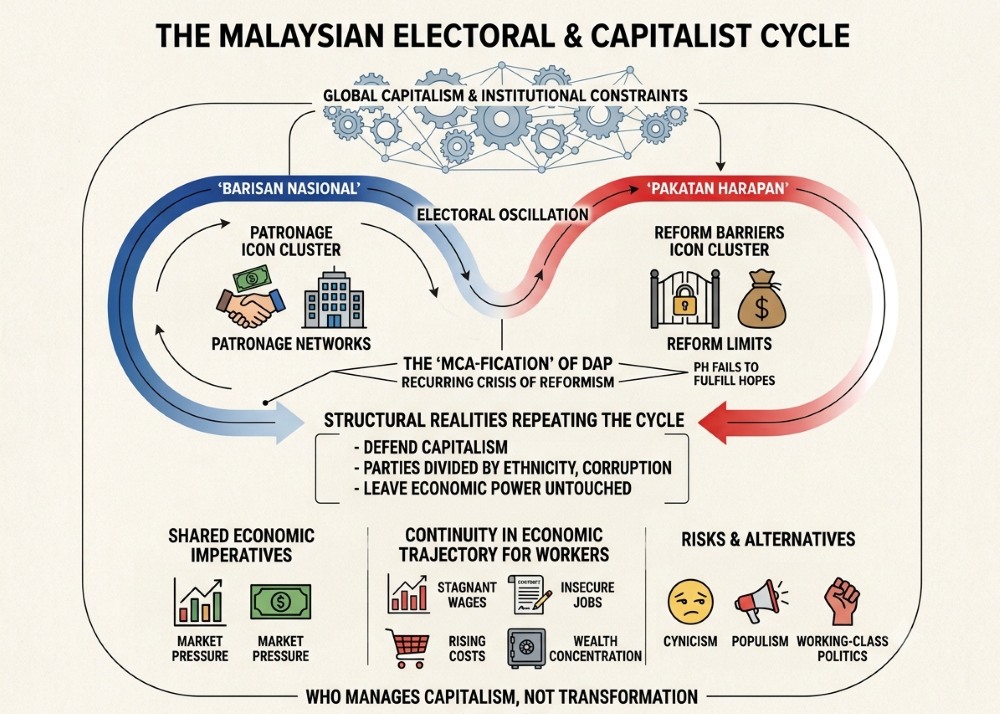
The electoral oscillation between Barisan Nasional and Pakatan Harapan is not primarily a contest between fundamentally different social projects. It is better understood as competition between factions of the same capitalist order.
The PH defeats of PH in Johor, following earlier setbacks in Sarawak, reveal structural features of Malaysian politics. These are not simply about campaign successes or failures.
For those of us who have lived through post-independence Malaysia, the ‘MCA-fication’ of the DAP has indeed come full circle. It is almost surreal.
The cycle of liberal democracy
Like the flailing liberal democracies of the West, Malaysian parliamentary democracy tends to offer voters a choice between parties committed to managing capitalism rather than transcending it.
- Sign up for Aliran's free daily email updates or weekly newsletters or both
- Make a one-off donation to Persatuan Aliran Kesedaran Negara (ALIRAN), Maybank a/c 507246118995 or CIMB a/c 8004240948
- Make a pledge or schedule an auto donation to Aliran every month or every quarter
- Become an Aliran member
Malaysia’s experience over the past decade illustrates this dynamic.
The historic victory of Pakatan Harapan in the 2018 general election generated enormous expectations. Many workers, young people and those from the middle class believed that defeating Barisan Nasional would usher in a qualitatively different political order.
Yet PH inherited an economy integrated into global capitalism and largely accepted its institutional constraints. Fiscal prudence, investor confidence, export competitiveness and private-sector-led growth remained central objectives.
You could not even raise wealth taxes in case you spooked the super-rich, said the DAP finance minister.
The result was a familiar contradiction. While smaller corruption scandals were addressed to varying degrees, the underlying class relations remained intact.
Rising living costs, insecure employment, stagnant wages relative to productivity, housing affordability and dependence on low-wage labour all persisted.
Disappointment replaced enthusiasm as a result. The electorate have swung back toward sBN in several state contests.
This is not necessarily because BN had become more attractive. It is because PH had failed to fulfil many of the hopes attached to its 2018 victory. This is less irrational voter behaviour than the recurring crisis of reformism.
Why the cycle keeps repeating
The repeated alternation between BN and PH reflects several structural realities.
First, both coalitions ultimately defend capitalist property relations. They may differ over governance, corruption, affirmative action, civil liberties or administrative reforms.
But neither proposes abolishing capitalist ownership of major industries or replacing production for profit with democratic economic planning.
They have accepted Dr Mahathir Mohamad’s privatisation as an article of faith, or turned government-linked companies into political party fiefdoms.
Second, electoral politics channels popular dissatisfaction into periodic changes of government while leaving economic power largely untouched.
Major banks, plantation conglomerates, energy companies, developers and multinational companies continue to shape investment and jobs. This holds true regardless of which coalition governs.
Third, every incoming government eventually confronts similar constraints. These include pressure from financial markets, dependence on private investment, global commodity prices, competition for foreign direct investment and budgetary limitations.
Governments managing corporate capitalism eventually administer many of the same economic imperatives, even if their rhetoric differs considerably.
PH represented a broad alliance including liberals, social democrats, Islamists and former Umno figures.
Such coalitions can mobilise against corruption or authoritarianism, but their social base often pulls them in contradictory directions.
The urban middle class may prioritise institutional reform.
Business interests demand stability.
Workers seek higher wages.
Rural communities seek subsidies and development.
Ethnic politics continues to influence resource distribution.
Reconciling these interests without fundamentally altering ownership relations is extremely difficult.
As a result, reforms often become incremental while structural inequalities persist.
Malaysia’s political history has encouraged electoral competition to revolve around ethnic representation, religious identity, anti-corruption, leadership personalities and regional autonomy. Class politics rarely becomes the primary organising principle.
The socialist party PSM has built respected grassroots campaigns around labour rights, housing, healthcare, migrant workers and Indigenous communities.
Yet these struggles have rarely translated into a mass political movement capable of contesting state power.
The left in Malaysia has become overly localised and activist-oriented. It lacks the organisational reach, trade union density, workplace presence and political education needed to build lasting working-class consciousness on a national scale.
An economy without real change
If the BN-PH cycle continues, Malaysia’s economic trajectory is likely to show continuity rather than real change.
Several trends may persist.
These include modest growth in gross domestic product (GDP) tied to exports.
Automation and technological upgrading will probably increase, along with reliance on migrant labour in key sectors.
Household debt may keep rising, and urban housing may stay expensive. More people may have to engage in precarious work through contract and gig jobs.
Governments may introduce targeted welfare programmes and subsidies to mitigate hardship. Yet these measures treat symptoms rather than causes.
Capital accumulation requires firms to maximise profits, restrain labour costs and compete internationally.
This places continual pressure on wages, working conditions and public expenditure.
For workers, alternating governments may produce meaningful differences in areas such as labour regulation, civil liberties or social spending. These differences should not be dismissed.
Nevertheless, neither coalition fundamentally challenges the extraction of surplus value through wage labour.
Workers therefore continue to face familiar pressures. Wages fail to keep up with inflation, contracts remain insecure, and working hours grow longer. Union power keeps weakening, retirement security keeps falling and essential services face privatisation.
Meanwhile, wealth remains concentrated among large companies, politically connected capitalists and financial institutions.
The risk of political cynicism
The greatest long-term danger is not simply alternating governments but growing political cynicism.
If each election cycle brings hope followed by disappointment, people may conclude that voting cannot meaningfully improve their lives. This disillusionment can lead to different outcomes.
One possibility is falling voter turnout and political apathy.
Another is growing support for more authoritarian or populist forces promising order, stability or ethnic protection.
A third possibility is the gradual rise of independent working-class politics. This would be rooted in workplaces, unions, tenant groups and social movements rather than in electoral coalitions led by elite politicians.
Whether such a movement emerges depends less on parliamentary arithmetic than on sustained class organisation outside Parliament.
The repeated swings between BN and PH reflect competition between different political blocs administering the same underlying economic system.
Election results matter. They can affect democratic freedoms, corruption and public policy.
But on their own, they do not transform the social relations that shape production, wealth and power.
The persistent weakness of socialist politics in Malaysia reflects two things.
One is the resilience of ethnic and patronage-based political structures.
And the other is the difficulty of building a broad class-based movement inside a capitalist economy tied to global markets. Working-class organisation remains weak and fragmented.
As a result, elections are likely to stay contests over who manages capitalism.
The bigger question of whether it should be fundamentally reorganised rarely gets asked.
From this view, the recurring swing between BN and PH is not really a sign of democratic renewal. It is more a sign of a political system where dissatisfaction moves between rival governing coalitions without resolving the deeper problems of inequality, insecure work and concentrated economic power.
Whether that cycle continues, or is eventually broken by new forms of political organisation, will shape more than Malaysia’s electoral future. It will also shape the everyday lives of its working people.
Dr Kua Kia Soong is a former MP and director of human rights group Suaram.
AGENDA RAKYAT - Lima perkara utama
- Tegakkan maruah serta kualiti kehidupan rakyat
- Galakkan pembangunan saksama, lestari serta tangani krisis alam sekitar
- Raikan kerencaman dan keterangkuman
- Selamatkan demokrasi dan angkatkan keluhuran undang-undang
- Lawan rasuah dan kronisme