M Santhananaban
This past July brought a moment of truth. A matter of great national significance was finally addressed – in a dutiful, dedicated but long-delayed manner.
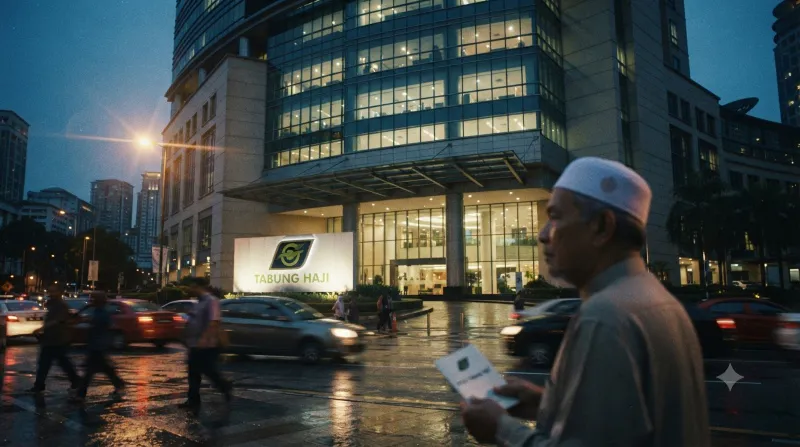
Since the evening of 29 July, there has been fairly accurate, balanced and analytical coverage of the Royal Commission of Inquiry report on Tabung Haji, the nation’s treasured pilgrimage fund.
The prime minister deserves credit for starting the cabinet process that led to the report’s declassification and release. – even if it was three years later.
Even more credit belongs to the chair and members of the royal commission. They showed courage, conscientious effort and careful, comprehensive attention to significant aspects of Tabung Haji’s operations.
- Sign up for Aliran's free daily email updates or weekly newsletters or both
- Make a one-off donation to Persatuan Aliran Kesedaran Negara (ALIRAN), Maybank a/c 507246118995 or CIMB a/c 8004240948
- Make a pledge or schedule an auto donation to Aliran every month or every quarter
- Become an Aliran member
Yet the Tabung Haji story is not the nation’s most devastating episode. Like many others before it, it is another failure to meet a reasonable standard of accountability, good governance, prudent fund management and transparency.
A digression
I have not yet read the full royal commission report on Tabung Haji. But as I read the coverage of the report, my mind wandered to the work of a much more modestly resourced committee of inquiry. Set up in 1984, it aimed to look into the US$1.1bn loss by the Bumiputra Malaysia Finance operation in Hong Kong.
That remarkable report, painstakingly compiled by Ahmad Noordin Zakaria, Chooi Mun Sou and Ramli Ibrahim, was given short shrift by the government of the day.
I had a particular interest in that report. I knew some of the characters involved, having served as a fledgling first secretary in our Hong Kong consulate general, then still a leased British territory.
Some of the bigwigs at BMF had volunteered their assistance to help the Malaysian government acquire a property in Hong Kong in 1979-80. The price they quoted for a particular building of interest was in excess of HK$260m.
Looking back, I did something rather rebellious, going against the ‘little Napoleons’ in our foreign service. I went to the vendor and offered HK$200m. I was half-expecting to be rebuffed.
At this meeting, the vendor was rather courteous. At my request, he produced a three-month-old valuation of the building from Jones Lang Wootton for HK$223m.
With the specific approval of our then finance minister, Tengku Razaleigh Hamzah, we were able to agree on the midpoint price of HK$212m within a week.
The sale and purchase agreement was signed on 14 February 1980. The sale was completed on 1 June 1980, when our government took possession of the 26-storey building.
After 46 years of housing several Malaysian agencies – and earning the government reasonable rental revenue from the 21 floors that were rented out – the current government has decided to dispose of the building.
For more than a decade, the building had failed to attract high rental-paying tenants because it had fallen into a state of neglect.
The Ministry of Finance’s bureaucracy apparently failed to act in time to repair, renovate or refurbish the 50-year-old building.
The blame for this neglect rests largely with the bureaucracy rather than the political leadership. A building bearing our nation’s name in a foreign territory carries symbolic and substantial significance that cannot be quantified. No one can deny that Hong Kong will remain one of Asia’s most vibrant cities. It is a pity our bureaucracy failed to recognise that.
I must confess that, because of my experience with some BMF officials in 1979, I had harboured misgivings about the bank’s management.
When the committee of inquiry’s report on BMF came out in January 1985, I was naturally keen to read it. But I was stationed in the isolated backwater of Vientiane, Laos, and did not get to read the report until much later.
The then leader of our government went on a tirade against the three respectable men who had compiled the report. The matter rested there.
A billion-dollar loss in the early 1980s was equivalent to a about 4% of the nation’s gross domestic product (GDP) at the time.
But because of a petty turf war over jurisdiction, the lessons of the BMF affair were lost.
Royal commission on Tabung Haji
Fast forward four decades. The royal commission on Tabung Haji was chaired by a respected retired chief justice. It had far wider authority to summon witnesses and reach its own conclusions. It also had a wider scope, significance and solid government support, with all the necessary facilities.
Undeniably, this royal commission panel handled its delicate, difficult task with considerable caution and circumspection.
Unlike the BMF matter, this Tabung Haji affair largely involved an area under Malaysian jurisdiction. There were no stories about the deaths of people like Bank Bumiputra investigator Jalil Ibrahim and Carrian Group legal adviser John Wimbush hanging over this inquiry.
In January 2022, when the royal commission was formally set up, the Prime Minister was Ismail Sabri Yaakob – a relatively low-profile figure within Umno’s hierarchy, with priorities of his own. He was the fourth prime minister since May 2018, after Najib Razak, Dr Mahathir Mohamad and Mahiaddin Yasin.
The mood then was one of genuinely seeking answers about what had happened at Tabung Haji in the decade since 2009. The saga was a small part of wider maladministration and misplaced state priorities.
Back in 1985, the mood was different. We were led to believe the prime minister of the day was flawless and formidable – prudent, proper and passionate in charting a new, much-needed course for the country.
That hype has now largely disappeared, after a string of short-lived administrations that failed to live up to their own slogans and promises.
In today’s Malaysia, the office of the prime minister is a much diminished institution.
Troubling disclosures
The report raised many troubling issues. Perhaps the most troubling was the fund managers’ excessive optimism, the questionable accounting and, in the eyes of some, plain greed.
In effect, this meant covering up losses while still dishing out bonuses to management and excessive annual payouts to contributors, based on vaguely set realisable-value assumptions. This was unhealthy at a time when the fund was not generating enough revenue, or when its revenue-generating capacity had diminished.
The Tabung Haji board seemed driven by a need to appear supremely efficient. Senior management were gung-ho and combative in exercising their authority within a comfortable governance domain.
This unusually autonomous style of governance was acknowledged even by the National Audit Department, which showed some lack of firmness in pointing out weaknesses in Tabung Haji’s accountability system.
The Tabung Haji operation seemed to enjoy unquestioned authority and appeared largely insulated from outside scrutiny. This gave Tabung Haji’s top managers room to live it up – paying themselves generous allowances and bonuses.
The politicians overseeing the fund were also powerful and influential, as they presumably drew their authority directly from the prime minister, in a system centred on the PM’s office.
Adherence to norms that applied to normal state-owned agencies was seen as unnecessary. Top management could deflect queries about its operations, given Tabung Haji’s unusual religious standing.
This sense of righteousness probably drove the board to act as it did. They had been appointed as guardians of a trust that managed pilgrimage services. They were mandated to provide not just good governance but exemplary accountability, clean and clear management, sound leadership, transparency and trustworthiness.
But they wilfully – or woefully – interpreted that mandate differently. They were not required to be austere, and instead maintained the plush lifestyles of the exclusive elite in banking and corporate circles.
It must be noted that they were, after all, managing a huge fund – one that exceeded the paid-up capital of several major national companies. Their power seemed unassailable. They even qualified for a bailout of close to RM20bn, as Tabung Haji was deemed too big to fail.
Menara TH Perdana is an iconic building in our capital city. Its central location, excellent access, architecture and workspaces, along with ample parking and perks for management, gave staff a sense of pride and pleasure few employers could match.
But a pampered lot were fiddling from the roof – and they lost their balance. When an entity handling a humble pilgrim’s modest savings loses its balance, anything is possible.
It has just been proven. Funds handling public money can invariably drift into similar failures of accountability and transparency if the consequences of the last scandal never reach beyond the operational level to the political one that allowed it to happen.
Dato’ M Santhananaban is a former Malaysian ambassador with over 45 years of public sector experience.
AGENDA RAKYAT - Lima perkara utama
- Tegakkan maruah serta kualiti kehidupan rakyat
- Galakkan pembangunan saksama, lestari serta tangani krisis alam sekitar
- Raikan kerencaman dan keterangkuman
- Selamatkan demokrasi dan angkatkan keluhuran undang-undang
- Lawan rasuah dan kronisme