C4 Center
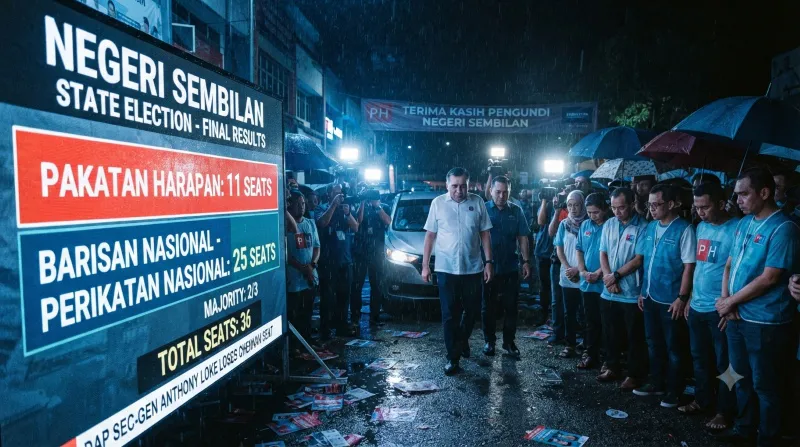
On 1 August, the Negeri Sembilan state election signalled an overwhelming rejection of the Pakatan Harapan coalition.
Out of 36 seats contested, PH won just 11, while the Barisan Nasional-Perikatan Nasional alliance swept to a two-thirds majority.
Notably, DAP secretary general Anthony Loke and former Negeri Sembilan menteri besar Aminuddin Harun both lost their seats.
This comes after PH were similarly trounced in Sabah and Johor, where they managed to win just one and eight seats respectively.
- Sign up for Aliran's free daily email updates or weekly newsletters or both
- Make a one-off donation to Persatuan Aliran Kesedaran Negara (ALIRAN), Maybank a/c 507246118995 or CIMB a/c 8004240948
- Make a pledge or schedule an auto donation to Aliran every month or every quarter
- Become an Aliran member
Three consecutive electoral drubbings paint a clear picture: voters are growingly disillusioned with a coalition that has repeatedly failed to deliver on many of its lofty promises or demonstrate commitment to the anti-corruption principles they claim to uphold.
Shortly after losing in Sabah, Loke stated that the DAP’s crushing defeat in Sabah’s elections was a “strong and unmistakable message from the voters”. In February 2026, he pledged that his party would work to “accelerate the reform agenda” within the next six months.
Six months have come and gone, but where are the reforms?
As the government’s term enters its final stretch, the Center to Combat Corruption and Cronyism (C4 Center) calls on the PH leadership to stop treating reform as a slogan reserved for election campaigns. The people have waited long enough, and the time for excuses has long run out.
Despite assurances that reforms were being ‘accelerated’, a number of the coalition’s most important reform commitments have either been quietly abandoned or left languishing without meaningful progress, namely:
- The establishment of a federal ombudsman’s office
- The legislation of a Political Financing Act
- Removing executive influence over the appointment of the Malaysian Anti-Corruption Commission (MACC) chief commissioner
- The legislation of a mandatory asset declaration framework
Even when legislation has been passed, these ‘reforms’ have fallen well short of meaningful progress. At worst, some of these ‘reforms’ may even have regressive effects to anti-corruption efforts:
- Government Procurement Act 2026 – Heavily criticised for concentrating broad discretionary powers in the hands of the finance minister
- Parliamentary Services Act 2025 – Failed to meaningfully provide Parliament with power to provide effective checks and balances on the executive
- Amendments to the Whistleblower Protection Act 2010 – While some changes are welcome, avenues for disclosure are still restricted to government agencies
Worse, two pieces of legislation touted as landmark reforms exposed the government’s lack of preparedness from the outset. Both were so shoddily drafted that they had to be referred to parliamentary select committees for revision:
- Separation of the attorney general’s and public prosecutor’s offices – Denied Parliament any meaningful role in the appointment process
- Freedom of Information Bill – Imposed restrictive application procedures to request information, while allowing secrecy laws to continue overriding the public’s right to information
While subsequent revisions to the bill for separating the attorney general’s and public prosecutor’s offices have significantly improved the legislation, these improvements did not arise out of the government’s own initiative.
They came about only after severe and sustained criticism from MPs, civil society and the public alike forced the government back to the drawing board.
Reform should not require public outrage before the government is willing to get it right.
Most insultingly, a coalition that campaigned off the backs of strong anti-corruption rhetoric in the 2022 general election, and a prime minister who promised zero tolerance to corruption after being sworn in, have themselves been the subject of persistent alleged corruption and misgovernance controversies.
During his term in office, numerous individuals appointed by Anwar Ibrahim to positions of power have found themselves tainted by scandal:
- Deputy PM Zahid Hamidi: Indicted with 47 corruption charges involving RM114m of Yayasan Akalbudi’s funds in 2018 – he was appointed deputy PM in 2022 and granted a discharge not amounting to an acquittal in 2023
- Former MACC chief Azam Baki: Implicated in two separate shareholding scandals, having allegedly owned millions of shares in four listed companies, directly contravening public service regulations – he was reappointed three times by Anwar before his retirement this year
- Former senior political secretary to the prime minister Shamsul Iskandar Akin: Allegedly linked to the Sabah mining scandal after whistleblower Albert Tei claimed to have paid him RM629,000, and that Shamsul had instructed him to secretly record Sabahan politicians
- Home Minister Saifuddin Nasution Ismail: Embroiled in a citizenship scandal involving forged documents and misleading parliamentary statements regarding seven ‘heritage’ footballers scouted to play for Malaysia
Add to this the fact that the MACC has found its name sullied by the “corporate mafia” scandal alleged by Bloomberg – where the MACC has been accused of colluding with businesspeople to facilitate corporate takeovers, employing intimidation tactics against targeted companies.
Therefore, it is not outrageous to claim that these humiliating back-to-back-to-back electoral defeats are entirely of Pakatan Harapan’s own making.
This is the inevitable consequence of a coalition that has repeatedly chosen political expediency over conviction to actually implement reforms, squandering every opportunity and ignoring calls for reform from civil society organisations and the public alike.
Evident here is that public trust in PH has profoundly eroded, and three consecutive electoral defeats should leave the coalition in no doubt about the depth of public dissatisfaction.
To call it a wake-up call would be a massive understatement. With the general election fast approaching, every further delay, compromise or abandoned promise only serves to erode the public’s loss of confidence in PH and its mandate to govern.
These electoral losses must serve as a warning to all political parties and factions, both present and future, that ordinary people will not tolerate broken promises of a government that is complicit in corruption and that has eroded our institutions of good governance. – C4 Center
AGENDA RAKYAT - Lima perkara utama
- Tegakkan maruah serta kualiti kehidupan rakyat
- Galakkan pembangunan saksama, lestari serta tangani krisis alam sekitar
- Raikan kerencaman dan keterangkuman
- Selamatkan demokrasi dan angkatkan keluhuran undang-undang
- Lawan rasuah dan kronisme