Kua Kia Soong
The proposal by Gelombang Saksama, a coalition of 19 Indian Malaysian NGOs, deserves serious attention.
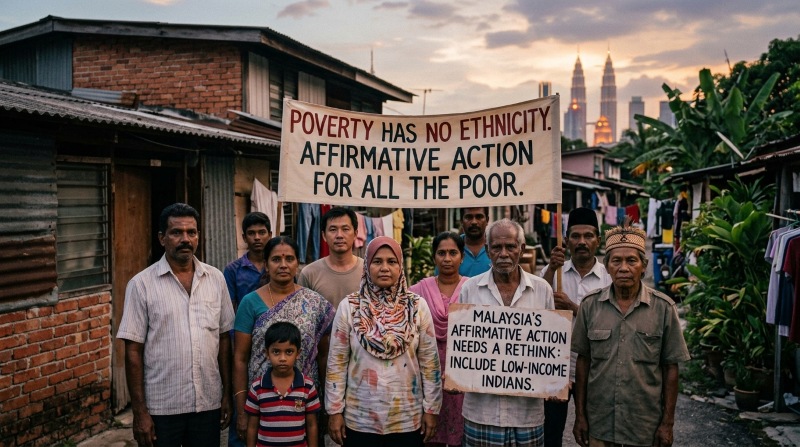
It does not just speak for the Indian community. It points to a much bigger question that Malaysia has avoided for far too long: who should affirmative action actually be for – the poor or an ethnic group?
Gelombang Saksama has proposed three concrete measures to tackle the socioeconomic problems facing the Indian Malaysian community: a dedicated statutory body, a public-private funding vehicle, and a cabinet committee responsible for the community’s problems.
The coalition argues that the socioeconomic position of low-income Indians has deteriorated over the past decade. It says a much stronger institutional response is needed.
- Sign up for Aliran's free daily email updates or weekly newsletters or both
- Make a one-off donation to Persatuan Aliran Kesedaran Negara (ALIRAN), Maybank a/c 507246118995 or CIMB a/c 8004240948
- Make a pledge or schedule an auto donation to Aliran every month or every quarter
- Become an Aliran member
These are eminently sensible proposals. After decades of government promises, programmes, blueprints, committees and agencies, the Indian community has every right to ask a question: why do so many of its problems remain unresolved?
Indeed, the fact that 19 NGOs have had to come together tells us something. It shows the inadequacy of existing arrangements.
But there is an even more important lesson here. The plight of the low-income Indians should finally force Malaysia to rethink the entire philosophy of affirmative action.
Poverty has no ethnic group
Malaysia has spent decades organising affirmative action largely around ethnic categories.
But poverty has no ethnic group.
A poor Indian family does not become less poor because a rich Indian businessman belongs to the same ethnic group.
A poor ethnic Malay family does not become prosperous because a Malay billionaire has accumulated enormous wealth.
A poor ethnic Chinese family does not suddenly gain economic security because another Chinese Malaysian owns a conglomerate.
And an Orang Asal family living in poverty does not become less deserving because its ethnic category is classified differently from the bumiputra majority.
This is the fundamental contradiction in Malaysia’s present approach. The objective of affirmative action should be to lift people who are disadvantaged – not to reward people merely because they belong to a particular ethnic category.
The original aspiration of the New Economic Policy was to eradicate poverty irrespective of ethnicity.
But over the decades, the principle of poverty eradication became increasingly overshadowed by ethnic entitlement and ethnic-based distribution.
The NEP’s expiry date was 1990. It is time to return to the first principle: need must be the primary criterion for affirmative action.
Ethnicity may sometimes be relevant in identifying historical disadvantage. This applies especially to the Orang Asal, where there is little class differentiation within their communities.
A warning sign
The Indian community’s experience shows why this reform is necessary.
The government already recognises the need for targeted assistance.
Mitra, for example, is specifically meant to address the socioeconomic development of the Indian community, particularly low-income households.
In 2026, the government allocated RM150m to Mitra. Six new initiatives worth RM65.5m are expected to benefit over 50,000 members of the community, particularly the low and middle-income groups.
But after all these years, why are we still discussing the same problems?
Gelombang Saksama’s intervention is therefore welcome. It is not simply another demand for a bigger allocation. It is demanding institutional reform: an accountable body, a sustainable funding mechanism and cabinet-level responsibility.
That is precisely the kind of structural thinking Malaysia needs. But we should go one step further.
If low-income Indians need special attention because of historical and continuing disadvantage, then every low-income household in Malaysia facing comparable deprivation deserves equally serious attention, regardless of ethnicity.
That includes poor Malays, poor Chinese and poor Indians, and it most certainly includes the Orang Asli of the peninsula and the Indigenous peoples of Sabah and Sarawak. Many of these communities remain among the most economically disadvantaged in the country.
Let Sabah shame us
The latest official poverty statistics make the case starkly. According to the Department of Statistics Malaysia, Malaysia’s overall absolute poverty rate fell to 5.1% in 2024.
But Sabah recorded an alarming 17.7% – by far the highest rate among the states. Sarawak’s rate was 10.0%. The figures have improved, but the underlying disparity remains enormous.
If a Malaysian living in an indigenous community in Sabah is struggling to get decent housing, education, healthcare, clean water, transport or a sustainable livelihood, does it matter what the government calls its affirmative action? Whether it’s labelled ‘bumiputra policy’, ‘indigenous policy’ or something else makes no difference to that family.
What matters is whether the assistance reaches them. This is why Malaysia needs to move from ethnic-based affirmative action to needs-based affirmative action.
A dedicated mechanism for the Indian community can address particular historical, social and institutional problems that need specialised knowledge. But the broader principle should be that public resources are distributed according to demonstrable need and disadvantage.
A needs-based framework
The government could establish such a framework. Eligibility could take into account household income, wealth, location, housing conditions, educational disadvantage, disability, employment insecurity, access to healthcare and other measurable signs of deprivation.
Such a system could give priority to the poorest households, children and young people from disadvantaged families, communities with severe educational deprivation, households trapped in low-wage employment, rural and remote communities, people with disabilities, single-parent and vulnerable households, and Indigenous communities facing long-term exclusion.
And yes, it would include Malay, Chinese, Indian and Orang Asal low-income households too.
That would be affirmative action worthy of the name. Our country should stop subsidising privilege.
The real danger of race-based affirmative action is not just that it can exclude poor people of other ethnic backgrounds in Malaysia – it can also let privilege masquerade as poverty alleviation.
A wealthy person does not become economically disadvantaged because of his or her ethnicity. Yet a poor person can be excluded from opportunities simply because they belong to the ‘wrong’ ethnic category.
That is the absurdity Malaysia must finally confront. That is the direction Malaysia should take.
Let Gelombang Saksama’s proposals become the start of a new national approach – not another chapter in Malaysia’s endless history of ethnic-based bargaining.
The country needs an affirmative action system that does not ask whether you are Malay enough, Indian enough, Chinese enough or indigenous enough. It should ask one question: how badly do you need help?
Social justice is the most urgent reform today. And the poor, whatever their ethnic background, have waited long enough.
Dr Kua Kia Soong is a former MP and adviser to the human rights group Suaram.
AGENDA RAKYAT - Lima perkara utama
- Tegakkan maruah serta kualiti kehidupan rakyat
- Galakkan pembangunan saksama, lestari serta tangani krisis alam sekitar
- Raikan kerencaman dan keterangkuman
- Selamatkan demokrasi dan angkatkan keluhuran undang-undang
- Lawan rasuah dan kronisme