Mohideen Abdul Kader
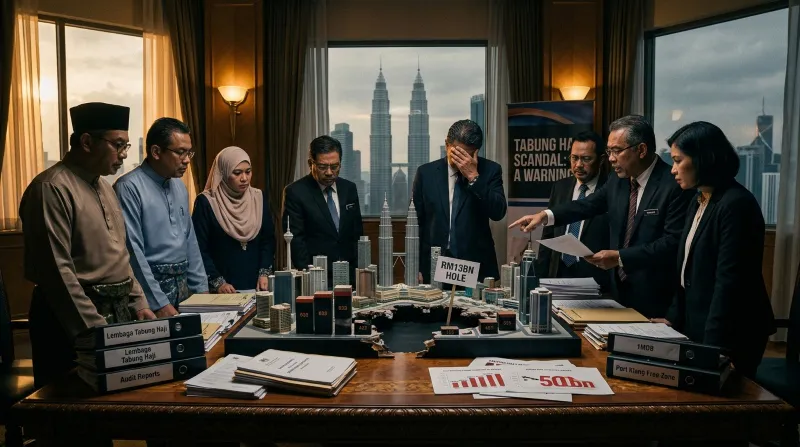
The RM13bn hole blown into Lembaga Tabung Haji, the Hajj pilgrimage fund board, is not an isolated tragedy. It is a warning.
The Royal Commission of Inquiry into Tabung Haji exposed creative accounting, opaque transactions and reckless decisions involving the savings of millions of Muslims.
More disturbingly, it revealed how a system can allow those entrusted with a public institution to take enormous risks while ordinary people bear the consequences.
This is the deeper problem Malaysia must confront: an entrenched Malaysian version of the ‘Epstein class’ – a network of politically connected elites, brokers, professionals and institutional enablers who can convert access and influence into private wealth while insulating themselves from accountability.
- Sign up for Aliran's free daily email updates or weekly newsletters or both
- Make a one-off donation to Persatuan Aliran Kesedaran Negara (ALIRAN), Maybank a/c 507246118995 or CIMB a/c 8004240948
- Make a pledge or schedule an auto donation to Aliran every month or every quarter
- Become an Aliran member
The Consumers’ Association of Penang (CAP) warned about this class in our recent commentary on the Tabung Haji scandal. The government – and especially Parliament – must now take the threat seriously.
Look at the record. Malaysia has endured 1MDB, with liabilities exceeding RM50bn; the Port Klang Free Zone debacle, where costs escalated from RM1.1bn to an estimated RM12.4bn; the alleged misappropriation of RM1.5bn in Sabah rural development funds; and corruption allegations involving systems critical to national security.
The problem is not simply a few bad apples. It is the network around them: the intermediaries who arrange deals, the professionals who provide legitimacy, the officials who look the other way and the institutions that fail to stop the abuse.
The most disturbing question is therefore not merely who stole the money. It is who made it possible.
Consider the auditor general. The Tabung Haji controversy raises deeply uncomfortable questions about the appointment and performance of the country’s most important public auditing office.
Madinah Mohamad, who served as auditor general from 2017 to 2019, issued an unqualified audit opinion on Tabung Haji’s 2017 financial statements.
The subsequent royal commission questioned that decision.
This raises a fundamental question: how can someone whose professional qualifications and technical background are apparently so poorly matched to the demands of such a critical technical position be appointed to head the nation’s supreme audit institution?
That appointment could not have happened in a vacuum. Someone had to recommend it. Someone had to approve it. Someone had to assess the candidate’s qualifications. Someone had to conduct the relevant checks.
What role did the Public Service Department play? What role did the prime minister’s Office play? What did the appointment and security-vetting processes actually examine?
And where was the Malaysian Institute of Accountants? If Malaysia’s premier professional accounting body is committed to maintaining professional standards, what did it do when questions arose about the country’s highest auditing office? Did it raise concerns? Did it investigate? Did it ask how such an appointment could be made?
These are not questions of personal vindictiveness. They are questions of institutional accountability. And they point to something even more disturbing.
Perhaps the system does not merely fail to see corruption. Perhaps there are people within the system who benefit from its failures – and therefore have an interest in looking the other way.
That is what makes the ‘Epstein class’ so dangerous. It is not necessarily a secret organisation. It is a system of relationships and mutual protection. One person gets appointed. Another approves a transaction. Another provides the professional signature. Another fails to ask questions. Another delays an investigation.
Nobody needs to give an explicit order. Everyone simply understands how the system works.
Indonesia’s civil society has described such networks as a ‘jaringan buruk’ – a rotten web of brokers, officials and professionals who facilitate corruption.
Malaysia needs to confront the possibility that we have developed our own version. The danger extends beyond Tabung Haji.
The 2007 Lingam video controversy raised allegations concerning judicial appointments and the fixing of cases. In 2019, a Court of Appeal judge made serious allegations about interference within the judiciary and called for a royal commission of inquiry.
Allegations of corruption and collusion have also periodically reached the police and other enforcement institutions.
Each case is different. But together they demand one question: what happens when the institutions designed to police power become vulnerable to the very networks they are supposed to police?
And what of government-linked companies? These firms control enormous pools of public wealth. Their boards and executives are entrusted with ordinary people’s money.
Yet when things go catastrophically wrong, losses are ultimately socialised onto taxpayers while those responsible may retain their wealth, connections and status. That is the ultimate injustice.
The factory worker saving RM50 a month. The fisherman trying to feed his family. The pensioner counting every ringgit. The teacher working a second job.
These people cannot gamble with their savings. But those managing billions sometimes can.
When a public institution loses billions, ordinary people pay through taxes, lost opportunities, weaker public services and diminished trust in government.
Malaysia therefore needs more than another investigation after another scandal. We need to attack the network that makes the scandal possible.
CAP calls on all MPs – government and opposition – to do much more. Much, much more. Parliament must stop treating each scandal as an isolated episode to be debated for a few days before disappearing from public attention.
MPs must demand answers about appointments, procurement, professional oversight, regulatory failures and the networks of individuals who repeatedly appear around the country’s biggest scandals.
They must strengthen parliamentary oversight of government-linked firms and public institutions. They must demand transparency in senior appointments. They must protect whistleblowers. They must insist that professional bodies answer for failures within their own professions.
And they must urgently revisit and strengthen the Economic Sabotage Bill. The law should make deliberate or reckless destruction of public wealth through abuse of public resources a serious offence.
Where there is evidence of knowing participation, accountability must extend beyond the person who signs the cheque to the intermediaries and professional enablers who knowingly make the transaction possible.
There must also be effective asset recovery, professional disqualification and, where legally appropriate, removal of honours. A title must never become a shield against accountability.
Malaysia does not need another slogan about fighting corruption. We need to change the incentives that make corruption worthwhile.
The Tabung Haji scandal should be the line in the sand. Parliament must act – not merely talk. Every MP, regardless of party, should ask: who enabled this? Who benefited? Who knew? Who looked away? And why were they allowed to continue?
If Parliament cannot answer those questions, we will eventually face another Tabung Haji, another 1MDB, another institution hollowed out from within.
Malaysia’s hardworking people have sacrificed enough. Their savings are not casino chips. Public institutions are not private fiefdoms. Government contracts are not political rewards.
Public trust is not something powerful people can steal and expect taxpayers to replace.
The Epstein class has had its feast. Parliament must now close the table. – CAP
Mohideen Abdul Kader is the president of the Consumers’ Association of Penang.
AGENDA RAKYAT - Lima perkara utama
- Tegakkan maruah serta kualiti kehidupan rakyat
- Galakkan pembangunan saksama, lestari serta tangani krisis alam sekitar
- Raikan kerencaman dan keterangkuman
- Selamatkan demokrasi dan angkatkan keluhuran undang-undang
- Lawan rasuah dan kronisme