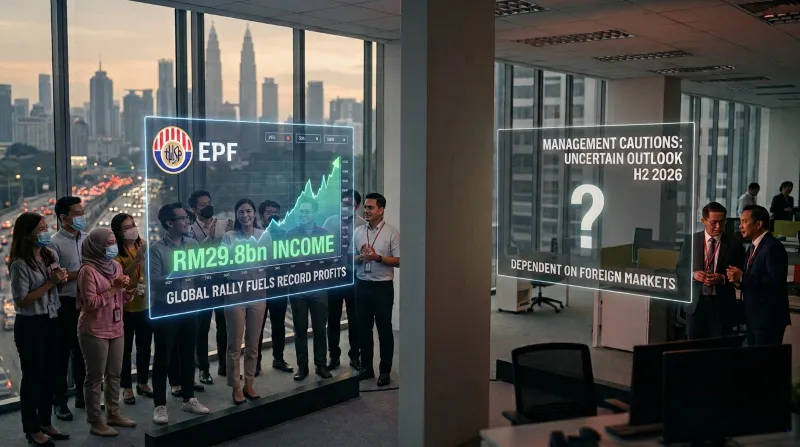
The Employees Provident Fund (EPF) recently announced a total investment income of RM29.8bn for the second quarter of the 2026 financial year.
That is a 44% jump from the RM20.6bn recorded over the same period last year.
On the surface, this looks like good news for contributors. But the EPF’s management has cautioned members not to expect similar returns in the second half of the year.
We need to ask two questions. What do these profits actually mean for ordinary people in Malaysia? And who truly controls this wealth?
A global gamble with local savings
This recent surge was not driven primarily by investments that build up Malaysia’s local economy. It was driven mainly by a global stock market rally.
- Sign up for Aliran's free daily email updates or weekly newsletters or both
- Make a one-off donation to Persatuan Aliran Kesedaran Negara (ALIRAN), Maybank a/c 507246118995 or CIMB a/c 8004240948
- Make a pledge or schedule an auto donation to Aliran every month or every quarter
- Become an Aliran member
This means the EPF’s success depends heavily on foreign markets, especially in the US and other advanced economies.
In economic terms, Malaysia is a ‘semi-peripheral’ economy. It has advanced semiconductor and AI data hub sectors, while still relying on low-wage labour and the extraction of palm oil and minerals in others.
We collect compulsory savings from local workers and invest them in core global markets. When those overseas markets boom, the EPF reports huge profits. But when they crash, our retirement savings take a direct hit.
Based on public disclosures, the EPF has steadily increased its foreign investment exposure since 2016. Overseas assets – equities, bonds and other instruments – rose from roughly RM212bn (about 30% of total assets) at the end of 2016 to around RM590bn-600bn (about 38-39% of total assets) by mid-2026.
This is a classic feature of dependent or semi-peripheral financialisation. This is where institutions capture the upside of core-market asset inflation, while remaining dependent on those markets’ liquidity, interest rates and appetite for risk (Wallerstein, 1974; Arrighi, 1994).
The EPF’s warning about the second half of the year proves this point. Our financial security is tied to the unpredictable ups and downs of foreign economies rather than to local growth that directly benefits workers and households in Malaysia.
The nation’s giant capital bank
The EPF is part of a vast network of government-linked firms and investment companies. Together, these entities manage around RM2tn in assets across nearly 2,000 companies.
The core issue is that the huge profits generated by this network are rarely used to improve universal welfare or to directly benefit contributors.
Instead, the wealth stays within the government’s own financial system. It is routed through entities like PNB, Khazanah, Petronas, Tabung Haji and various proxies, keeping the money under the tight control of the state. This system is often called ‘Minister of Finance Inc’.
Rather than being used to fund broader social safety nets, such as universal healthcare, public infrastructure or community services, the wealth and the returns generated from it stay locked inside institutions accountable to the state.
This is an unfair system. These funds sit within the state’s coffers. They are not redistributed directly or immediately to the individual contributors, whose compulsory savings built the capital base in the first place.
Managing public expectations
How does the government justify keeping this wealth? By pointing to the EPF’s strong performance. From a critical perspective, this is a way for the state to manage and neutralise public demands.
The Italian political theorist Antonio Gramsci had a term for this: transformismo (the absorption of opposition demands into the existing power structure, defusing them without real change).
When the EPF announces high dividends, it reinforces the image of the government as a competent, caring manager of our future.
But this also acts as a quiet takeover of the public’s demands. Popular claims on social surplus, such as the desire for a comfortable retirement or universal basic provision, are absorbed by the state rather than fulfilled through direct empowerment.
In fact, control over the RM2tn asset base remains with the state, not the individual contributors. The government decides how much of the profit to pay out as dividends, and how much to keep.
Ordinary members get a yearly dividend. But they have no real say in how the bulk of the wealth is used, nor true ownership rights over their own compulsory savings.
Formally, worker representatives sit on the EPF board, but strategic asset allocation and investment approvals are driven by the EPF’s investment panel and management, limiting contributors’ practical control.
Who really holds the purse strings?
This wealth is routed through trustee structures, staying under the effective control of what the academic Edmund Terence Gomez has called ‘Minister of Finance Inc’ (Gomez, 1994, 2017; Gomez & Jomo, 1999).
True reform would mean giving contributors greater direct control. This could mean creating portable individual accounts with genuine ownership, or using the EPF’s surplus to systematically fund universal welfare.
One way to move beyond this model of political control is what could be called a ‘compact state model’. This would restructure the relationship between state power and business through three mechanisms: pluralised ownership, mission-led mandates and democratic accountability. These ideas will be explored in future articles.
Until then, the EPF’s record profits will keep serving the state’s capital accumulation, and the power that comes with it. They are not transferring lasting economic wealth or political power to the people.
What is needed instead is a system of fairness and justice – one the public has every right to demand.
AGENDA RAKYAT - Lima perkara utama
- Tegakkan maruah serta kualiti kehidupan rakyat
- Galakkan pembangunan saksama, lestari serta tangani krisis alam sekitar
- Raikan kerencaman dan keterangkuman
- Selamatkan demokrasi dan angkatkan keluhuran undang-undang
- Lawan rasuah dan kronisme