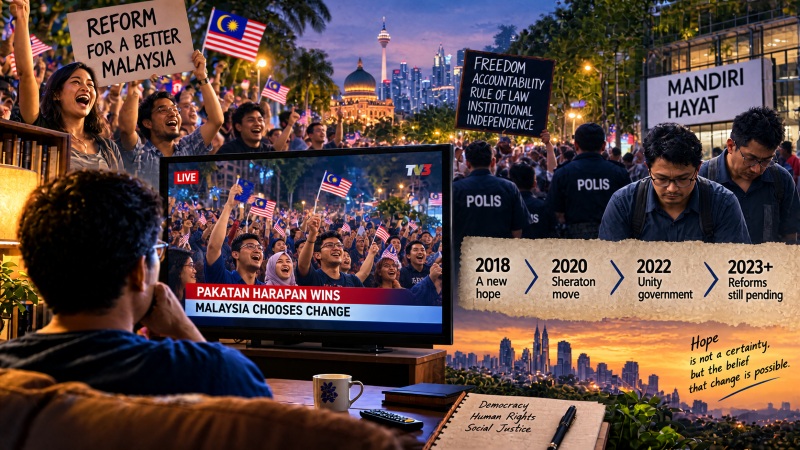
On the night of 9 May 2018, I was at home, glued to the TV.
I watched with increasing excitement as the general election results slowly rolled in.
By the end of the night, more than six decades of rule by Barisan Nasional and its predecessor, the Alliance, had ended.
For the first time, Malaysia had changed its federal government through the ballot box. It had elected a Pakatan Harapan government that had promised long-awaited reforms.
For many of us who had spent years advocating reform, it felt almost like a political miracle. We had watched the same political order survive election after election and protest after protest. Now, what had seemed impossible had actually happened.
A door opens
- Sign up for Aliran's free daily email updates or weekly newsletters or both
- Make a one-off donation to Persatuan Aliran Kesedaran Negara (ALIRAN), Maybank a/c 507246118995 or CIMB a/c 8004240948
- Make a pledge or schedule an auto donation to Aliran every month or every quarter
- Become an Aliran member
With that change came hope. There was a sense that a door had finally opened. Longstanding concerns raised by civil society – freedom of expression, accountability, the rule of law, institutional independence – suddenly seemed within reach.
But expectations are often shaped by the excitement of the moment. As the euphoria faded, it became clear that a change of government would not by itself bring reform.
Laws, institutions and political practices built up over decades do not change overnight. Reform requires time, political will and sustained public pressure.
The early months of the new government were promising. But progress stalled, and the ‘Sheraton move’ in 2020 brought the PH government crashing down.
What followed was a wearying period of political instability. Much of the hope of 2018 gave way to disappointment.
The next general election in November 2022 offered another opening. But no coalition won a majority.
Anwar Ibrahim, long seen as the face of the reform movement, became prime minister. His ‘unity government’ included BN – the very coalition reformers had opposed for decades.
The return of PH to power was a welcome relief after years of volatility. Yet the public mood was guarded, and with good reason.
It is understandable that reforms take time. But many of those reforms long demanded by civil society have been delayed, diluted or set aside.
Repressive laws such as the Sedition Act and section 233 of the Communications and Multimedia Act remain in us. At times they are used by those who once campaigned against them.
The Mandiri arrests
The recent treatment of the youth-led group Mandiri (independent) shows just how far we still have to go.
Earlier this month, Mandiri says, their bank accounts were frozen and travel bans imposed without public explanation.
Then, on 18 September, police raided the office that Mandiri shares with the anti-death penalty group Hayat (life).
Then, on 22 September, police arrested Mandiri executive director Amir Hariri Abdul Hadi and finance director Dobby Chew under the anti-money laundering law. They had voluntarily appeared before investigators to give their statements. Both have since been released, but the investigation continues.
Whatever the outcome, the manner of this crackdown sends a chilling message to anyone who speaks out. Laws meant to combat money laundering should not be used to intimidate civil society.
This is unacceptable under a government that promised to open up democratic space. The authorities must disclose the grounds for the investigation and lift the unexplained account freezes and travel bans. They must also stop using anti-money laundering powers against civil society groups.
A change in who governs, it seems, does not guarantee a change in how power is exercised.
This is why the present moment matters. Pressure on civil society is not an isolated issue. It is part of the unfinished work of democratic reform.
If anything, slow progress makes civil society more important, not less. When governments change but deeper structures remain, there must still be people willing to question, scrutinise and demand accountability.
This is something Aliran has understood since its founding in 1977. It has continued to raise questions about democracy, human rights and social justice under every government Malaysia has had.
Having been involved with Aliran for nearly two decades, I have seen some of those changes myself. I have also seen how easy it is to become discouraged when, after years of struggle, progress does not always come as quickly as we had hoped.
Hope in the long struggle
Yet we should also remember 2018. For years, change seemed impossible. Then, unexpectedly, it happened.
That should make us wary of assuming today’s circumstances are permanent. We cannot know when change will come again, or what form it will take. But the future is not fixed by the present.
That is what hope means in a long struggle. It is not the certainty that things will turn out as we wish. It is the recognition that things can change, and that what we do in the meantime matters.
Václav Havel spent years as a dissident before becoming president of a free Czechoslovakia. He put it this way: hope “is not the conviction that something will turn out well, but the certainty that something makes sense, regardless of how it turns out.”
The struggle for a more democratic Malaysia was never going to be won by one election or one government. The lesson of 2018 is not that change is easy. It is that change is possible.
And when progress seems slow, that is reason enough to carry on.
Chris Chong
Co-editor, Aliran newsletter
28 September 2026
AGENDA RAKYAT - Lima perkara utama
- Tegakkan maruah serta kualiti kehidupan rakyat
- Galakkan pembangunan saksama, lestari serta tangani krisis alam sekitar
- Raikan kerencaman dan keterangkuman
- Selamatkan demokrasi dan angkatkan keluhuran undang-undang
- Lawan rasuah dan kronisme