Kua Kia Soong
Malaysia now has a Reformasi government arresting Reformasi activists.
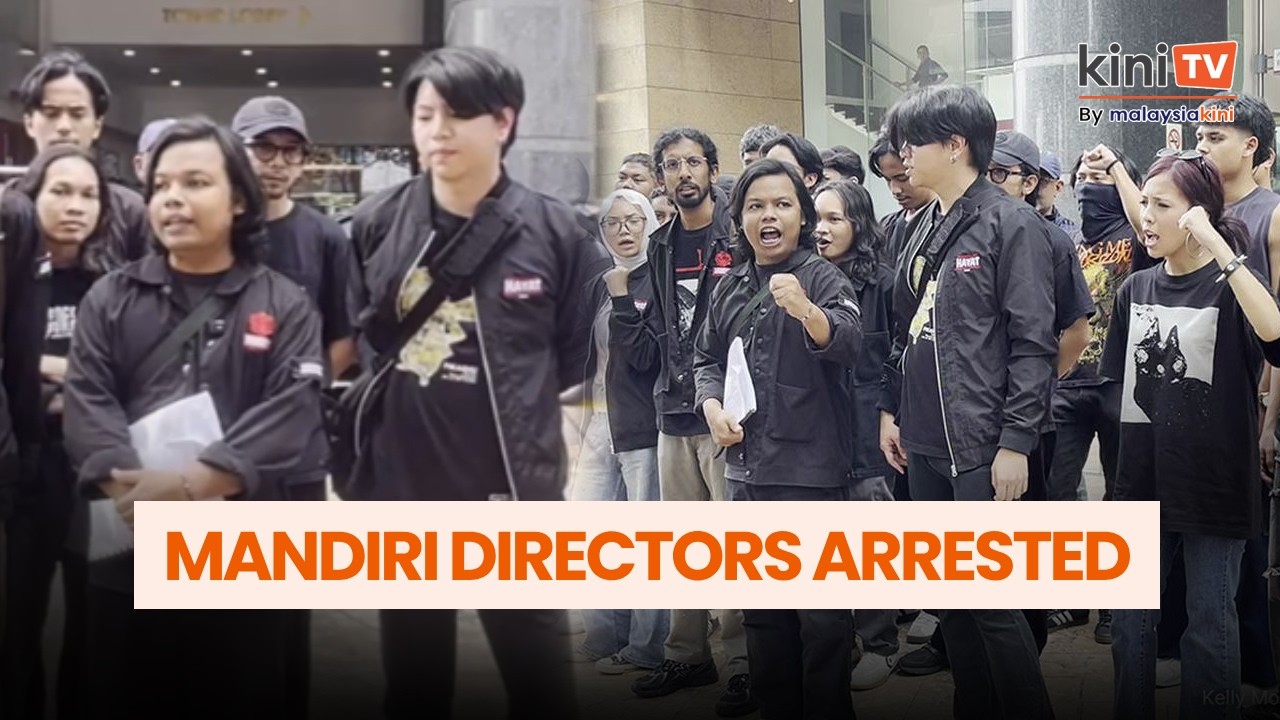
On 22 September, Amir Hariri Abdul Hadi, executive director of youth-led NGO Mandiri, and Dobby Chew, its finance director, were arrested under the anti-money-laundering law Amla after voluntarily presenting themselves to police to assist an investigation. They were remanded for three days and released on 24 September.
Police say the investigation concerns suspected unlawful funds and that five bank accounts have been frozen.
No, they are not podcasters. The podcasters came earlier. On 6 August, Brian Kong of Let’s Get It Podcast and Shamsul Saad of The Gut Shot Podcast were arrested and remanded for two days over an episode ‘Malaysia introduced me to racism’, which police said raised racial and religious sensitivities. They were investigated under the Sedition Act, Penal Code and Communications and Multimedia Act.
- Sign up for Aliran's free daily email updates or weekly newsletters or both
- Make a one-off donation to Persatuan Aliran Kesedaran Negara (ALIRAN), Maybank a/c 507246118995 or CIMB a/c 8004240948
- Make a pledge or schedule an auto donation to Aliran every month or every quarter
- Become an Aliran member
So here we are. Activists arrested. Podcasters arrested. Human rights defenders investigated. Civil society bank accounts frozen.
And this is supposed to be the government born of Reformasi. Perhaps the slogan has undergone a little institutional reform itself:
Reformasi – formerly a movement against the machinery of repression. Reformasi 2.0 – now operating the machinery.
The joke would be complete if the government announced that the next Reformasi rally will be held at the nearest police lock-up.
The question for the former reformers
This is where I would particularly like to hear from those who once stood on the other side of the barricades.
Adam Adli was a student activist who became a symbol of youthful dissent before entering government. He is now deputy higher education minister.
Fahmi Fadzil, once associated with the Reformasi generation, is now communications minister – the very portfolio intimately connected with freedom of expression and the regulation of online speech. Parliament records him as the minister responsible for the communications and multimedia legislation.
So, gentlemen, a simple question: Where are your red lines? Is there a point at which the arrest of activists becomes unacceptable? A point at which the detention of journalists or podcasters becomes intolerable? A point at which laws inherited from the old order are used so aggressively that you say: “Enough. This is not the Reformasi we fought for”?
And if that point exists, what is it? Is there a line beyond which you would resign in protest rather than remain in office and defend the indefensible?
Or has entering government produced a miraculous transformation in political eyesight – where the handcuffs that once looked oppressive from the outside suddenly look perfectly reasonable from the inside? This is not a question about party loyalty. It is a question of principle.
The great Reformasi rinse cycle
Malaysia has seen this movie before. First comes the noble language: Reform. Justice. Democracy. Freedom. Rule of law. Then comes power.
Then comes the discovery that the laws used against one’s opponents are actually rather useful.
And finally comes the most beautiful phrase in the administrative vocabulary: “Let the authorities do their job.”
Of course, the authorities must investigate genuine criminal allegations.
But democracy requires another job to be done as well: the government must restrain the machinery of the state when that machinery threatens legitimate civil society, freedom of expression and political dissent.
The UN special rapporteur on human rights defenders has already urged the Malaysian authorities to halt measures that misuse anti-money-laundering or anti-terrorism laws to harass or unduly restrict human rights defenders. Several international rights organisations likewise raised due process and chilling effect concerns over the crackdow on Mandiri and Hayat.
These are not trivial questions. In a democracy, remand is not conviction. But deprivation of liberty is still deprivation of liberty.
Perhaps the greatest irony is that many of today’s government politicians once understood this perfectly. They knew that democracy was not simply about winning elections. They knew that civil society had to be free to criticise the government. They knew that dissent was not treason. They knew that activists were not enemies of the state.
So what happened? Did Reformasi finally succeed – only to discover that the former rebels had become the establishment? Or did the establishment simply swallow Reformasi whole?
There is an old political warning: Power does not necessarily corrupt. Sometimes it merely reveals whether your principles were conditional on not having power.
That is why the question to the former Reformasi activists now in government is so simple: What are your red lines? If an activist is arrested, what will make you speak? If a podcaster is detained, what will make you act? If freedom of expression is curtailed, what will make you resign?
If the laws once used against you are now being used against the next generation of activists, how many arrests will it take before you say: “This is no longer Reformasi”?
If there are no red lines, perhaps Malaysians should stop calling this a Reformasi government. Perhaps it is simply another government that has discovered the comfortable side of power.
And perhaps the most appropriate Reformasi slogan for Malaysia in 2026 is: ‘Reformasi – please report to the lock-up.’
Dr Kua Kia Soong, a former MP, is the director of human rights group Suaram.
AGENDA RAKYAT - Lima perkara utama
- Tegakkan maruah serta kualiti kehidupan rakyat
- Galakkan pembangunan saksama, lestari serta tangani krisis alam sekitar
- Raikan kerencaman dan keterangkuman
- Selamatkan demokrasi dan angkatkan keluhuran undang-undang
- Lawan rasuah dan kronisme