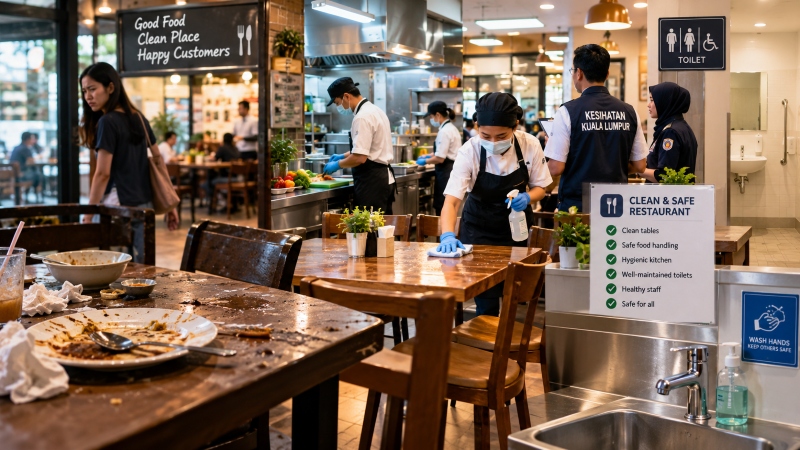
Cleanliness in restaurants is important for public health, customer trust and a thriving business.
Most consumers expect cleanliness. Many will walk out of or avoid a dirty place to eat.
Owners should put patrons’ health and protection first. Good hygiene prevents foodborne illnesses, bacterial growth and contamination from raw ingredients.
Cleanliness and hygiene also protects human health and improves daily wellbeing.
Conforming to regulations
Strict hygiene standards help restaurants avoid costly health code violations, mandatory closures and fines. These come from local authorities like Kuala Lumpur City Hall and the Health Department.
- Sign up for Aliran's free daily email updates or weekly newsletters or both
- Make a one-off donation to Persatuan Aliran Kesedaran Negara (ALIRAN), Maybank a/c 507246118995 or CIMB a/c 8004240948
- Make a pledge or schedule an auto donation to Aliran every month or every quarter
- Become an Aliran member
Recently, three restaurants with over 20 food stalls in Bangsar were ordered to close for a set period for hygiene reasons. They have two weeks to clean up their act.
These restaurants were popular at lunchtime, at dinner and at weekends. I was a regular customer at all three but will now have second thoughts about patronising them.
Negative reviews about cleanliness drive diners away. Clean, well-reputed, highly rated establishments see more customers and greater loyalty.
These restaurants draw hundreds of customers at lunch. They offer a wide variety of food at affordable prices, including several outlets serving what is called economy rice.
What restaurants must observe
Kitchens and food stations need regular sanitising. This includes cutting boards, cooking stations and storage racks. Raw and cooked foods must be kept separate.
Dining areas need frequent wiping down of tables, door handles and menus between guests. After customers leave, the owner or staff in charge must ensure the table is cleaned and sprayed with disinfectant.
Sadly, in my many visits to restaurants, I have often found the toilets in a bad state. They fall short of basic hygiene expectations.
Sinks, toilets and floors must be spotlessly clean and washed with antiseptic at least twice a day. This directly reflects the establishment’s hygiene standards.
Strict hygiene standards must be enforced on staff. This applies especially to handwashing and the proper use of uniforms and gloves. Employers should provide caps to staff, especially those in the kitchen, to ensure cleanliness.
Restaurants should also provide proper toilet facilities, with rough-surfaced floor tiles, an exhaust fan and sufficient lighting. There should also be handrails for older people and people with disabilities. Toilets need enough paper, a door hook and a washbasin with soap.
Depending on the number of customers, toilets may need cleaning more often. This is best done after hours or before opening. That keeps them accessible throughout the day.
Kitchens should be cleaned multiple times a day. This is best done as staff move from one task to the next. Restaurant owners must have enough staff for this purpose.
Likewise, dining areas should be swept and cleaned several times a day. For example, cleaning could be done before opening and after the morning rush, after lunch and in mid-afternoon, and finally after closing.
Regular health checks
City Hall regularly conducts health and hygiene enforcement operations on restaurants, cafes and food stalls across the city. Public health officers often help in this task.
Teams of five can be seen making these checks. They ensure outlets observe hygiene standards and premises are free of rats and cockroaches. But checks must be more frequent as local councils have a duty to ensure clean premises.
City Hall must also ensure that newly renovated premises have proper piping and a pleasing layout, with a clean and appealing ambience.
Restaurant patrons should alert the health authorities and food vendors about any shortcomings. Some kitchens are cramped and cannot cope with the volume of cooking.
Many coffee shops and food outlets have sublet their premises to a variety of food stalls. But the restaurant owner must be responsible for cleanliness instead of expecting stall vendors to handle it.
Operators must keep their premises in tip-top condition. They should offer not just tasty and nourishing food but also a clean and safe environment for patrons.
AGENDA RAKYAT - Lima perkara utama
- Tegakkan maruah serta kualiti kehidupan rakyat
- Galakkan pembangunan saksama, lestari serta tangani krisis alam sekitar
- Raikan kerencaman dan keterangkuman
- Selamatkan demokrasi dan angkatkan keluhuran undang-undang
- Lawan rasuah dan kronisme