RimbaWatch
Malaysia is experiencing a data centre boom, as demand for cloud services, data storage and computing power skyrockets.
Selangor alone green-lit almost 40 data centre projects between 2021 and 2025, while Johor approved 51 facilities worth RM183bn in investments as of November 2025.
Malaysia’s data centre capacity was expected to double by end-2026, with a further 3,500MW planned after 2026, placing it among the top three data centre markets in the Asia-Pacific region behind Tokyo and Beijing.
However, as tech parks reach capacity, operators are increasingly constructing data centres closer to residential areas, stirring public outcry over the associated environmental and health externalities, including heightened water risks, noise pollution and urban heat islands.
- Sign up for Aliran's free daily email updates or weekly newsletters or both
- Make a one-off donation to Persatuan Aliran Kesedaran Negara (ALIRAN), Maybank a/c 507246118995 or CIMB a/c 8004240948
- Make a pledge or schedule an auto donation to Aliran every month or every quarter
- Become an Aliran member
Recently, strong community objection to a proposed data centre project in Section 9, Kota Damansara resulted in the proposal being withdrawn by the consultants.
These instances highlight the importance of ‘visibilising’ and understanding data centre locations across the peninsula.
This would allow the public to evaluate the immediate risks involved (including potential water shortages or overlaps with drought areas) and larger structural issues (a rise in emissions due to increased fossil fuel-based energy consumption and the complicity of big tech data centre companies in genocidal regimes).
Identifying problematic projects facilitate federal and state accountability to the public, ensuring improved governance over the approvals and construction of data centres.
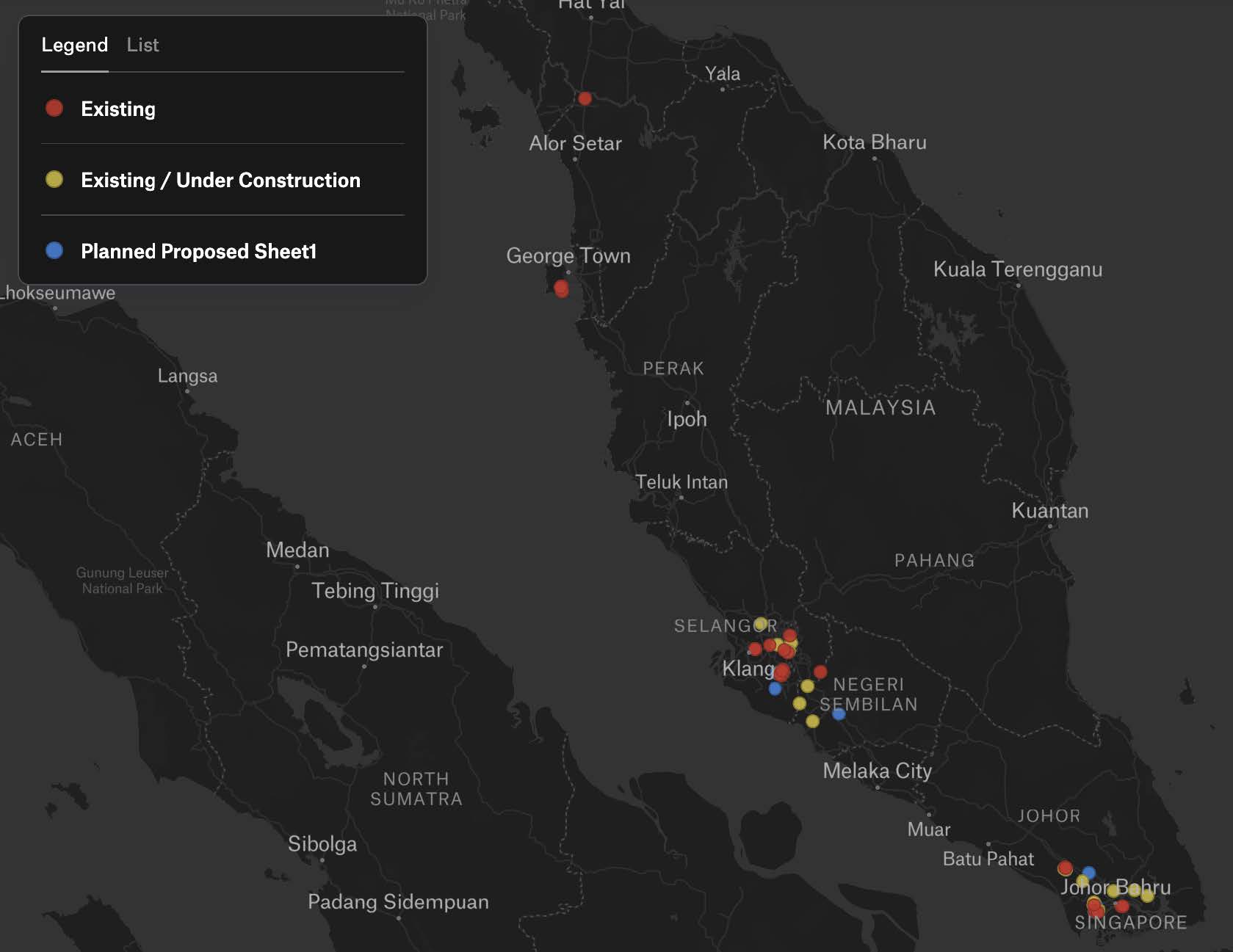
Mapped: 66 data centres and counting
As a first step, RimbaWatch has located and mapped the approximate locations of 66 data centres across the peninsula, encompassing Kedah, Penang, Negeri Sembilan, Selangor, Kuala Lumpur and Johor.
These data centres include hyperscale facilities (ie YTL Green Data Centre Park) and smaller enterprise or co-location premises (ie Menara AIMS Data Centre) that are existing, under construction, or planned or proposed. Locations that have not been fully verified (either through news reports or GoogleMaps) have been tagged as ‘alleged locations’.
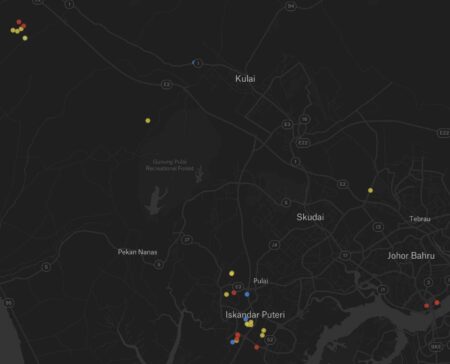
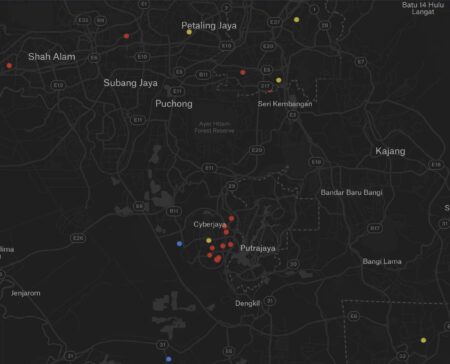
Half the facilities (33 data centres) are located in Johor, primarily in Iskandar Puteri. Selangor and KL facilities comprise 38%, with the remainder in Negeri Sembilan (a growing data centre region) and Penang.
Thus far, we have found one data centre in Kedah (Open DC D8-1), located in the Delapan Special Border Economic Zone, near the Malaysia-Thai border.
We have observed that some of these locations straddle residential areas. These include an alleged location in Nilai, near Taman Tasik Ujana Impian, as well as a few locations in Bukit Jalil.
The images below are close-ups of data centre locations in Johor (left), Selangor and Kuala Lumpur (right):
 |  |
44 million tonnes of CO2
In attempts to account for emissions from our database of facilities, we collected the approximate capacities of 51 mapped data centres from operator press releases and websites, as well as secondary sources, including aggregator portals.
These logged capacities are to be taken as mere estimates and not official numbers. For some facilities, particularly smaller data centres, we found only the IT loads and not full capacity (including for cooling and other purposes). As such, the total capacity calculated is likely to be lower than what it should be for these 51 data centres.
From these facilities, we found a total capacity of about 7.5GW, burdening Malaysia’s grid with 65,700GWh of energy consumption, equivalent to that of 101 million households, and resulting in annual emissions of almost 44 million tonnes CO2 equivalent; roughly one-fifth of our national-level greenhouse gas emissions in 2024 and equivalent to the annual emissions of entire countries, such as Tunisia and Guatemala.
Bearing in mind that these emissions estimates account for only 51 of our 66 mapped facilities, and excludes numerous other projects which have not been mapped, it is abundantly clear that Malaysia’s approach to data centre investments negates our mitigation responsibilities and results in immense climate impacts.
These considerable emissions from data centres are attributed to Malaysia’s current energy mix, with fossil fuels comprising an estimated 79% of energy sources in 2025.
Instead of targeting a fossil fuel phase-out, government and corporate leaders are centring our energy transition pathways around the use of fossil gas. The National Energy Transition Roadmap, which targets a 56% gas share in the energy mix by 2050, states that “natural gas is set to be not only a transitional fuel, but also the primary contributor of the total primary energy sources”.
This is highly problematic as fossil gas is a severe climate risk, not a ‘cleaner’ energy source. Its main component, methane, is a potent greenhouse gas with 25 times the planet-warming potential of C02 over a 100-year lifespan.
Data from the Intergovernmental Panel on Climate Change’s Fifth Assessment Report (2014) indicates that fossil gas is the third-most polluting energy fuel source behind coal and biomass (co-firing), with emissions that are 17 times higher per KWh than clean energy sources such as utility-scale solar.
In line with Malaysia’s fossil gas narrative, the government intends to increase its fossil gas-fired power plant capacity by 50% to meet demands from data centres, contradicting urgent warnings from the IPCC to phase out all fossil fuel expansions to stay within the critical 1.5C pathway.
A people’s endeavour
To ensure that people in Malaysia are kept abreast of ongoing data centre expansions across the country and their impacts, we are currently building this database from sources online (including the Data Centre Map, news reports and social media platforms) and through manual searches on GoogleMaps or StreetView. We hope to expand our efforts to site visits for identification and confirmation of locations.
However, we could use your help to ensure this map evolves into a comprehensive representation of data centres across the peninsula and Sabah and Sarawak.
If you know of a planned or existing data centre that we have not mapped, submit the information here. Upon reviewing and verifying your submission, we will add the location to our database. – RimbaWatch (Kuala Lumpur)
AGENDA RAKYAT - Lima perkara utama
- Tegakkan maruah serta kualiti kehidupan rakyat
- Galakkan pembangunan saksama, lestari serta tangani krisis alam sekitar
- Raikan kerencaman dan keterangkuman
- Selamatkan demokrasi dan angkatkan keluhuran undang-undang
- Lawan rasuah dan kronisme