Kua Kia Soong
There is something almost comical about the British government’s latest discovery that apologising for slavery is a rather complicated business.
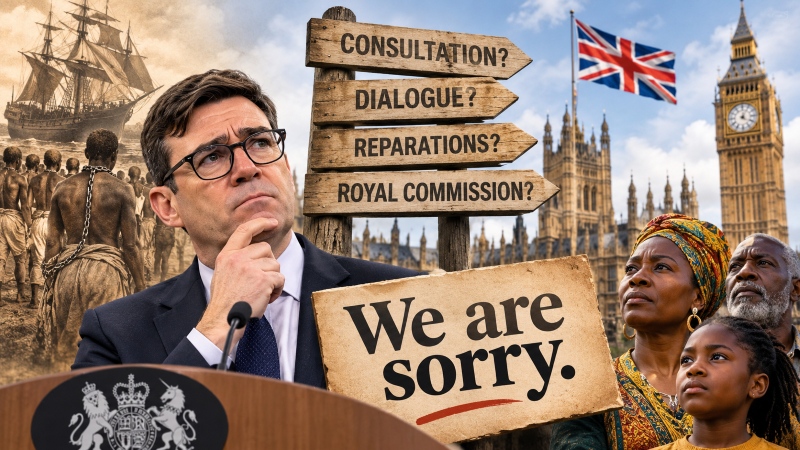
Prime Minister Andy Burnham has declared himself “open” to a formal apology for Britain’s role in the transatlantic slave trade. He is even proposing a structured dialogue with the countries and communities affected so that they can help shape the wording and form of Britain’s eventual apology.
One might have thought that the country which gave the world Shakespeare, Oxford, Cambridge and some of the finest legal minds in history could manage to compose a simple apology without requiring its former colonies to sit on an editorial committee.
What exactly is so difficult about saying: “We are sorry. What our country did was profoundly wrong, and we apologise unreservedly for the suffering, exploitation and injustice inflicted on millions of Africans and their descendants”?
- Sign up for Aliran's free daily email updates or weekly newsletters or both
- Make a one-off donation to Persatuan Aliran Kesedaran Negara (ALIRAN), Maybank a/c 507246118995 or CIMB a/c 8004240948
- Make a pledge or schedule an auto donation to Aliran every month or every quarter
- Become an Aliran member
Apparently, that is asking too much. Instead, we have the carefully calibrated language of political evasion: Britain is “open” to an apology, “listening” to calls for one, and willing to enter into “structured dialogue” about its possible form.
What next? A royal commission to investigate whether the word sorry might cause constitutional indigestion at Westminster?
An apology is not a diplomatic negotiation
Let us be clear. There is nothing wrong with consulting the countries and communities affected by slavery. Their voices should be heard. They have every right to explain what they endured, what they inherited and what they expect from Britain.
But surely consultation should concern the consequences of the injustice and the measures needed to address them, not whether Britain should apologise in the first place.
An apology is an acknowledgement of wrongdoing. It is not a favour bestowed upon the victims after sufficient diplomatic preparation.
Britain does not need the permission of Jamaica, Barbados, Guyana or Ghana to recognise that slavery was a crime against humanity. Nor does it need their assistance to establish that millions of Africans were abducted, transported across the Atlantic, sold as property, subjected to brutal forced labour and deprived of their humanity for generations.
The British state knows what happened. Its archives know. Its universities know. Its museums know. Its historians have written extensively about it.
Britain was not an innocent bystander that happened to witness a regrettable episode in somebody else’s history. British merchants, shipowners, financial institutions, plantation owners and the state itself were deeply involved in a system that generated enormous wealth through human exploitation.
The British Parliament abolished the slave trade in 1807 and slavery throughout most of the British Empire in 1833, with abolition taking effect in 1834 and the transitional apprenticeship system ending in 1838.
But the fact that the formal institution was abolished does not erase the centuries of accumulated wealth, dispossession and human suffering that preceded it. Two centuries have passed since abolition began. That is ample time to learn how to say sorry.
The British taxpayer argument: A convenient escape route
Burnham’s position becomes even more revealing when he turns to reparations. He argues that British people today cannot be held liable for historical wrongs committed in another age, under different laws, in which they played no personal part.
This sounds reasonable until one remembers that the demand for reparations is not primarily a demand to punish individual British citizens for the actions of their ancestors. It is a demand for the British state and the institutions that benefited from slavery to acknowledge their historical responsibilities.
States survive changes of government. Their treaties, debts, property rights and legal obligations do not simply disappear when one generation passes away.
Britain does not cease to own its national heritage, its institutions or the accumulated wealth of its history merely because the people who created them have died.
If the British state can inherit the privileges and assets of its predecessors, why should it be allowed to disclaim all responsibility for their injustices?
And why should the descendants of those who were enslaved be told that history is too old to matter when the economic and social consequences of that history remain visible today?
The argument that present generations were not personally responsible is a convenient way of confusing individual guilt with institutional responsibility.
Nobody is asking today’s British schoolchildren to apologise for their great-great-great-grandparents. The demand is that the British state acknowledge what its predecessors did and consider what justice requires today.
The Mau Mau precedent: Britain can pay when it has to
There is another reason Britain’s refusal to contemplate reparations rings hollow.
In Kenya, victims of British colonial brutality during the Mau Mau uprising have already secured compensation from the British government. The British authorities detained, tortured, castrated and subjected thousands of Kenyans to horrific abuses during the colonial emergency of the 1950s.
The victims’ legal battle eventually forced Britain to confront its responsibility. In 2012 the High Court allowed claims by Kenyan torture victims to proceed, rejecting the government’s attempt to have them struck out on the grounds of the passage of time.
In 2013, the British government agreed to pay £19.9m in compensation to 5,228 Kenyan claimants and expressed sincere regret for the abuses suffered. The settlement was made without an admission of legal liability.
Nevertheless, it established an important precedent: the passage of time does not automatically extinguish every moral or legal claim arising from colonial atrocities.
Of course, the Mau Mau case involved identifiable survivors and specific abuses, whereas the transatlantic slave trade raises much broader questions of historical responsibility, descendants and institutional redress. The legal circumstances are not identical. But the moral question is unavoidable.
If Britain could negotiate compensation for victims of colonial torture in Kenya, why is it so unwilling even to discuss reparatory justice for the victims and descendants of its slave-trading empire?
The government seems perfectly capable of finding money when the legal and political circumstances become sufficiently uncomfortable. Its sudden insistence that historical wrongdoing cannot create present-day responsibilities looks suspiciously selective.
Who really benefited from slavery?
One of the most persistent evasions in this debate is the suggestion that reparations would unfairly burden ordinary British taxpayers for something they did not do.
But the question is not simply who should pay today. It is also who benefited yesterday and who continues to benefit from the structures of wealth and privilege created during the colonial era.
British ports, shipping companies, banks, insurers, merchants and plantation owners, even the royal family accumulated fortunes from the slave economy. The wealth generated by slavery helped finance commercial expansion, industrial development and the growth of British capitalism.
The descendants of enslaved Africans, meanwhile, inherited the consequences of dispossession, forced labour, family separation and racial discrimination.
This does not mean that every British institution today is directly responsible for every historical crime. It does mean that a serious examination of reparatory justice must consider the institutions, wealth and economic relationships that survived the abolition of slavery.
And reparations need not mean simply writing cheques to individuals. They could include educational investment, healthcare, cultural restitution, institutional partnerships, technology transfer, debt relief and development programmes shaped by the countries concerned. These are not acts of charity. They are possible forms of historical repair.
The Caribbean countries have not been asking Britain merely for a few expressions of regret. Their demands, articulated through Caricom and other initiatives, include formal acknowledgement, compensation, debt relief, investment in education and healthcare, cultural restitution and measures to address the continuing inequalities rooted in slavery.
Britain should not presume to dictate what constitutes adequate repair. That is precisely why the affected countries and communities must be involved in determining the appropriate response.
But involving them in shaping reparations is not the same as requiring them to persuade Britain that it should apologise.
Kua Kia Soong, a former MP, is the former director of human rights group Suaram.
AGENDA RAKYAT - Lima perkara utama
- Tegakkan maruah serta kualiti kehidupan rakyat
- Galakkan pembangunan saksama, lestari serta tangani krisis alam sekitar
- Raikan kerencaman dan keterangkuman
- Selamatkan demokrasi dan angkatkan keluhuran undang-undang
- Lawan rasuah dan kronisme