A critical reading of Iman Research’s report Kami Orang Sini Juga: Indian Youths and Democratic Belonging (we belong here too) paints a sobering picture of young ethnic Indians in Malaysia.
The report draws on 111 in-depth interviews with young Indians aged 18 to 35 across the peninsula, including three respondents living abroad.
Many respondents said they felt pushed to the margins by discriminatory schools, a closed job market, an exclusionary rental sector and political tokenism.
Read through a socioeconomic lens, the report is less about cultural grievance. It is more a critique of how class, ethnicity and institutions collide. But remember, the study is qualitative and not nationally representative. Its findings reflect the experiences and perceptions of those interviewed, not hard evidence about all young Indians.
Exclusion starts early
The central finding is that discrimination, as respondents describe it, begins early and can compound over time.
- Sign up for Aliran's free daily email updates or weekly newsletters or both
- Make a one-off donation to Persatuan Aliran Kesedaran Negara (ALIRAN), Maybank a/c 507246118995 or CIMB a/c 8004240948
- Make a pledge or schedule an auto donation to Aliran every month or every quarter
- Become an Aliran member
Some interviewees allege teachers used ethnic slurs in front of students. Others said they were denied leadership positions or matriculation places despite strong results.
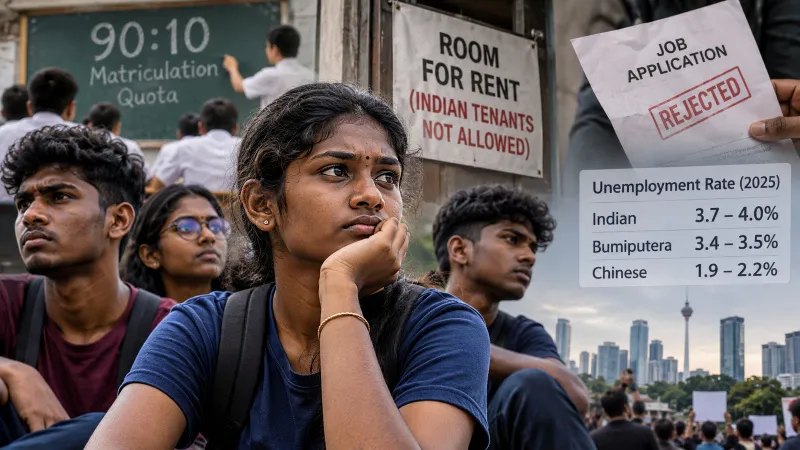
The 90:10 quota for matriculation places, favouring bumiputras over ethnic minorities, remains a central grievance. It hits low-income Indian households hardest, as they cannot easily afford STPM (Year 12-13) alternatives or private colleges.
The result can be a trap. Poor young Indians may be pushed away from institutions meant to widen access to higher education.
Class, jobs and trust
This exclusion follows many into adulthood. An Architects of Diversity study cited in the report found that 31.7% of room-rental listings on iBilik in the Klang Valley explicitly excluded ethnic Indian tenants.
Some youths said they lost jobs after managers learnt their ethnicity. Others said landlords charged higher deposits, assuming Indians were bad payers. These accounts reflect interviewees’ experiences and perceptions.
The Department of Statistics’ 2025 quarterly labour force survey tables show ethnic unemployment rates of 3.7-4.0% for Indians, 3.4-3.5% for bumiputras and 1.9-2.2% for Chinese.
These figures are not abstract. They provide a wider labour-market context for the experiences described in the report.
Though unemployment stood at 3.0% in 2025, youth unemployment among 15-24-year-olds stood at 9.6%, or 272,000 people. This was 3.2 times the national rate. The figures covers all young people, not just Indians.
Insecurity is part of the picture. Think of gig work without EPF retirement benefits and Socso accident cover, unpaid internships, and graduates in jobs below their skills.
In my view, this acts as a structural mechanism (a “reserve army of labour”) that keeps wages down. I would argue also that Malaysia’s ‘ethnocapitalism’ and elite patronage make things worse.
Yet the most striking socioeconomic finding is internal. The report says the top 20% of Indian households hold 44.1% of the community’s income in 2024, while low-income Indians bear the brunt of discrimination.
Middle-class young Indians can retreat to English-speaking networks, private tutoring and family resources. Poor young Indians cannot.
This contrast highlights why Indian Malaysians should not be treated as a homogeneous community. Discrimination cuts across the community, but its consequences are shaped by household income, education and access to social networks.
The report also highlights gang recruitment as a risk for vulnerable youths. It describes boys as young as 13, lacking positive role models, being pulled into gangs. These groups may promise money, brotherhood and a faster route up.
Class also operates within the community through language and caste, interviewees said. English-speaking youths may be marked as ‘atas’ (upper-class), while Tamil speakers may carry the stigma of the plantation past. These are social patterns identified in some interviews, rather than universal characteristics of Indian youths.
The report also identifies caste divisions within the Indian community, including their influence on marriage choices and social relationships. Although many younger Indians reject caste distinctions, these divisions have not entirely disappeared.
Politically, young Indians are drifting away from ethnic-based parties. The Malaysian Indian Congress (MIC) won one parliamentary seat in the 2022 general election. Interviewees perceive the party as captured by caste networks and personal rivalries.
Analyses by the S Rajaratnam School of International Studies (RSIS) and UCA News describe the Hindu Rights Action Force (Hindraf) protests of 2007 as a major turning point.
Hindraf emerged from a coalition of Indian NGOs and included prominent Tamil lawyers. It protested poverty, limited educational opportunities, religious-conversion disputes, and the demolition of Hindu temples.
These days, many young Indians view the Malaysian Indian Transformation Unit (Mitra) as opaque, underfunded and bureaucratic.
For these respondents, trust in political institutions is seriously eroding, and several said they would not vote in the next general election.
Pakatan Harapan drew broad multiracial support in the 2018 general election, including from reformist-minded Indian voters. So, this erosion of trust is a warning it cannot ignore.
What needs to change
The report’s eight recommendations are largely sound.
Anti-discrimination legislation covering employment, housing and education is long overdue.
Shifting the matriculation quota from ethnicity to financial need would address a long-standing equity concern. It would, however, require more policy detail on political and legal feasibility, and on how need would be assessed.
Transparency in Mitra funding, formal channels to report racial incidents in schools and civic-education programmes are sensible measures. They match the realities described in the interviews.
But the recommendations stop short of the deeper class question.
If the top 20% of Indian households hold 44.1% of community income, redistribution within the community matters as much as state action across all communities.
Mitra’s RM150m allocation for 2026, up from RM100m, is significant. But, in my view, it may still fall short of what is needed for mentorship, skills training and rental assistance for low-income Indian youths.
Civil society organisations such as Minda, mentioned in the report, already do this work, but their reach may be limited and their capacity needs to be assessed.
A democratic test
A socioeconomic reading of Kami Orang Sini Juga suggests the Indian youth question is not a side issue. It is a measure of whether Malaysia’s plural society can offer dignity to all its people.
It is a question of social conscience, not just for those protected by class, ethnicity or political connection.
Addressing the concerns of young Indians is a matter of social justice and a democratic necessity.
AGENDA RAKYAT - Lima perkara utama
- Tegakkan maruah serta kualiti kehidupan rakyat
- Galakkan pembangunan saksama, lestari serta tangani krisis alam sekitar
- Raikan kerencaman dan keterangkuman
- Selamatkan demokrasi dan angkatkan keluhuran undang-undang
- Lawan rasuah dan kronisme