Atul Chandra
On Sunday, as Southeast Asian leaders gathered in Manila for the 49th Asean summit, the Philippine police carried out what activists call the largest single-day crackdown in decades of Ferdinand Marcos Jr’s presidency.
At Sucat People’s Park in Muntinlupa, a designated freedom park, police took more than 300 people into custody. Eight more were seized at Liwasang Bonifacio in Manila as they tried to march towards the summit venue. TV footage showed police brutally arresting and detaining them. The National Union of Journalists of the Philippines (NUJP) says at least 22 media workers who were covering the protests were harassed.
Who were they? Farmers, students, indigenous people and workers. What united them was a demand that the guest of honour of the Asean conference would rather not hear: scrap ‘Pax Silica’.
President Donald Trump landed in Manila on Tuesday, 17 November. It is his first visit since 2017, and nearly 20,000 police officers have been deployed across the capital to receive him and other Asean leaders. He is expected to pressure Southeast Asian governments to join Pax Silica.
- Sign up for Aliran's free daily email updates or weekly newsletters or both
- Make a one-off donation to Persatuan Aliran Kesedaran Negara (ALIRAN), Maybank a/c 507246118995 or CIMB a/c 8004240948
- Make a pledge or schedule an auto donation to Aliran every month or every quarter
- Become an Aliran member
To understand why so many Filipinos are willing to be arrested to stop it, we must go back to 1991.
That year, the Philippine Senate did something few small nations dare to do. It voted to end the Treaty of Friendship, Cooperation and Security that allowed the US to keep military bases on Philippine soil. That same year, Mount Pinatubo erupted and buried Clark Air Base under ash. By the end of 1992, the last American warships had sailed out of Subic Bay.
For a generation, Filipinos told this story with pride. The bases were gone.
Thirty-five years later, the Americans are returning to Clark. This time, they are bringing data centres.
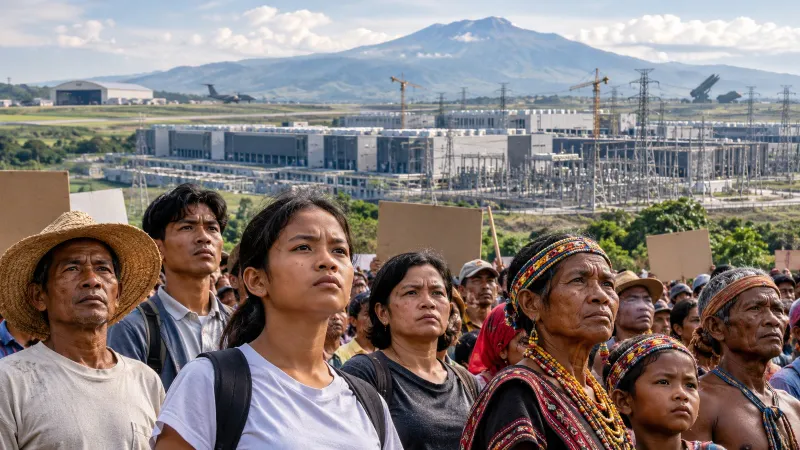
Pax Silica’s first physical project is around 4,000 acres for an AI industrial hub at Luzon Economic Corridor, on part of the old Clark air base.
Under pressure from the streets, US Ambassador to the Philippines Lee Lipton now says no announcement will be made at the summit, and Manila hopes to sign before the year ends. The deal has been delayed.
But Sunday’s arrests show how far the government will go to keep it alive.
A peace written in Washington
The US State Department launched Pax Silica in December 2025. It brings together the countries that matter in the ‘silicon stack’: the mines, power plants, chip factories, computing centres and AI models on which the digital economy runs.
About two dozen governments have signed, from Japan and South Korea to India, Israel and Kazakhstan.
The name is no accident. Pax Romana was the long ‘Roman peace’ that began in 27BC, imposed on the Mediterranean world by Rome’s legions and paid for by tribute from conquered provinces.
Pax Britannica was the century after 1815, when the Royal Navy ruled the seas and Britain’s empire stretched from India to Africa.
Pax Americana is the order the US built after 1945, resting on the dollar and on hundreds of military bases around the world.
Those at the centre called each of them peace. For those at the edges, they meant conquest, plunder and wars fought far from the imperial capital.
Pax Silica openly claims a place in this line.
The man who drew up this one is Jacob Helberg, the State Department’s Undersecretary for Economic Affairs. Before taking office, he was a senior adviser to the chief executive of Palantir, the company that builds surveillance and targeting software for armies and spy agencies.
Pax Silica was born where Silicon Valley meets the security state.
The official story is that Pax Silica protects supply chains from China, as evident with the term ‘coercive dependencies’.
This argument gained more strength with a Reuters report revealing a draft State Department letter to 35 countries warning them against “duplicative initiatives whose expectations conflict with our own”.
The terms of loyalty are strict. The immediate target is China’s new World Artificial Intelligence Cooperation Organization (Waico). But the message reaches every partner. Your choices are no longer entirely your own. This is the old politics of the client state, rewritten for the age of AI.
That is part of the truth, but only part. Its deeper purpose is to decide who controls the technologies of the coming century, and on whose terms.
Inside the bloc, the roles are already fixed. Washington and its tech giants keep the most advanced AI models, write the standards and hold the off switch. Partners provide the land, the water, the minerals and the labour. Critics warn this creates a trap of ‘trusted interdependence’.
The bases come back
Return now to Clark and look at the map around it.
The Port of Subic Bay, once one of the largest US naval bases overseas, has been named the official maritime gateway for Pax Silica.
Further north lie the military sites that US forces use under the ‘Enhanced Defence Cooperation Agreement’. There are now nine of them. A US Typhon mid-range missile system has been stationed on Luzon since April 2024, and during this year’s Balikatan war games US anti-ship missile launchers were set up at one of these sites.
Philippine officials insist that the AI hub is purely commercial.
But commerce and war are hard to separate when the goods are chips and critical minerals. Rare earths guide missiles. Semiconductors fly drones and run radars.
Manila’s new rules on critical minerals could open about nine million hectares to mining exploration.
This is why the people’s alliance Bayan calls Pax Silica war production disguised as development.
China is the obvious rival in this design, and Washington makes no secret of it.
Yet the logic of empire runs wider than any single rival. The US wants Asia’s land, labour, minerals and loyalty organised around its own arms industry and tech monopolies, whoever the enemy of the day may be.
The membership list reflects that. Israel, a founding signatory, has used AI targeting systems in its war on Gaza. Kazakhstan holds vast mineral wealth on China’s western border. Singapore guards the Strait of Malacca.
These are not simply markets. They are chokepoints, mines and frontlines.
Who pays the price
The price is being paid first in Tarlac. As reported, in the village of Sapang Kawayan, about 200 Aeta families have received letters from the state developer telling them they must relocate.
The Aeta are the Indigenous people of the Pinatubo foothills, and many were driven from their homes once before by the eruption of 1991.
“They should just have us killed because we will fight for our land,” said Casamira Capiz Maniego, who is 72.
The Bases Conversion and Development Authority (BCDA) insists only 40 households are affected and that no one “will be displaced”.
The land is only the beginning. According to Mongabay, the hub would need about three gigawatts of electricity and between 60 and 90 million litres of water every day.
Filipinos already pay the highest household electricity rates in Southeast Asia.
Farmers nearby fear for their water in the dry season, and environmental groups say the authorities have produced no hydrological studies.
Opposition now reaches far beyond the left.
Caritas Philippines, the social action arm of the Catholic Church, opposes the hub in its present form.
Bishop Gerardo Alminaza says the project is being rushed, with too little consultation with the Aeta.
The mayor of Capas, the town that would host the hub, says local officials were never consulted.
When consultation is missing, coercion fills the gap. In September, police arrested five paralegals and detained nearly 30 people outside a hotel hosting a Pax Silica forum.
Sunday’s mass arrests are the same pattern on a larger scale. An empire that needs cheap land and quiet communities abroad also needs governments willing to silence their own people.
This is the old bargain of the empire in new clothes. The land, the water and the labour come from the South. The profits, the patents and the power stay in the North.
None of this means the Global South should turn its back on technology. Developing countries need chips and AI.
But they need them on their own terms, through technology transfer, public investment and cooperation among themselves, and with the consent of the communities whose land and water are at stake.
Pax Silica offers none of this. Southeast Asia knows that refusal is possible. Of the eleven Asean members, only Singapore and the Philippines have joined.
In 1991 Filipinos showed the world that foreign bases could be sent home.
The farmers, students and Aeta who filled the jails of Metro Manila on Sunday are carrying that memory forward. They are not against technology. They are against being made the raw material of someone else’s empire. – Globetrotter
Atul Chandra is the Asia co-coordinator of Tricontinental: Institute for Social Research.
AGENDA RAKYAT - Lima perkara utama
- Tegakkan maruah serta kualiti kehidupan rakyat
- Galakkan pembangunan saksama, lestari serta tangani krisis alam sekitar
- Raikan kerencaman dan keterangkuman
- Selamatkan demokrasi dan angkatkan keluhuran undang-undang
- Lawan rasuah dan kronisme