
Nasha Rodziadi Khaw
To understand Malaysia’s place in today’s Indo-Pacific, it helps to look back at the history of maritime Southeast Asia.
The country sits between the Indian and Pacific oceans, straddling the Straits of Malacca and the South China Sea. This position has long given Malaysia a strategic role built on connectivity and exchange (Mohd Yusri, 2023).
The Sultanate of Malacca sat in the same strategic space. Its rise depended on regulating trade, building varied external relations, and positioning itself well within overlapping regional systems (Nasha, 2022).
Ancient Malacca kept ties with Ming China, Siam, Majapahit, neighbouring Malay states and Indian Ocean trading communities. Meanwhile, it held onto real political flexibility amid shifting geopolitical conditions. Today’s Indo-Pacific reflects similar interconnected dynamics.
- Sign up for Aliran's free daily email updates or weekly newsletters or both
- Make a one-off donation to Persatuan Aliran Kesedaran Negara (ALIRAN), Maybank a/c 507246118995 or CIMB a/c 8004240948
- Make a pledge or schedule an auto donation to Aliran every month or every quarter
- Become an Aliran member
Malaysia and the Indo-Pacific conventional frameworks – non-alignment, balancing, hedging and middle-power diplomacy – help explain Malaysian foreign policy. But they do not fully capture how states simultaneously deal with rival powers across several domains: strategic, economic, institutional and diplomatic.
Frameworks built around rigid alliances and major-power rivalry oversimplify the Malaysian case. They fail to take into account the historical reality of maritime Southeast Asia. Authority in this region has long worked through layered relationships, trade interdependence, selective alignments and adaptive dealings with several outside powers.
The Indo-Pacific is largely a geopolitical construct shaped by major-power competition. Malaysia has to navigate it with vigilance and flexibility, with full situational awareness (Tharishini, 2023).
This is where strategic multi-alignment comes in – a useful way to frame Malaysia’s current foreign policy.
Conventional hedging is mainly about managing risk amid uncertainty between rival major powers (Kuik, 2022, 2023).
Strategic multi-alignment goes further. It means actively managing different relationships across several domains at once: strategic, economic, institutional, technological and societal.
It rests on compartmentalised engagement, network diplomacy and varied external links that keep room to manoeuvre without locking Malaysia into any single geopolitical bloc.
This approach is an expression of Malaysia’s longer maritime strategic culture – one that is shaped by maritime statecraft and varied external engagements as an intermediary power within competing maritime environments.
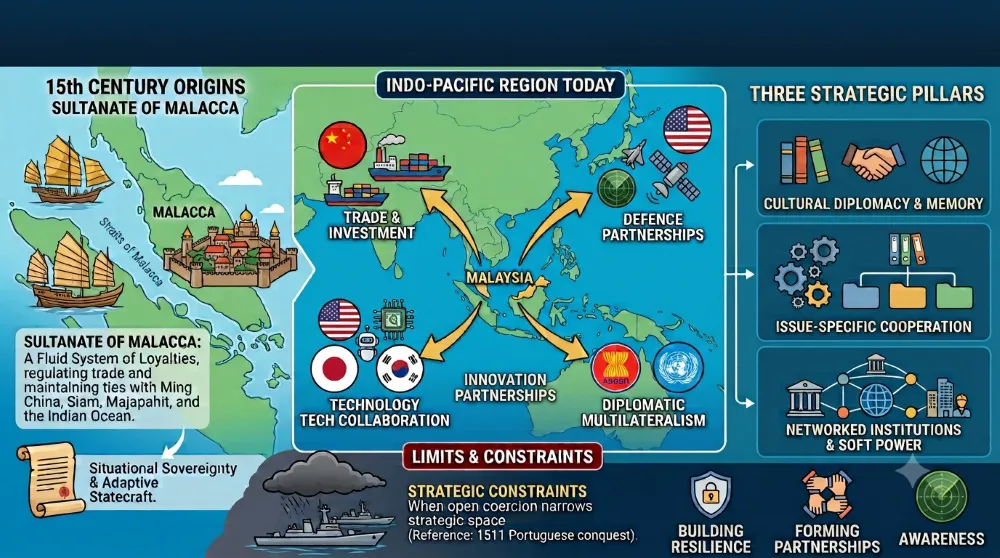
Malaysia’s role today is easier to grasp through the historical experience of the Sultanate of Malacca. Malacca was never a centralised empire. It operated instead as a fluid system of loyalties between allied ports, located along critical sea lanes (Nasha, 2022).
Malacca’s rise in the 15th Century depended on controlling the movement of people and goods across the Straits of Malacca and the South China Sea. It did this while maintaining ties with the major regional powers of the day.
In maritime Southeast Asia, tributary ties and overlordship worked through negotiated relationships, symbolic recognition, shifting loyalty and flexible hierarchies rather than permanent outside domination.
Even within China’s wider tributary system, most Southeast Asian states kept real autonomy over their own affairs, external relations and regional networks. Historical actors were often pragmatic, reactive and adaptive rather than following a grand strategy.
Even so, broader patterns hold: situational sovereignty, varied external engagement and managing regional traffic within competitive maritime environments. These patterns matter because present behaviour still carries echoes of centuries of maritime statecraft.
In today’s Indo-Pacific, rivalry between the United States and China increasingly shapes the region (French Government, 2025).
China’s economic scale, technological reach, infrastructure investment and growing maritime presence have made it central to Southeast Asia. For many states, China is at once an economic partner, a source of investment, a technology collaborator – and a strategic worry.
The US, meanwhile, generally remains the main security actor through its regional defence partnerships.
Yet Southeast Asian states rarely see regional dynamics as a simple choice between alignment or confrontation.
For Malaysia, China is a longstanding presence connected to maritime Southeast Asia through trade, diplomacy, migration and cultural exchanges stretching back almost two millennia (Wade, 1997). This complexity calls for a strategy built on flexibility and calibrated engagement.
History backs this up. Malacca survived by constantly adjusting its relationships as conditions shifted (Nasha, 2022).
Malaysia today faces similarly fluid circumstances, involving overlapping institutions, competing powers, economic interdependence and security challenges on several fronts.
Strategic multi-alignment continues a tradition of adaptive maritime statecraft that needs constant recalibration, varied partnerships and careful protection of room to manoeuvre.
Putting multi-alignment into practice
Narrative-building and cultural diplomacy
Narratives shape how states read geopolitical reality (Kuik, 2023), define national identity and legitimise foreign policy choices.
Perceptions, historical memory and political identity all shape how states judge legitimacy and create expectations of behaviour.
Cultural diplomacy is a way these narratives take shape, beyond official channels alone (Goff, 2013). Historical narratives can travel through educational exchanges, academic collaboration and maritime heritage projects.
This engagement opens channels outside formal diplomatic channels. It keeps relationships functional even during geopolitical tension. Over time, this builds goodwill, institutional familiarity and people-to-people links.
Carefully shaped public narratives also create domestic space for a diversified foreign policy by framing strategic multi-alignment as a historically rooted tradition.
Compartmentalised engagement
In practice, foreign policy emerges from diverse institutions, bureaucracies and economic sectors – all pursuing different priorities at the same time.
This is why strategic multi-alignment works through compartmentalised engagement across different domains. Various institutions within the state can pursue distinct forms of engagement depending on their priorities.
This allows states separate areas of disagreement from areas of cooperation, allowing practical engagement to continue despite broader political differences (Dogan-Akkas, 2026).
At the same time, states hedge to manage risks, while balancing when needed against imminent threats or excessive outside pressure (Kuik, 2022).
This differentiation creates space for issue-specific engagement across economic, technological, diplomatic and security sectors.
Malaysia can deal with different powers across distinct domains without letting any single relationship dominate its foreign policy. Economic ties with China, security cooperation with the US, and technology partnerships with Japan and South Korea add up to a differentiated approach.
This approach allows Malaysia to engage multiple centres of power at once. It preserves its policy autonomy and reduces dependency on any single actor.
Layered diplomacy network
Strategic multi-alignment increasingly goes beyond formal state-to-state diplomacy into multiple institutional and societal layers.
Universities, think tanks, business communities and quasi-state actors all play a growing role in building long-term strategic familiarity and trust.
This reflects how the Indo-Pacific has become more polycentric, with influence spread across overlapping economic, intellectual and institutional networks rather than concentrated in formal interstate structures alone.
Through such networks, states can keep dialogue going even amid wider geopolitical tension. Influence comes from network density, institutional embeddedness and the ability to shape strategic narratives.
States that build broad diplomatic, academic, cultural and institutional links often gain influence disproportionate to their material power by acting as trusted intermediaries.
Historical memory, cultural diplomacy and heritage cooperation have become important tools for Malaysia. They reinforce the nation’s go-between role without it becoming structurally dependent on any single major power.
Limits and constraints
History shows that diplomatic flexibility alone cannot guarantee long-term resilience.
The fall of Malacca to the Portuguese in 1511 shows the limits faced by go-between maritime states when confronted by heavily militarised, expansionist powers willing to use concentrated force beyond regional norms.
The arrival of European powers transformed maritime Southeast Asia, forcing regional states to rethink survival strategies.
Successor states successfully negotiated with competing Western actors for a time. But the growing militarisation of trade steadily narrowed their strategic space.
This shows that compartmentalised engagement and strategic flexibility work best when geopolitical competition stays below the threshold of open coercion. Such approaches depend on competing powers being willing to operate within relatively stable diplomatic and institutional environments.
Once rivalry becomes militarised through naval intimidation or economic coercion, problems arise. Small and middle powers come under real strain with reduced bargaining leverage. In such cases, calibrated engagement alone may no longer be enough to preserve autonomy.
Strategic multi-alignment is not passive neutrality. It is a strategy that needs continuous adaptation, institutional resilience and credible deterrence. It need partnerships that balance national security with long-term stability.
It also has practical red lines. Becoming too dependent on any single power in sensitive areas – such as defence procurement, digital infrastructure or technology networks – can gradually erode strategic autonomy. This then creates the perception of political alignment.
States must manage material dependencies, geopolitical perceptions and diplomatic signalling, guided by situational awareness.
Long-term resilience needs varied partnerships and diplomatic agility through bilateral and multilateral platforms. This would allow states to respond to changing realities without becoming locked into any single strategic bloc.
Final thoughts
Understanding Malaysia’s foreign policy means going beyond conventional frameworks like non-alignment, balancing or hedging.
The Sultanate of Malacca shows that power often rested on managing internal networks, sustaining varied external relationships and keeping diplomatic flexibility within an interconnected environment.
Strategic multi-alignment is the modern expression of this longer maritime culture. Its practice depends on compartmentalised engagement, network diplomacy, narrative-building and layered networks that go beyond formal state-to-state relations.
That said, we must acknowledge the structural limits on flexibility. History shows that go-between maritime states remain vulnerable when confronted by heavily militarised forms of outside power that disregard diplomatic norms.
Today’s Indo-Pacific shows similar strategic reality: compartmentalised engagement works best before geopolitical competition turns into open hostility.
Strategic multi-alignment is a diplomatic posture that needs institutional resilience, varied partnerships, credible deterrence and careful management of external dependencies.
Its success ultimately depends on agility, situational awareness and enough flexibility to survive intensifying rivalry.
Dr Nasha Rodziadi Khaw is currently an associate professor and exercises the function of director of the Centre for Global Archaeological Research at Universiti Sains Malaysia.
AGENDA RAKYAT - Lima perkara utama
- Tegakkan maruah serta kualiti kehidupan rakyat
- Galakkan pembangunan saksama, lestari serta tangani krisis alam sekitar
- Raikan kerencaman dan keterangkuman
- Selamatkan demokrasi dan angkatkan keluhuran undang-undang
- Lawan rasuah dan kronisme
