
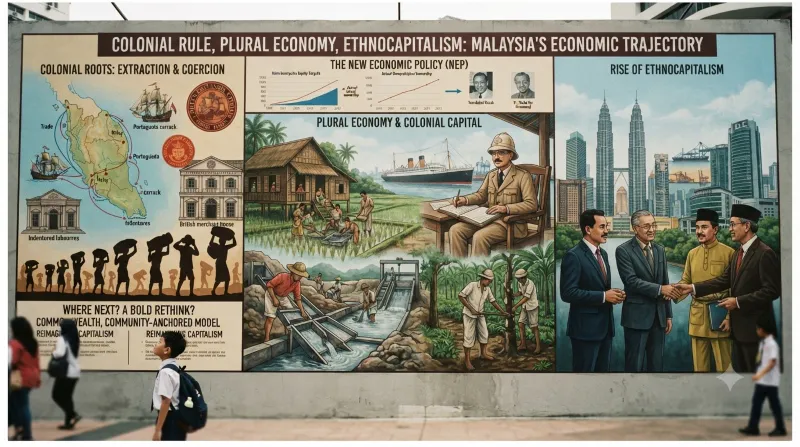
Malaysia’s political economy can be better understood in the context of its colonial inheritance.
British colonial rule built a plural economy. Ethnic identity was often mapped onto economic roles. The ethnic Malays were concentrated in rural, agrarian subsistence, with significant numbers of migrant Chinese and Indian labour employed in the extractive and commercial sectors.
This was not just an administrative convenience. It was a structural feature of colonial capitalism, designed to keep a disciplined labour force and to stop a unified anti-colonial movement from taking shape.
Colonial roots
The roots of this capital intrusion into Malaysia go back to the era of imperial expansion and mercantilism.
Portuguese plantation capitalism in Madeira formed part of this wider imperial history. This was later transferred to Malacca’s spice-based maritime trade after its conquest in 1511.
- Sign up for Aliran's free daily email updates or weekly newsletters or both
- Make a one-off donation to Persatuan Aliran Kesedaran Negara (ALIRAN), Maybank a/c 507246118995 or CIMB a/c 8004240948
- Make a pledge or schedule an auto donation to Aliran every month or every quarter
- Become an Aliran member
This was institutionalised further by the Dutch East India Company, whose ‘state within a state’ corporate structure marked the region’s early experience of global capitalist enterprise.
British colonialism then deepened this trajectory, embedding mercantile capitalism more aggressively into Malaya’s governance and economy.
Through the exploitation of plantation resources and the systematic use of indentured, contract and coercive migrant labour in the peninsula, Sarawak and North Borneo, British rule enforced an imperial capitalist mode of accumulation marked by coercion and extraction.
Rise of ethnocapitalism
The post-colonial era saw a shift from foreign-dominated capitalism to what might be called ‘ethnocapitalism’ – a form of state-mediated capitalism in which bumiputra advancement was often pursued through affirmative action policies, government-linked companies, privatised entities and state enterprises.
Critics argue that these arrangements sometimes fostered rent-seeking and clientelism, particularly where access to contracts, licences and state assets depended on political connections.
This shift gathered pace after the Guthrie Dawn Raid – a landmark moment in economic nationalism when control of the British-owned Guthrie plantation group passed into Malaysian hands.
But this nationalist push soon turned into an economic structure dominated by a politically connected ethnic capitalist class. This was the creation of bumiputra ethnocapitalism.
The New Economic Policy, introduced in 1971, was meant to fix economic disparities between ethnic groups. Its stated objectives were poverty eradication irrespective of race and the restructuring of society to reduce the identification of race with economic function.
In practice, it entrenched access for a class of Malay capitalists, often sidelining poorer members of the bumiputra community itself, according to many critical scholars.
The policy gave significant advantages to affluent bumiputras, notably through quotas in public company equity and preferential access to property and other business opportunities. Official narratives argued that these measures were necessary for equitable development.
But data from the Asian Strategic and Leadership Institute (Asli), the University of Malaya, and Singapore’s Iseas-Yusof Ishak Institute have been cited to suggest that bumiputra equity ownership had reached or exceeded its targets decades earlier. Such claims remain contested because estimates vary according to definitions, valuation methods, nominee ownership and whether government-held assets are included.
The policy continued anyway, with some analysts arguing it benefited a select group of elites while structural poverty went unaddressed.
Privatisation in the 1980s and 1990s, driven by the first Mahathir Mohamad administration, deepened this rentier-clientelist capitalism further, according to this analysis. A string of government bailouts for failed privatisations disproportionately benefited politically connected bumiputra tycoons.
Meanwhile, scholars have noted the irony that Malaysia remains dependent on foreign multinationals despite the nationalist rhetoric.
The state’s role in economic centralisation stayed intact, now channelled through government-linked investment companies. These institutions can concentrate ownership and influence, though their legal forms and mandates differ considerably.
The ‘seven sisters’ together manage an estimated RM2tn in assets, though totals vary depending on which entities and assets are counted. They are Minister of Finance Inc, the Employees Provident Fund, Permodalan Nasional Berhad, Khazanah Nasional Berhad, Retirement Fund Inc (KWAP), the Armed Forces Fund Board (LTAT) and the Hajj Pilgrims Fund Board (Tabung Haji).
Estimates of capital accumulation, once robust at 16% a year between 1989 and 1997, slowed sharply to 6% a year between 1999 and 2019. Studies have estimated that rent-seeking behaviour may have cost Malaysia over 2% of gross domestic product (GDP), depending on the methodology used.
After the 1997 Asian financial crisis, the IMF and other economists recommended structural reforms to strengthen the banking and corporate sectors, improve corporate governance and transparency, and promote competition and efficiency.
Although Malaysia implemented significant financial sector reforms, progress on some broader reforms remained partial or contested.
The lasting influence of neoliberal economic thinking – introduced through Harvard’s Development Advisory Service and reinforced by bodies like Pemandu, formed in 2009 with McKinsey’s help – has been argued to have kept Malaysia dependent on market-oriented technocratic fixes. These often reinforce, rather than dismantle, ethnocapitalist and clientelist frameworks.
Policy models since the NEP, including the Bumiputera Prosperity Council, further entrench these patterns under the guise of inclusive growth, in the view of some observers.
Even PuTERA35, the bumiputra economic transformation plan, faces criticism. Launched in 2024, the plan sets out 132 initiatives across 12 growth drivers. It targets bumiputra equity ownership, skilled employment and control of government-linked companies and investment funds.
Researchers have argued that the plan’s core weaknesses lie in its structural premises, execution risks and policy contradictions.
The plan has been criticised for insufficiently specifying how it will support micro, small and medium enterprises (MSMEs), which contributed 39.5% to national GDP – worth RM652bn – and accounted for 48.7% of total employment or 8.1 million workers in 2024, according to the Department of Statistics.
Where next?
Malaysia now stands at a critical juncture. Critics argue the current set-up – dependency-driven state capitalism propped up by rentier and cronyistic logic – has not consistently delivered sustainable, equitable development.
James Puthucheary’s 1960 study Ownership and Control in the Malayan Economy remains a starting point. So does later work on colonial surplus extraction and Malaysia’s economic development – including the transfer of profits, dividends, interest, remittances and other economic surpluses from Malaya to overseas interests – by economists and historians such as Jomo Kwame Sundaram, Alec Gordon, Sultan Nazrin Shah, John Drabble and Prema-chandra Athukorala.
Proposed alternatives must move beyond ethnonationalist capitalism toward a common-wealth, community-anchored model. Possibilities include elements of Kerala’s decentralised social welfare model, Venezuela’s community communes – though these would require careful adaptation – or a Malaysian variant rooted in the Bangsa Malaysia ideal.
Many of today’s development economists were trained in the UK or the wider Commonwealth.
Few studied anti-imperialism at Lumumba University in Moscow or engaged closely with the Nordic social democratic model of the Stockholm School, notably associated with Karl Gunnar Myrdal, Erik Robert Lindahl, and Bertil Gotthard Ohlin. And few engaged with South America’s liberation theology and its “option for the poor”. Only recently have graduates emerged from medical schools in Cuba and China, representing a narrow but notable shift.
These traditions, among others, could offer a better understanding of foreign capital exploitation and social struggle.
A broader mix of economic development approaches could include ‘targeted area poverty alleviation objectives’ – a rights-based, participatory framework in which resource ownership and decision-making are democratised.
This kind of transformation needs more than policy tweaks. It calls for reimagining capitalism not as elite privilege, but as a shared socioeconomic compact built on justice, inclusion and sustainability.
A cooperative movement, working through the state, is worth considering – especially if paired with artificial intelligence and an input-output-outcomes-impact approach to speed up social and economic development.
A bold rethink is needed – not least on the ownership and governance of Khazanah, Petronas and Telekom, including whether they should be restructured as national entities that drive real socioeconomic activity.
AGENDA RAKYAT - Lima perkara utama
- Tegakkan maruah serta kualiti kehidupan rakyat
- Galakkan pembangunan saksama, lestari serta tangani krisis alam sekitar
- Raikan kerencaman dan keterangkuman
- Selamatkan demokrasi dan angkatkan keluhuran undang-undang
- Lawan rasuah dan kronisme






A stark absence of analysis on ethno-capitalism of the Chinese version in Malaysia. Just look at the Forbes list of Malaysian richest. The author is a retired Chinese academic, still cant get away from his ethnic prejudices and frustrations. A waste of ALIRAN magazine space.