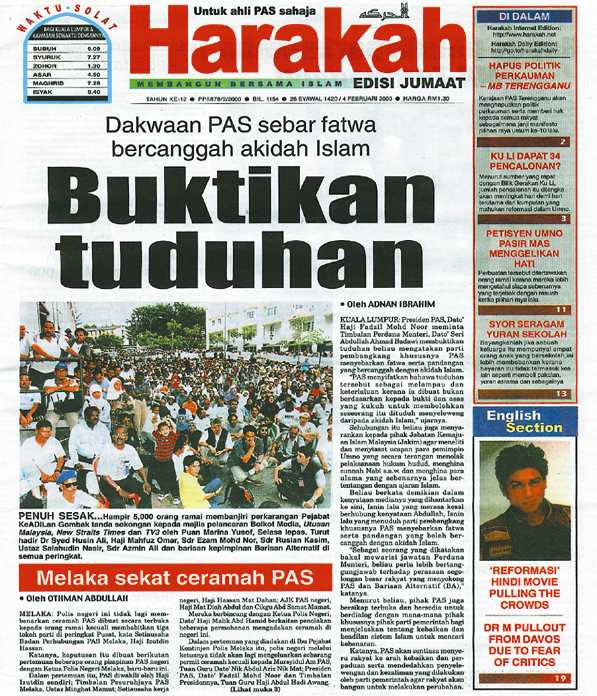
Harakah
Malaysians hungry for alternative views will continue to be drawn to the popular tabloid despite the latest curbs
By Dr Mustafa K Anuar
|
For a variety of reasons, Harakah, the political organ of PAS, has become the darling among many Malaysians over the last few years. Concerned citizens prefer the tabloid to the pliant mainstream press for its incisive analyses, lively letters’ column, and a fair degree of journalistic credibility.
The Malaysian government, on the other hand, wants to curb Harakah purportedly to maintain unity in a divided Malay community and to block the Opposition from allegedly lying, slandering and smearing the country’s image. So it did not come as a surprise when, on 1 March 2000, Harakah was slapped with a virtual ban, its frequency of publication slashed from twice a week to twice a month - a whopping 75 per cent cut.
Spurious Justification
Government leaders offered two reasons to justify the revised conditions in Harakah’s newly approved publishing permit. The first: that the Harakah publisher had violated the condition of the permit restricting its sales to PAS members only. They argued that as Harakah was found to have flouted this ruling on a number of occasions, the publisher had to be "gently" punished.
The other reason given was that Harakah’s frequency had to be cut to twice per month so that some sort of "standardisation" could be achieved by putting Harakah on par with other less frequently published party organs.
Such reasons should be closely scrutinised. Political organs such as Harakah should not be confined to party members only. In a democracy, a political party should have the right to propagate its ideology, policies, and programmes to as many people as possible, irrespective of their political or ideological leanings. Political parties must have sufficient democratic space to contest on a level playing field. These parties should be allowed to freely disseminate their ideas not only through their respective party organs but also through other media.
A political party should also have the right to decide on the frequency of its newsletter. That should hinge on important factors such as the party’s financial capacity, human resources and political priorities. It should not be fixed by a Home Ministry decree aimed at "streamlining" political mouthpieces.
If political organs are only allowed to publish twice a month, then the country’s mainstream newspapers such as Utusan Malaysia, New Straits Times, The Star, Berita Harian, and The Sun must adhere to this new ruling. This is because they have, by and large, been acting more like BN mouthpieces.
Punishing the Culprits
So what are the real reasons for the curbs on Harakah? Well, the ruling coalition, especially UMNO, has probably identified the bilingual tabloid as the main "culprit" responsible for dwindling popularity of UMNO amongst the Malay community. Some in UMNO have even claimed that PAS, via Harakah, has sown seeds of disunity among the Malays.
This kind of warped logic fails to see the real reasons for Harakah’s popularity and UMNO’s eroding support among the Malays. Disenchanted Malays, put off by the harsh ouster of former deputy prime minister Anwar Ibrahim, have found Harakah to be a useful platform to air their views, frustration, and even helplessness. There have been strident calls for justice, fairness, and political reforms across the nation and these issues have filled the many pages of Harakah.
It is not only many Malays who have turned to Harakah to satisfy their intellectual and political yearning. Many non-Malays, too, have found themselves drawn to the publication - a phenomenon that certainly has raised eye-brows among BN politicians. A glance at the political analyses and readers letters, especially in Harakah’s English Section, reveals the rapport that has developed between the publication and its non-Malay readers. For it is here that issues and problems associated with the non-Malay community - the very stuff that most of the mainstream press shy away from - have been highlighted and intensely debated. In other words, Harakah has provided democratic space for many non-Malays to express themselves as citizens living in a democracy are entitled to.
In many ways, Harakah has given many Malaysians a taste of what press freedom is about. That has contributed to Harakah’s soaring circulation (at least before the latest curb) and the flagging popularity of the somewhat Jurassic mainstream press. Some analysts have speculated that the new ruling was meant to help shore up the troubled circulation of a number of affected mainstream newspapers while curtailing Harakah’s sales and profits.
Exacerbating Matters
Restricting Harakah will not solve UMNO’s problems. If anything, it will only exacerbate matters for not only UMNO members but also other Malaysians. The virtual ban on Harakah means that a platform for Malaysians to air their legitimate grievances and views has been almost blocked. Interaction between the people and government leaders becomes less, and the gap between the two sides widens dangerously.
More than that, the legitimate right of Malaysians to express themselves, to rationally discuss issues, and to air dissenting views in a civilised manner has been curbed using the archaic Printing Presses and Publications Act. Seen in this light, the Act is indeed contemptuous of the human mind and inimical to intellectual development in our society.
This law is a British legacy that has been steadfastly maintained and promoted by a self-proclaimed nationalistic government that purports to be a leader among countries of the South. It certainly doesn’t ‘jive’ with the government’s oft-pronounced goal of bringing Malaysia into the forefront of the so-called information revolution via the Multimedia Super Corridor (MSC) project and Information Technology, which thrives on the free-flow of information.
Malaysians will continue to look for other sources of information apart from the mainstream media. Despite the curbs – or perhaps because of them - the forbidden fruit that is Harakah will look even more attractive for many concerned Malaysians.