|
Subhuman Hellhole A nightmarish 5-Day/4-Night enforced 'holiday' in one of the Pearl of the Orient's lesser known hideouts - the police lockup by Organic OngFriday, 17 March 2000
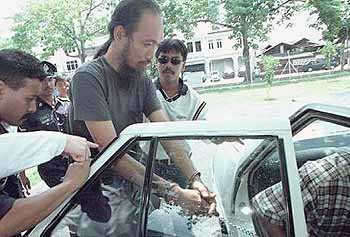
My name was called by an Inspector Nazli at about 10.30pm. I was working at SOS! Centre located at 67 Noordin Street. He asked me to go to Patani Road Police Station for an investigation. I have had previous experiences in such 'investigations' and therefore agreed without any worry. The inspector wanted Ooi to come along, as he had identified Ooi as one of the two people holding up a protest banner in front of the Chief Minister's car in a morning protest. The inspector wanted the other person holding the banner to come along as well. But he was not around and could not be contacted at his home either. So another friend drove both of us to the police station. Upon arrival, we were told that we were under arrest on a charge of rioting. The police officer was friendly. He expressed his support for the cause of the protest and suggested that it was a mistake of the CM not to meet the affected tenants. But the arrest was ordered from above; otherwise he would have finished the investigation quickly and released us. We were asked to leave all our possessions with the friend who drove us there. We waited for a while before the police decided to bring us to the police lockup in Penang Road. Then the media got hold of the news (They had been informed of the police's intention since the morning) and several familiar reporters swung into action when we were hurriedly taken downstairs to a waiting police vehicle. Panic was written on their faces as though something terrible was going to happen to us. We were brought to the police lockup after entering a few heavy metal gates. We walked past cells of detainees, about 20 of whom were crammed into each cell measuring 30 feet by 10 feet. We stopped at No.10. We were asked to strip to our underpants like the other detainees. The shirts were left in an open locker just beyond reach outside the cell's thick metal-grille gate. Rules for bending We were asked by the existing detainees why we had been detained. They were quite amazed with the reasons as we were not involved in any criminal action. It was getting a bit cold. A fellow detainee told us that we could wait for a friendly police officer to pass by and ask for his assistance to retrieve our shirts. We did get back our shirts - but we need to take them off when senior officers come to check later. This was only the first of many rules made but open to unofficial 'bending' in prison. We asked to be bailed out. But the police officer said that we would not be charged as it was a holiday for civil servants the next day and a public holiday the day after. We would only be charged on Monday i.e. the third day after our arrest! I protested that we had the right to be charged within 24 hours or be released. No immediate response. We were prepared for another two days in the lockup. We finally got tired after an extended period of anxiety. We wanted to sleep. There was a cement platform, which could take 9 people. It had a thin plywood cover on top. The rest had to sleep on the cement floor around the platform. When we were about to lie down on the platform, the 'friendly' fellow detainees who had been there longest - about 60 days, told us that new detainees would have to wait for their turn and sleep on the floor first. Another detainee said that it was cooler on the cement floor so I took his advice. My friend Ooi gave an excuse, saying he had a backache. His excuse was accepted and so he slept on the platform. Saturday, 18 March When I woke up the next morning, I got to see the cell better. Other than the platform for sleeping, there was a back portion where there was a toilet (no door)-cum-bathing area, which had piped water supply. There was a big plastic barrel to hold the water. There was no towel, no soap, no detergent, no toothbrush, no toothpaste allowed in. The only 'towel' was an old rag shared by everyone. Sanitation and hygiene was obviously not considered by whoever was responsible for designing this lockup. There was a long queue to get to the bathroom. I took my breakfast without washing my face or rinsing my mouth. Breakfast was just a piece of bread and a drink of light coffee. The coffee came in a big plastic bag. There was no cup. So a dissected mineral water bottle was used - one end was stable while the other was not. The 'cup' was shared by all. A sense of comradeship ensured that nobody fought over these scarce implements. There was no doubt that the conditions were meant as a punishment even before a person could be pronounced guilty of any crime. Even though I have not been in prison, I think the police lockup is obviously worse than a prison as there is no reading material allowed, no room to exercise, no opportunity to interact with other cellmates, no recreational facilities, no time and space for religious believers to say their prayers etc. Drug Haven in Lockup Half of the detainees were drug cases while the other half were illegal migrants from Indonesia and Bangladesh. The drug cases were almost automatically given 14-day detention orders during which their urine samples were tested. If tested positive, they would be charged and sent away for two years' imprisonment. Many of them were 'regulars', it seemed. There was no problem in obtaining drugs in the cells. There were two self-confessed sellers in the cell. One long-term detainee claimed that he could order drugs and other things into the cell. Two sellers were doing their transaction between adjacent cells right in front of our eyes. It was common talk as long as you could pay, you could get almost anything into the cell. The smell of ganja was so thick in the air that no one could fail to notice it. Smoking was about the only pastime in the cell. Singing and banging about to make music ranked second. Illegal Migrants cum Slave Labour The illegal migrants, who made up half the detainee population at the time, also played roles as labourers to distribute meals and as cleaners. Only long-term detainees were assigned these 'jobs'. Since they were not paid for performing these jobs supposedly done by other workers, they were virtually slave labourers within the detention centre. An explanation for using them to distribute food was that since they didn't have as many friends as locals they could not double as distributors of illicit material. Unhealthy food and poor medical attention We had two options for lunch: one loaf of white bread or white rice with a piece of fish. The famed 'curry rice' offered by the police lockup was but a few stingy spoonfuls of thin curry soup, not even enough to wet a quarter of the rice. For lunch, the curry sauce was mixed in the rice. In the evening, it came in a small plastic bag. This allowed the detainees to keep some of the packets for breakfast the next day. I was reduced to taking only white rice because I have maintained a vegetarian diet for some years now. Ooi, my friend, who is not a vegetarian, also avoids fish in his diet. He too had to make do with only white rice. I can imagine healthy people could well get sick with such a diet and sick people would get worse in no time. In the afternoon a prisoner in another cell fell and hurt himself above the eyebrow. The cellmate called out for help. No response. They shook the metal grille door repeatedly. The whole lockup was shaken. And yet there was no response. It was at least 30 minutes before an officer came to take the detainee out for medical attention. A worse case happened in the middle of another night. A detainee next door had stomach ulcers and was in pain. The cellmates called for the lockup officer. No response. They followed with rounds of violent shaking of the metal grille door. Everyone was woken up. Much cursing followed. The lockup officer turned up quite a while later. He probably offered some milk to the guy as a stopgap measure despite a request for medical attention. Half an hour after he left, the sick detainee was groaning loudly again.... I hope that, even though humanitarian consideration might not figure in the minds of the powers-that -be, at least rational thinking should persuade them to provide reasonably healthy meals to the detainees under their custody so that the authorities would not have to pay heavily for medical facilities should the detainees develop health complications later! Statement interrupted by the press After breakfast, we were taken to the Patani Road police station to record a statement. I was handcuffed together with Ooi. The officer-in-charge was obviously well briefed on the case and offered a most sympathetic account of his understanding of our case. After a fair bit of waiting we almost got to start the statement. Then a number of motorbikes belonging to the press roared into the police station compound. The police were irritated and hurriedly took us down from the second floor. Yet we did not manage to evade the press. Our statement was finally done at the Penang Road police headquarters the next day. This sensitivity to the media was not to stop at the recording of our statement. It even extended to the application for the extension of our remand, which involved moving a magistrate to the police lockup. Not once, but twice. Magistrate called to the lockup in the middle of the night Despite my complaint that we should be produced before a magistrate within 24 hours of arrest (to extend detention or to be charged) I was quite resigned to having to wait until Monday to see a magistrate. The atmosphere behind the thick wall of the lockup persuaded me to bear with their opaque operation. Boredom was a punishment that affected everyone. I could not keep up any more enthusiasm to speak to my fellow detainees about their specific circumstances after a few hours. The appearance of a lockup officer, another new detainee passing by, inspection and scolding by some senior officers, all seemed like 'welcome' breaks from a quietly insidious sickness called `boredom'. After dinner I chatted a while with my fellow detainees and headed for sleep. It was quite impossible. The detainees who had been sleeping most of the day had by now woken up and were banging around while singing. A kind of fatigue closed my eyes anyway. But suddenly I was woken up. A police officer came for me and Ooi. We were taken to the front of the lockup - the officers' department. A woman magistrate was called in and we were told that the police had requested a 7-day extension of our remand. The magistrate asked if we had any objection. I mentioned that we had not been investigated so far even though we were taken in on that pretext. Also that we had been denied legal representation. She took some notes and declared that she was allowing detention until Monday, when another magistrate would consider further extension requested by the police. She was led away after our 'hearing' - apparently the only case before her at that time. In less than 5 minutes, we were taken back from the make shift 'courtroom' to our cell. Our first taste of 'justice' was not as satisfactory as we thought it would be. The 24-hour limit to our detention was respected to the letter and the solemn process to extend it was reduced to a charade. Sunday, 19 March The next day was less eventful inside than outside the lockup. Two events coloured the day: a candlelight vigil cum sing along was organised by SOS! supporters just outside the lockup. It was a courageous action by these mainly youthful members of the public. In a typically sensitive response, the police dispersed the crowd of 50 within half an hour. While this was happening, the detainees were singing along even louder inside so that we were kept totally unaware of the supportive action outside. That was the case until we were told of the event by a helpful member of the lockup. We were naturally encouraged to know that the public had not been cowed by the cowardly action of the State Government in taking a law and order response towards what was essentially a socio-cultural problem. Just when we were about to close our eyes for the day, there was a stampede at the entrance of the lockup. Close to a hundred mainly young people were taken into the lockup on suspicion of taking the designer drug Ecstasy. They were quite well dressed and must have been quite shocked at the lockup conditions. Our statement was finally recorded in the afternoon. The detainees under the initiative of the 'old-hacks' did a clean-up of the cell in the afternoon. This was perhaps the only collective, purposeful action in the cell in the entire duration that we were there. Even the din that it caused did not arouse any complaint. Everyone participated in the effort voluntarily. Monday, 20 March Much anticipation was built up for Monday as we thought we stood a good chance of being bailed out once we were produced in court. Many detainees were also led out for various reasons. A number of them left for other destinations after their respective court proceedings. We watched as one detainee after another left the cell until lunchtime. We were puzzled as to why we were not called. A police officer did mentioned to us that "a lot" of our supporters were in the courthouse waiting to meet us. In fact later we found that the big crowd was augmented by relatives of the youngsters who were detained for taking Ecstasy. Magistrate in a police lockup? At 11.00 am we were finally led out to see the magistrate. But to our shock and disbelief, we were led to the same makeshift 'courtroom' in front of the lockup. This time a male magistrate was ushered in. He told us that the police had requested another five days for investigations. He asked us if we had any objections. I responded by telling him that we had not been questioned all this time and to detain us further would constitute an unjustifiable punishment. Ooi offered the reason that he needed to bring an old lady to court to face eviction proceedings on 24 March and therefore needed to be out before then. I wanted to elaborate on my defence. But the magistrate recorded the argument and passed an instantaneous judgement to allow another five days of detention, not counting the two days holiday that we had spent behind bars. We were quite depressed. But there was no choice. We were quite disappointed that we were not given a chance to appear in court, where we could have consulted our legal advisers. But we had no idea how to address this travesty of justice. A depressing afternoon was given a slight uplift in spirit by the visit of Ooi's wife, who brought some change of clothes and some small things like toothbrush for us. The food had to be consumed outside the cell while the things were brought into the cell through the help of a police officer. Then came additional company: Leong, who was the third wanted person. He had held a press conference to clarify that there was no cause to charge us for violent intent as the three of us were in front of the Chief Minister's vehicle, so it would have been impossible for any of us to hit the vehicle without being noticed. If someone had hit the vehicle, it was the work of people who happened to be on the spot, and who were perhaps angered by the Chief Minister's unresponsiveness to the plight of the people. Leong gave himself up after the press conference. He was taken into the Penang Road lockup and joined us. Our spirit was uplifted by his information that our arrest had blown up the issue nationally and had attracted widespread notoriety for the Chief Minister. We were taken to an identification parade together, while Leong made his statement. Tuesday, 21 March We took our breakfast in silence. Leong was particularly disturbed and suggested that we collect a petition for the relevant United Nations instrument to expose the horrible lockup conditions in Malaysia. The only paper we had was our lunch wrapper. We could borrow a pen from the next cell. So we had a project. We told some of the fellow detainees. They expressed confidence in obtaining a good collection of signatures. We were taken to the Patani Road police station again. We were not aware of the purpose. We were asked to sit in a police room for a long time. A police officer told us that we would be released earlier than expected. Police brutality Then we witnessed police brutality right before our eyes. A 16-year-old boy was brought in and sat beside us on the floor. A police officer kept accusing him of being the thief of a police helmet. He was supposed to be the pillion rider of an older guy whom he had met just a few days earlier. He said the theft was the work of his friend. The police officer's voice rose quickly. Then he dragged the boy into a room. We heard many hard hitting sounds against the wooden walls interspersed with loud accusations to force an admission. It was not successful. Then another officer took over. This was the officer who had taken my statement. His rather personable outlook could not explain the harsh sounds which emanated from the room where the boy was held. The other instance of police brutality that we heard about at the lockup was the beating meted out to suspected drug cases. Those who were beaten on their heels became so badly affected that they could never walk properly again after that. We were transferred to another room where, out of the blue, we were told that we would be freed immediately, without being charged. We just needed to leave our fingerprints and so on to finish their record-keeping rituals. The press somehow had been alerted and greeted us at the gate. We went back to the cells to collect our few belongings, most of which we left behind to the 'comrades' - like our change of clothes which was brought in the day before by Ooi's wife. At the risk of implicating personnel at the police station - especially those who were 'kind' to us or who took us into confidence, we are writing this report in the hope of bringing about some improvement in the subhuman conditions which prevail in the police lockup of this 'progressive' and 'liberal' city, under the rule of a reputedly caring Chief Minister. Note : This is abridged from the original account which is available at http://www. pinang.org/sos/statements/000417_sos.htm/
|