|
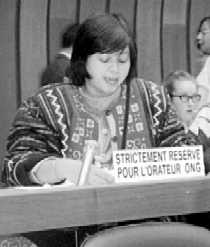
Aliran at the United Nations: Further Erosion of Human Rights in Burma by Deborah Stothard
Mr Chairperson, I speak on behalf of Aliran Kesedaran Negara. May I express concern at the tendency to disassociate economic, social and cultural rights from civil and political rights. In fact, the indivisibility of these rights is explicitly stated in the International Covenant on Economic, Social, and Cultural rights. This is conveniently overlooked when certain oppressive governments "hijack " ESC rights as an excuse for violations of civil and political rights. To quote Nobel Laureate Aung San Suu Kyi: "One of the main problems is that the present military regime tries to separate civil and political rights from economic, social and cultural rights. We would like to point out that this cannot be done. Economic, social and cultural rights are inextricably linked to political and civil rights." My colleague from the Asian Legal Resource Centre has already presented overwhelming evidence on the tragic crisis of hunger and malnutrition in a country where there has been no major natural disaster, a country once regarded as "the rice-bowl of Asia". The Burmese regime puts military spending ahead of the well-being of the people. The World Bank reports that the use of public health services has fallen by 80 per cent in the last 10 years due to an extraordinarily low budgetary outlay of 0.2 per cent. This is particularly immoral in the light of the HIV/AIDS crisis in Burma, where the UN AIDS program estimates 440,000 HIV-positive people. Current government spending for education as a share of national income "is among the lowest in the world." Diplomats have commented that substantial portion of defence spending is not included in official figures, indicating that actual spending for the military is much higher. From official figures alone, defence spending equals 16 times the amount spent on health. On cultural rights, to further quote Aung San Suu Kyi: "… although the military regime claims that it has achieved unity with the ethnic nationalities, the truth is that our ethnic nationalities are suffering greatly from repression of all kinds. For example in the Mon state … the teaching of Mon language in schools has been prohibited." In October 1999, the Military Intelligence ordered the closure of an ethnic Mon school in Kwan-tar village, Mudon Township, Mon State. The students' parents were told that the school was an illegal institution and teaching of Mon language was also illegal. On the national level, many universities and colleges remain shut. Universities and colleges have only been opened for a total of 30 months out of the past 12 years. Some institutions were "reopened" in December under severe constraints. Even then campuses such as those in Thanlyin and Hmaw Bi have already been closed again by the authorities. The long-term implications for the future of the country's young people, and indeed the population, are grave. It is shameful that the Association of Southeast Asian Nations (ASEAN), as strong ESC rights advocates, have been "constructively engaging" with the Burmese regime to further erode the rights of the Burmese peoples. ASEAN's impotence to deal with this problem has caused its member states to receive the negative impact of the regime's irresponsibility. Unless ASEAN member states and their dialogue partners face up to this reality, this threat against the peoples of Burma and ASEAN will continue to grow. As Aung San Suu Kyi reminds us: "Please do not forget that instability in one part of the world could spread very rapidly these days. I hope that the world would be able to make an example of what happened recently in East Timor and learn to help when help is needed and not only when help is overdue."
|