

|
Thinking Allowed Sex, Lies and Politics What a story we’re got this month in the Abu Hassan fall from grace! Our unassuming, soft-spoken, Mr. Clean (or so they say in the mainstream press) met his Waterloo after a king-size skeleton rolled out of the cupboard! After a 43-year stint with UMNO in various capacities, culminating in gaining the coveted Selangor MB seat, it was ashes to ashes for Abu, so to speak. The dethroned 60-year old MB cited health reasons and a heart-bypass for his retirement but no one for one minute believed this was the real motive. Why then did he actively contest the UMNO vice-president post in May? The real reason was an allegation of a sex scandal. The saliva-dripping story had it that the erstwhile MB had allegedly fathered a boy, now 11 years, with his sister-in-law, out of wedlock! Abu Hassan and the whole family has condemned the story as the work of poison-pen specialists out to discredit and depose him. However, in an interview (cited in The Star, August 13, 2000), the retired MB intimated that his sister-in-law, Shamshzillia Daud, indeed did have a son but that the father was his good friend, a Chinese Muslim convert by the name of Abu Hassan Tan Abdullah. The said boy would then be a “bin Abu Hassan” of course, and, unfortunately for the ex-MB, could easily be mistaken for his son! Was that why the poison-pen specialists started getting busy? Abu Hassan himself thought so. For him and the family it was really all a matter of mistaken identity! The dejected ex-MB lamented that, “This is unfortunately the reality in UMNO politics; your own people will betray you and plot your downfall.” What a gem of statement from the unassuming former MB for it’s been axiomatic from time immemorable that in politics, one has no permanent friends, only permanent interests. Like Anwar Ibrahim before him, Abu Hassan is indeed the victim of the mendacity and amorality of politics. But has Malaysian politics even sunk below that? Is it just amoral or is it immoral? What seems to have infected politics in recent times has been the pervasive use of sex scandals and outright lies to oust opponents. These specialists of fitnah and surat layang have honed their skills into a fine art in Malaysia. Doubtless, Abu Hassan will be able to draw parallels in his situation with Anwar Ibrahim, Rahim Thamby Chik, and D.P. Vijendran, to name a few prominent examples of recent times. (And, from a more distant clime, Bill Clinton?) But unlike most of them, Anwar is the only one booted out from the party and locked-up behind bars. What is troubling is that nobody seems to object. Indeed, sexual vocabulary has become something normal in politics. Today Malaysians see nothing strange about connecting such words like “sodomy”, “DNA tests”, “out of wedlock”, “underaged sex”, “pornography”, “statutory rape”, etc. with politics. If the BN government is really serious about wanting to protect valuable politicians, I have a serious proposal to make —conduct sex education courses for their aspirant star politicians. Impaired Vision in the Quest for Bangsa Malaysia The idea of a model Malaysian school, the so-called “Vision School” has created a bit of a flap. Education Minister Musa will meet the Chinese educationists to explain the idea while his predecessor Najib Tun Razak has called on all quarters not to politicise the proposal. I think that the idea of the integration of education, let alone integration through education, has always been flawed in Malaysia. Remember we’re a plural society where the three major ethnic groups have always had their own vernacular schools. Housing “national-type” vernacular schools in the same compound as a “national” Bahasa Malaysia medium school will never bear the fruit of a “Bangsa Malaysia”. Look at the flak generated even by the mere suggestion of vision schools never mind the ill-conceived concept in the first place. We Malaysians are truly quite perverse when it comes to thinking about ethnic relations. True, we’ve managed to keep our heads above water and haven’t had a racial riot since May 13, 1969 although the recent Kampong Rawa incident was close enough. But really, shouldn’t we be thinking of accepting that Malaysia today is a multicultural country beyond Indians, Chinese and Malays as major groups. We have a variety of different ethnic and sub-ethnic groups existing as distinct communities (well beyond Malays, Chinese and Indians) and the cultural rights of all these groups must broadly speaking be fully respected too. Since it would not be possible to have schools only for Iban, Punjabi, Sinhalese, Thai, Cantonese, et cetera, we have to accept that national schools must be given priority. These small minorities have no chance to learn and speak their “mother tongue” in their own vernacular schools. The exception was made historically for Mandarin and Tamil speakers but they must also think beyond the narrow conception that vernacular schools are only for preserving communal cultures. If this isn’t done, Chinese and Tamil schools will become purely institutions which put up barriers for the entry of children of various races to their schools. Will there be a day when schooling for learning and knowledge overrides the need to use them to assert cultural superiority? I certainly hope so. We have already arrived at an equilibrium in education policy today and the focus now should be on delivering to our school-going children effectiveness in learning rather than revive the old political debate about vernacularization. And, think also of licking that heavy school bag problem, Mr. Education Minister! And while we’re at it, are there any plans to get to the bottom of arson and violence among our school children today? DAP-bashing
Columnist Wong Chun Wai has asked the DAP to end its “marriage” with PAS and leave the Barisan Alternative.(The Star, August 3, 2000). Certainly there have been rumblings that both leaders and rank-and-file members of the DAP have been unhappy over certain PAS policies in Kelantan and Trengannu. The undertone of these attacks have been that DAP should return to its true constitutency — the Chinese — and stop flirting with the Muslim party. I find this distasteful and a patently false twisting of the circumstances of the current DAP dilemma. Lim Guan Eng expressed his party’s dilemma succinctly, “Damned if we’re in, damned if we’re out!” Should the DAP become a party to policies and actions that it cannot democratically accept whether they be the enforced donning of tudung for women or the banning of unisex hair salons? While the answer for the DAP must be quite clear, the problem is whether it should be too hasty in pulling out of the BA? The DAP should remember that the original motive for joining the BA was to create an alternative to the BN and to work slowly but surely toward to two-party system in Malaysia. It should also remember that other than PAS, there are other parties in the BA — Party KeADILan and PRM — which do not necessarily agree with some of the PAS policies in Kelantan and Trengganu. The DAP should surely think of working with these partners to pressure PAS into moderating some of its more “unpalatable” policies. And, in the spirit of democracy, accept that some of these policies of PAS do have a large and strong Muslim constituency behind them. In the spirit of democracy shouldn’t DAP be debating and challenging its partners to defend democratically their actions, and thereby dissuade them from following certain lines of action? Come on, Democratic Action Party, live up to your name!! But few can match the level of ethnocentricism displayed by an MCA minister. Ong Ka Ting had the gall to ask the DAP to apologize to the Chinese for forming a pact with PAS. Whatever for? Since when has the DAP been an exclusively Chinese party? In any case, MCA itself had no qualms working with PAS when it was part of the BN. The NEP: A Second Death This leads me yet to another saga of Malaysian ethnic relations - a new debate over the now defunct New Economic Policy. Now you know why ALIRAN lives on — our work never ceases in this wonderful country of many smiles, many-splendoured ethnic things. A write-up in The Far Eastern Economic Review (August 10, 2000) caught my attention. It was about the possible end of affirmative action a la NEP from various suggestions coming from a meeting of the National Economic Consultative Council (NECC). According to spokesman and Vice-Chairman, David Chua, the 30% Bumiputera participation rule may be removed for high-tech business and phased out for other sectors. Actually the NEP officially saw its demise in 1990 and was replaced by the New Development Policy (NDP), anchored by Mahathir’s Vision 2020 policy. Of course, NEP-like polices continue to be practised including the 30% rule. In practice, however, the Mahathir regime has all but dismantled the NEP in its original form not least of all by its privatization policy and its strategy of growth rather than distribution. Ten years into the NDP and we can already see some of the results. For me, it has been disturbing; cronyism has become a business culture and ordinary Malaysians regardless of race have now effectively a lower standard of living (caused by inflation and the Ringgit devaluation) and worse, new social ills have infected all sectors of society regardless of race. Of course, the business cronies in this system have grown by degrees and a couple of Chinese Malaysians have now made it into Forbes billionaire club. Perhaps we should now be thinking of a post-NDP policy — one that removes both ethnic affirmative action and cronyism. More "Oomph" for Kadir! The Minister of Culture, Arts and Tourism Abdul Kadir Sheikh Fadzir is “frustrated and deeply disappointed” about the slowness of the tourism industry to pick up his unusual ideas to promote Malaysia as a tourist destination (The Star, August 5, 2000). The Minister’s four ideas are the Malaysian style of greeting (placing the right hand on the heart), wearing of traditional attire, setting up in-house cultural bodies and treating tourists like guests in our homes. After one year, only one company to date, Country Heights Holdings, at the Mines Resorts City, has adopted the Minister’s proposals. We know why. On the question of greetings, Malaysians themselves are confused as to which is the better gesture—one hand to the heart or the two-handed clap in the air with one fist cupped? On the question of traditional attire, which? Malay, Indian, Chinese, Punjabi, Iban or Kadazan? I’d suggest Kadir’s ministry design one attire to incorporate all of these elements. Perhaps a songkok over a shalwar kameez or a Kadazan headress over a cheongsam?. Malaysia has to be represented equally by all of these groups. Be fair, lah! On setting-up in-house cultural bodies, that’ll do no good for other businesses. Imagine having a showcase culture all within the hotel. When are these tourists ever going to spend their money at your Panggung Budaya or the the Petronas Dewan Philharmonic? Besides tourists do want to know what the real people do — they don’t just dress up in finery to dance or silat their way to happiness. And treating tourists as house guests? We can imagine all hotels will now be forced to have their own in-house Mak Ciks and Pak Ciks, heartily greeting their charges at the lobby. Anyway, has the tourism ministry thought of showing tourists the real Malaysia instead of the smiley showcase Malaysia? This might even rake in more dollars since people like authentic experiences, not just staged ones. Examples of some alternative tours:
Quotable Quirks “Only a sick judge can call me a sick man.”— Anwar Ibrahim to Judge Ariffin Jaka, on the day of his sodomy trial verdict, 8th August, 2000. “I feel like leaving the government sometimes”— PM Mahathir Mohamed, since he’s only been paid RM16,000 a month compared to others who received RM40,000 a month. “I think that it’s futile to think that Mahathir will step down because he is unpopular. I think that Mahathir still seriously believes that he is popular.”— K. Das, back in 1986 in his book, The Musa Dilemma. “I can’t be changing deputies all the time. If you change deputies too many times, it must be because you are wrong and not them.” — PM Mahathir of course, quoted in “Asiaweek”, May 9, 1997. “I hope our beloved prime minister will live for another 100 years so he can lead our country to become the best in the world!” — Sri Nandini Naranyana Kutty, 11 year old, in The Star, July 13, 2000. “One must not forget that ‘the chilling effect’ (on the freedom of speech and expression) is nothing or is too mild compared to the great pains and sufferings that the libel had inflicted upon the respondent due to the venomous accusations made.” — CJ Eusoff Chin in awarding RM10 million in damages to billionaire Vincent Tan against M.G.G. Pillay et al. “People should not get excited over the BMF (scandal) since the money is all gone.” — Sanusi Junid, back in 1984. “Life is wonderful. Yes, it is — in Malaysia anyway.” — Adibar Abdul Rashid, 13 year-old, The Star, July 13, 2000. D.L. Daun |
 While on the subject of ethnic relations I have been always appalled by the way the MCA paper The Star has been taking pot shots at the DAP at every opportunity. The latest round of attacks seems to have racial overtones and has even resulted in a patronising or tongue-in-cheek call for the DAP to join the Barisan Nasional.
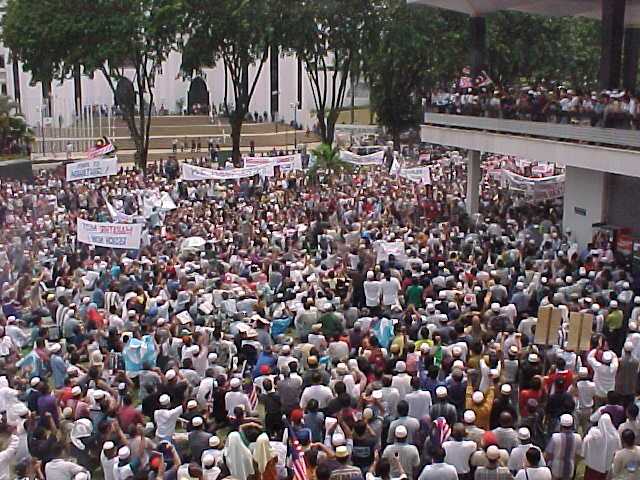 Tour of Famous Reformasi Sites: Again around the Kuala Lumpur area, a tour can be easily arranged for the socially-inclined tourist to witness the sites: Dataran Merdeka, Batu Road, National Mosque, High Court Area, etc., where the Reformasi movements held important gatherings. A few plaques and signboards could be put up to give brief explanations of the events.