
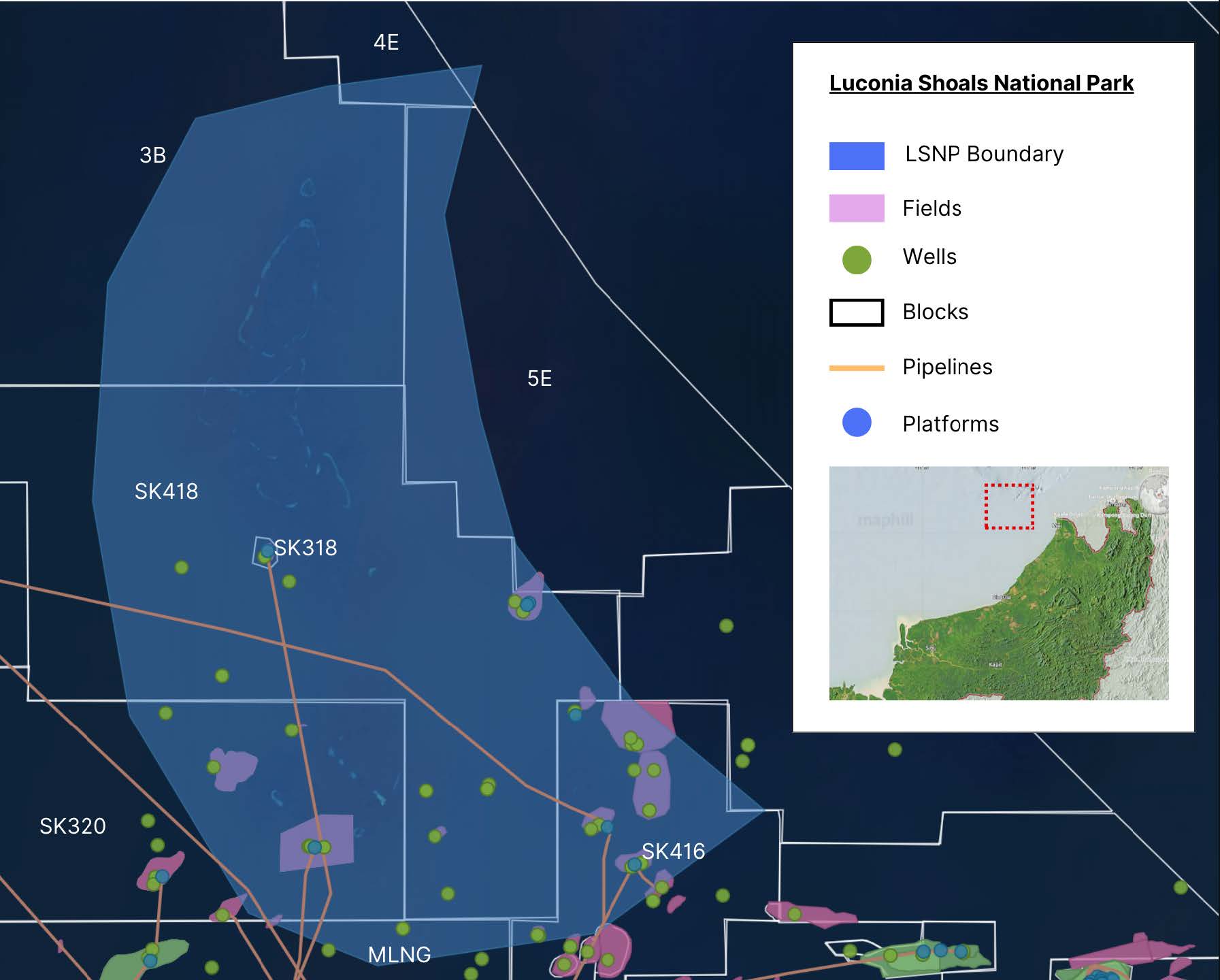
The Luconia Shoals National Park is the largest national park in Malaysia, with an area of 1,011,772 hectares located within the Coral Triangle Implementation Area; a multilateral collaborative partnership to protect the earth’s most biodiverse waters.
It was gazetted by the government of Sarawak in 2018 as a “totally protected area”.
According to Sarawak Chief Minister Abang Johari Openg, the national park is “mainly for conservation and preservation purposes” and will be “out of bounds for oil and gas exploration”.
RimbaWatch has published a policy brief, An Assessment of Oil and Gas Exploration and Production in the Luconia Shoals National Park. This brief finds that nearly 100% of the park is located within seven active oil and gas blocks. These are Block SK318, MLNG Dua, SK320, F29/F14, SK418, SK316 and 3B.
Within these seven blocks, there are a combined 31 wells and seven existing platforms commercialising at least eight known fields. Additionally, at least five gas pipelines run through the park.
- Sign up for Aliran's free daily email updates or weekly newsletters or both
- Make a one-off donation to Persatuan Aliran Kesedaran Negara (ALIRAN), Maybank a/c 507246118995 or CIMB a/c 8004240948
- Make a pledge or schedule an auto donation to Aliran every month or every quarter
- Become an Aliran member
The brief finds that five of the seven oil and gas blocks listed commenced their activities after the park was gazetted in 2018. For example, Block SK418’s and 3B’s production sharing contracts were both inked in 2023.
Meanwhile, Block SK320 (Pegaga field) began producing gas in 2022, Block SK318 (Timi field) in 2023 and Block SK316 (Kasawari field) in 2024; and all three blocks received environmental impact assessment approval from the Department of Environment.
A WWF-Malaysia report on important marine conservation areas describes the park as one of the “richest marine habitats in Sarawak”. This report identifies the park as a habitat for 12 submerged reefs, two atolls and various marine mammals.
The Beting Patinggi Ali reef specifically, within the park, is cited as one of the most productive fishing zones in the entire South China Sea due to its extensive coral reef systems.
Oil and gas exploration and production pose significant environmental risks to marine areas. These include:
- acoustic impacts on marine mammal species which can alter swimming and travel patterns
- damage to reefs, seabed and benthic organisms during drilling and from discharge of lubricants and other fluids
- increased sedimentation
- risks of blowouts, oil spills and failure of infrastructure.
Major incidents related to oil and gas activities have already occurred recently in Malaysia. In October 2020, a ship collided with an oil rig in Sarawak, and in May 2021 an offshore oil rig sank while being set up.
Further, according to DoE data, 130 documented oil spills occurred in Malaysia’s waters between 2014 and 2022, with the top environmental impact cited being damage to marine life.
Given the designation of the Luconia Shoals National Park, the verbal commitment from the chief minister that the park would not be used for oil and gas activities, and the biodiversity and climate risks outlined above, RimbaWatch questions how the DoE could approve oil and gas projects within Malaysia’s largest national park, which is gazetted as a totally protected area by Sarawak.
RimbaWatch director Adam Farhan says: “Instead of being out of bounds for oil and gas exploration, as promised by the state government, at least 14.3 trillion cubic feet of gas reserves are being commercialised within the LSNP, which will emit nearly one billion tonnes of greenhouse gas emissions.
“We remind the DoE and the Ministry of Natural Resources and Environmental Sustainability, that all oil and gas expansion will breach the global remaining carbon budget to limit warming to 1.5 degrees, and that the International Court of Justice’s 2025 advisory opinion specifically ruled that states which approve new fossil fuel projects breach their duty under international law to prevent significant harm to the environment.”
RimbaWatch calls for the appeals board of the DoE to revoke all environmental impact assessments for oil and gas projects in the park which were approved after the park was gazetted, on the basis that these projects do not conform to zoning under 1.2.2 of the 2016 environmental impact assessment guidelines.
Further, RimbaWatch calls on the Ministry of Natural Resources and Environmental Sustainability to be proactive in meaningfully tackling the environmental impacts of Malaysia’s highest polluting sector by:
- including targets for a fossil fuel phase-out in the upcoming Climate Change Act
- joining other Global South oil-producing nations such as Colombia and Pakistan in endorsing the call for a fossil fuel non-proliferation treaty, which will establish a global framework for a just transition for workers, communities and industries
– RimbaWatch
AGENDA RAKYAT - Lima perkara utama
- Tegakkan maruah serta kualiti kehidupan rakyat
- Galakkan pembangunan saksama, lestari serta tangani krisis alam sekitar
- Raikan kerencaman dan keterangkuman
- Selamatkan demokrasi dan angkatkan keluhuran undang-undang
- Lawan rasuah dan kronisme
