
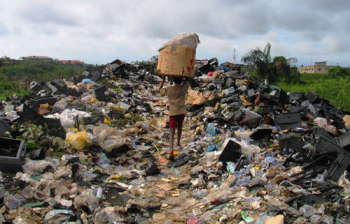
On 22 October, the Basel Action Network (BAN), released a new investigative report Brokers of Shame: The New Tsunami of American e-Waste Exports to Asia.
The report documents how a group of large US brokers appear to be facilitating what BAN estimates to be a billion-dollar trade in exporting electronic waste to developing countries.
Based on trade data, field observations and independent GPS tracking, BAN’s findings indicate that significant volumes of US electronics continue to be exported to countries that have prohibited their import and often lack capacity for managing them.
As enforcement actions in these countries show, this unwelcome or illegal trade nevertheless thrives and persists, raising urgent ethical, environmental and legal concerns.
BAN’s research estimates that each month, about 2,000 shipping containers (representing roughly 32,947 tonnes) maybe filled with discarded US electronics waste leave American ports, destined for countries that have banned their import and are far less equipped to safely handle them.
- Sign up for Aliran's free daily email updates or weekly newsletters or both
- Make a one-off donation to Persatuan Aliran Kesedaran Negara (ALIRAN), Maybank a/c 507246118995 or CIMB a/c 8004240948
- Make a pledge or schedule an auto donation to Aliran every month or every quarter
- Become an Aliran member
Between January 2023 and February 2025, the 10 highlighted US “brokers of shame” collectively appear to have exported more than 10,000 containers of possible e-waste, which would be valued at over $1bn.
Extrapolated industry-wide, this trade could exceed $200m in traded waste each month – with Malaysia, a Basel Convention state, identified as the primary recipient.
During the study period, BAN estimates that US e-waste shipments may have represented nearly 6% of all US trade to Malaysia, underscoring the staggering scale of this toxic trade.
“These companies present themselves as responsible recyclers helping to solve the e-waste crisis,” said BAN founder Jim Puckett.
“But our data and field investigations show a troubling pattern of exports that appear inconsistent with both US and international efforts to ensure safe and legal handling of hazardous waste.
“These practices undermine public trust, the rule of law, industry certifications and the protection of human health and the environment.”
The report also reveals that:
- Containers tracked by BAN were routed through – and to – Malaysia, Indonesia, Thailand, the Philippines and the United Arab Emirates despite clear bans under the Basel Convention and national regulations for these countries to lawfully receive this waste
- Eight out of the 10 identified brokers hold R2V3 certifications, an industry standard meant to prevent the kinds of possibly illegal and harmful practices they appear to be engaged in
- Several brokers operate out of California, despite the state’s strict e-waste laws requiring full reporting and responsible downstream handling of e-waste and universal waste
- A large retailer and Fortune 500 company has become implicated in the harmful exports as revealed by BAN’s GPS tracking highlighting the need for greater downstream due diligence.
- One identified “broker of shame” was recently awarded a US Defence Logistics Agency contract to manage and process sensitive electronic waste from the US Department of Defence – thought to be the largest electronic waste generator in the world
- Hazardous e-waste may be routinely misdeclared as “commodity materials” such as unwrought metals, or working or new electronics, probably to evade detection or prevent paying tariffs
- In countries receiving US e-waste, undocumented workers desperate for jobs, toil in makeshift facilities beside palm plantations and industrial waysides, inhaling toxic fumes as they strip wires, melt plastics and dismantle complex devices without protection
The scale of the e-waste problem continues to surge worldwide, with devastating consequences. In 2022, a record 62 million tonnes of e-waste was produced, and this is projected to rise 32% to 82 million tonnes in 2030.
Yet, currently only 17–22% is formally collected and recycled, according to UN figures – but even these figures understate the problem. Much of the counted ‘recycled’ materials end up exported to dirty recycling operations in developing countries, BAN reports.
“The trafficking of plastic and electronic wastes to my country has caused immense harm,” said Pui Yi Wong, a BAN Researcher in Malaysia.
“Waste traffickers and illegal recyclers blatantly violate Malaysia’s laws in the name of ‘recycling’, in order to reap profits by polluting our water, air and soil, making communities sick, exploiting and poisoning undocumented workers, and fostering corruption.
“Like China, Malaysia is now learning the hard way that recycling the world’s wastes comes at a heavy price. Americans should recycle their old electronics and plastics in their own country.”
The Brokers of Shame report underscores that the US remains the only industrialised nation that has not ratified the Basel Convention, and is one of only six countries in the world that has failed to do so.
The Basel Convention is the international treaty designed to stop rich industrialised nations from dumping their hazardous and other wastes in developing countries.
According to BAN, In lieu of the US federal government reigning in this nefarious trade, it falls on industry leaders to step up and reform their operations and certifications to ensure that communities in South and Southeast Asia, Africa and beyond will not face a future buried under mountains of hazardous and toxic e-waste.
BAN presents this report not as a condemnation of the entire electronics recycling industry, but as a call to greater accountability and reform. You can read the full report and BAN’s recommendations to enabling actors in the trade of e-waste here. – BAN
AGENDA RAKYAT - Lima perkara utama
- Tegakkan maruah serta kualiti kehidupan rakyat
- Galakkan pembangunan saksama, lestari serta tangani krisis alam sekitar
- Raikan kerencaman dan keterangkuman
- Selamatkan demokrasi dan angkatkan keluhuran undang-undang
- Lawan rasuah dan kronisme
