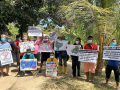
The Center to Combat Corruption and Cronyism (C4 Center) takes note of Transparency International’s Corruption Perception Index (CPI) 2025, which saw Malaysia improve its score by two points at 52 out of 100 points, and move up three places to 54th out of 180 countries.
These findings indicate a slight improvement in how corruption is perceived in Malaysia.
Though this increase appears as a step forward in the fight against corruption, C4 Center cautions the government against complacency and emphasises the need for further action in meeting its anti-corruption goals.
Malaysia’s improved CPI score could possibly be attributed to a number of high-profile raids and arrests conducted by the Malaysian Anti-Corruption Commission (MACC).
In the past year, the news cycle has been awash with photos and reports of multi-million-ringgit seizures carried out by the MACC, including:
- The seizure of over RM169m from Ismail Sabri Yaakob and his former political secretary
- The raid of 12 factories in Selangor and Johor linked to illegal e-waste processing
- The raid of Sapura and a “Tan Sri” involved in a RM500m money-laundering probe
- The raid and seizure of RM16m worth of luxury items in the ‘Sukuk’ probe
- Sign up for Aliran's free daily email updates or weekly newsletters or both
- Make a one-off donation to Persatuan Aliran Kesedaran Negara (ALIRAN), Maybank a/c 507246118995 or CIMB a/c 8004240948
- Make a pledge or schedule an auto donation to Aliran every month or every quarter
- Become an Aliran member
While the MACC’s actions are not insubstantial, far more must still be done if the government is serious about its pledge to reach a top-27 CPI ranking by 2028, as per the national anti-corruption strategy for 2024–28. For context, Malaysia would need to improve by 14 points within the next two years to achieve this goal.
In three full years of the “Madani” (trustworthy) government, the score has only increased by two points.
This belies a greater problem: despite the perception of constant anti-corruption enforcement, there have been few, if any, meaningful reforms implemented that target wider systemic corruption.
Within the past year, numerous scandals and controversies have plagued the government with little end in sight, namely:
- Yayasan Akalbudi – The Attorney General’s Chambers classified Deputy PM Zahid Hamidi’s Yayasan Akalbudi case as requiring no further action despite the prosecution already having proved credible evidence on 47 corruption charges
- Sabah mining scandal – 15 Sabah assembly members were implicated in corruption over the granting of mineral exploration rights and alleged to be taking bribes in exchange for concessions
- Shamsul Iskandar Akin – The former political secretary to Prime Minister Anwar Ibrahim was alleged to have received bribes, linking him to the Sabah mining scandal [He has pleaded not guilty]
- Football Association of Malaysia (FAM) – FAM has been accused of submitting falsified documents in order to ensure the eligibility of seven foreign football players to represent the Malaysian national team
- Adam Radlan’s acquittal – Despite facing 12 corruption charges related to the Jawa Wibawa project, Segambut Bersatu deputy chief Adam Radlam was fully acquitted after only paying a compound of RM4.1m
- Another Azam Baki shareholding scandal – A report from Bloomberg alleged that MACC Chief Commissioner Azam Baki owns around RM800,000 worth of shares in a company, potentially breaching public service regulations
It is apparent, then, that frequent raids, arrests and seizures have done little to meaningfully affect greater structural change within Malaysia’s public institutions.
While the MACC has conducted numerous large-scale operations and publicised substantial asset seizures, very few political actors have ultimately been convicted or held fully accountable.
C4 Center has long highlighted the nature of grand corruption in Malaysia that ultimately serves the material and political goals of the elite, while ordinary people bear the consequences.
Without real change at the highest levels of power, these acts of enforcement will be nothing more than a temporary solution to corruption at best, and at worst, a public relations exercise that obscures the deeper systemic corruption and allows the powerful to act with further impunity.
As the Madani government enters its fourth year in office, it is worth asking: what meaningful reforms have actually been delivered during its tenure? This question is no longer being raised solely by civil society or the wider public, but increasingly by figures within the government itself.
In December 2025, following a resounding defeat in the Sabah state elections, the DAP’s central leadership openly acknowledged the need to restore public confidence by accelerating long-delayed reforms. We could not agree more.
If the Madani government is intent on targeting corruption at its deepest levels, it cannot rely simply on reactive enforcement exercises.
Therefore, C4 Center strongly urges that the government make haste in implementing the following reforms:
- Reform of the MACC, by removing the prime minister’s appointment powers over the MACC chief commissioner and the expansion of the proposed national ombudsman’s jurisdiction to investigate misconduct complaints against the commission
- The separation of the offices of the attorney general and public prosecutor, with an independent public prosecutor appointed through a non-executive-dominated process and governed by clear prosecutorial guidelines
- The legislation of a political financing act, which must include mandatory public reporting of all political funds, prohibition of corporate donors, and strong limits to anonymous donors. – C4 Center
AGENDA RAKYAT - Lima perkara utama
- Tegakkan maruah serta kualiti kehidupan rakyat
- Galakkan pembangunan saksama, lestari serta tangani krisis alam sekitar
- Raikan kerencaman dan keterangkuman
- Selamatkan demokrasi dan angkatkan keluhuran undang-undang
- Lawan rasuah dan kronisme