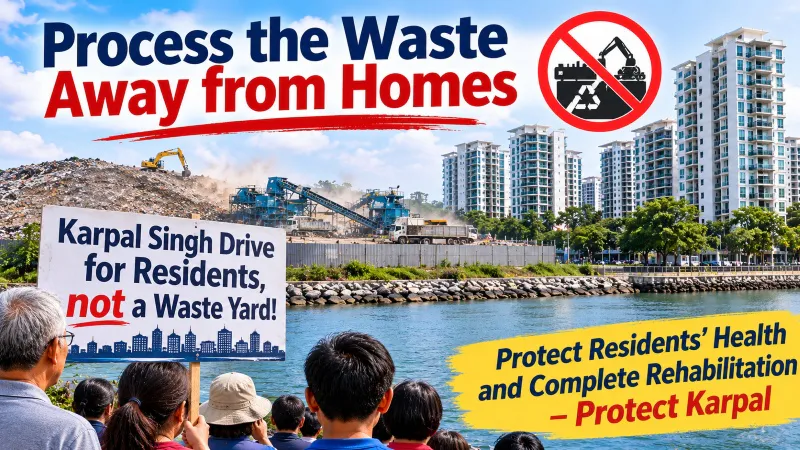
The Protect Karpal Singh Drive action committee, ProtectKarpal, strongly opposes the proposed processing of excavated landfill waste near high-density residential areas along Karpal Singh Drive.
The committee, which operates under the auspices of the Bandar Sri Pinang Pulau Pinang Residents’ Association, demands that the Penang state government prioritises the transport of excavated waste to authorised facilities located far from residential communities for recycling, treatment and safe disposal.
PLB Engineering Berhad (PLB) has reportedly submitted an application to Penang PlanMalaysia on 2 November for permission to operate recycling machinery at the Jelutong landfill.
Why should thousands of residents be exposed to the risks of industrial-scale waste processing when off-site treatment at appropriately equipped facilities should be independently evaluated as an alternative?
Do not turn a residential waterfront into a waste-processing zone.
- Sign up for Aliran's free daily email updates or weekly newsletters or both
- Make a one-off donation to Persatuan Aliran Kesedaran Negara (ALIRAN), Maybank a/c 507246118995 or CIMB a/c 8004240948
- Make a pledge or schedule an auto donation to Aliran every month or every quarter
- Become an Aliran member
ProtectKarpal’s examination of the publicly displayed February 2025 environmental impact assessment reveals plans for a maximum of 20 heavy-duty recycling machines to be deployed sequentially from the existing landfill towards Karpal Singh Drive, just in front of high-density residential areas.
The proposed activities include drying, sorting, crushing and processing excavated landfill waste in open-air conditions for more than 10 hours daily.
These operations would involve material excavated from a decades-old landfill containing mixed waste, rather than clean, separately collected recyclables.
Turning Karpal Singh Drive’s residential coastline into a prolonged open-air waste-processing zone is unacceptable.
Mechanical crushing and sorting can generate fine particulate matter (PM2.5 and PM10), noise and odours. Disturbing buried waste may also release landfill gases, biological aerosols and other contaminants, depending on the composition of the excavated materials.
These are recognised environmental and health hazards. Their potential impact on surrounding homes requires independent assessment, not assurances that recycling machinery can operate safely.
Residents, children, older people and nearby businesses should not have to endure years of potential pollution and disruption simply because processing waste near the excavation site may be commercially convenient.
The burden must be on the developer to demonstrate safety, not on residents to prove harm after exposure has occurred.
Process the waste further away
ProtectKarpal calls for an independent assessment of transporting excavated landfill waste to suitable off-site facilities in appropriately zoned locations, equipped with enclosed processing systems, pollution controls and safe disposal arrangements.
Intensive crushing, sorting and recycling should be directed away from densely populated communities wherever a safer, technically feasible off-site alternative is available.
This is an established approach in contaminated-site remediation, not an unreasonable or technologically impossible demand.
Malaysia’s Department of Environment adopts a risk-based approach to contaminated-land rehabilitation, prioritising the protection of human health and the environment when evaluating remediation options.
The state must therefore explain why intensive waste processing needs to take place near residential areas rather than at facilities better suited to such operations.
The latest planning application raises another serious question: is the developer seeking permission for one machine, several machines or the first phase of the larger recycling scheme described in the 2025 environmental impact assessment?
The state must disclose the proposed machinery’s locations, processing capacities, operating hours and duration, and whether further applications could progressively expand operations towards residential areas.
Temporary permission must not become a back door for establishing extensive waste-processing activities.
Another broken promise
The application follows yet another extension granted to PLB until 31 January 2027, despite Chief Minister Chow Kon Yeow’s public commitment that no further extension would be allowed after the final deadline of 18 October.
The state executive council approved the extension on 28 October, although the DoE had reportedly identified 22 land-use compatibility issues on 28 September.
PlanMalaysia subsequently reportedly submitted temporary land-use guidelines on 29 October, followed by PLB’s application on 2 November.
What technical evidence justified the executive council’s extension, and how were the health and safety interests of surrounding residents considered?
Chow must explain the reversal of his public commitment and disclose the environmental and planning assessments supporting the decision.
Don’t compromise residents’ health
ProtectKarpal unequivocally supports the urgent rehabilitation of the Jelutong landfill.
However, rehabilitation must reduce environmental risks, not introduce additional hazards into neighbouring residential communities.
We maintain our call for lawful termination of the existing joint development agreement and rejection of the proposed 70-acre reclamation.
ProtectKarpal demands that the state government:
- Reject any application for intensive waste processing near residential areas
- Commission a transparent comparison of off-site and on-site treatment alternatives, prioritising authorised facilities away from densely populated communities and safe transport arrangements
- Disclose the developer’s complete recycling-machinery application, the environmental impact assessment’s proposed processing arrangements, and the evidence supporting the executive council’s latest extension
- Establish meaningful resident participation before approving any rehabilitation or waste-processing plan affecting surrounding communities
The Jelutong landfill must be rehabilitated. But residents should not be made to live beside industrial-scale processing of decades-old waste when safer alternatives may be available.
Karpal Singh Drive is a residential, recreational and commercial waterfront, not an industrial waste-treatment facility.
Process the waste in suitable facilities away from homes. Protect residents’ health. Make rehabilitation environmentally responsible. – Protect Karpal
AGENDA RAKYAT - Lima perkara utama
- Tegakkan maruah serta kualiti kehidupan rakyat
- Galakkan pembangunan saksama, lestari serta tangani krisis alam sekitar
- Raikan kerencaman dan keterangkuman
- Selamatkan demokrasi dan angkatkan keluhuran undang-undang
- Lawan rasuah dan kronisme