Kua Kia Soong
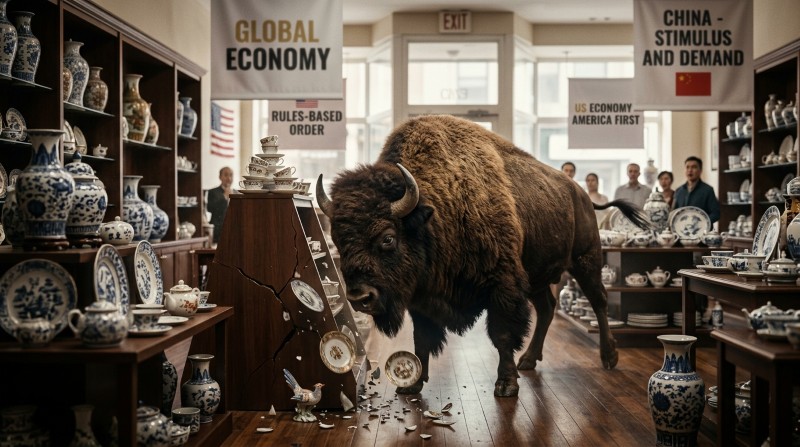
There is something almost comical about watching the US lecture the world about the virtues of a rules-based international economic order while repeatedly behaving like a bull in a China shop.
Washington’s latest economic rampage is directed not only at Iran but increasingly, at anyone foolish enough to continue trading with Iran. Canada is being battered with punitive tariffs. China is being threatened with secondary sanctions, and countries around the world are being told, in effect: trade with whom you like – provided Washington approves.
This is not free trade. It is economic coercion masquerading as foreign policy. The latest US campaign against Iran is particularly revealing. After months of war failed to produce the decisive victory Washington promised, the US has turned increasingly to economic strangulation.
On 25 August, Treasury Secretary Scott Bessent announced a new round of measures against more than 60 Iranian-linked individuals and entities and warned other countries that doing business with Iran could put their access to the dollar-based financial system at risk.
- Sign up for Aliran's free daily email updates or weekly newsletters or both
- Make a one-off donation to Persatuan Aliran Kesedaran Negara (ALIRAN), Maybank a/c 507246118995 or CIMB a/c 8004240948
- Make a pledge or schedule an auto donation to Aliran every month or every quarter
- Become an Aliran member
And Canada has discovered that even being America’s neighbour, ally and major trading partner provides no immunity. On 25 August, Ottawa announced retaliatory tariffs on about $20bn of American imports, covering roughly 700 products, after Washington imposed new 50% tariffs on Canadian goods.
This is what passes for American economic statecraft in 2026: threaten your allies, punish your enemies, intimidate everybody else and call the resulting chaos ‘America First’.
The China shop is the world
The irony is that the country Washington increasingly treats as its principal economic adversary has repeatedly demonstrated a very different approach to systemic economic crises.
China did not create the 2008 global financial crisis. Wall Street did. Yet when the financial system imploded in 2008, China did not respond by trying to pull the rest of the world into an economic war. It responded by trying to keep demand, investment and trade alive. That distinction matters.
The collapse of the American financial system produced a devastating contraction in global trade. The World Trade Organization (WTO) estimates that world merchandise trade fell by about 9% in volume terms in 2009 – the largest annual decline in decades.
China responded with its famous US$586bn stimulus programme, announced in November 2008, directed heavily towards infrastructure, housing, transport, energy and other investments. It was not an act of charity. Beijing was protecting its own economy.
But that is precisely the point. In an interconnected world, protecting one’s own economy by sustaining demand can simultaneously help everybody else.
China’s stimulus helped prevent its economy from falling into the deep recession experienced by many Western economies. China’s growth recovered strongly, reaching around 10% in 2010.
More importantly for the rest of the world, Chinese demand helped provide a market for commodities, machinery, components and manufactured goods when demand in the US and Europe was collapsing.
China therefore became part of the mechanism through which Asia – and eventually the wider global economy – could begin to recover.
There was another important lesson. China did not respond to the crisis by saying, “My country first, therefore everybody else’s economy must suffer.” It expanded domestic demand, maintained investment, supported employment and continued importing, remaining deeply engaged in international trade.
The result was not merely China’s recovery. It helped sustain the trading system upon which countries from Australia and Brazil to Malaysia and South Korea depended. That is what responsible economic leadership looks like.
Washington’s asinine war
The US war against Iran has created an enormous threat to global energy and shipping.
The Strait of Hormuz is one of the world’s critical arteries for oil and liquefied natural gas. The war and disruption to shipping have therefore threatened not merely Iran or the Gulf but the economic welfare of countries thousands of kilometres away. And which country has had to absorb the shock? China.
China is Iran’s largest oil customer. Reuters reported that China imported about 1.38 million barrels a day of Iranian oil in 2025.
Yet Beijing has not simply responded by joining Washington’s campaign of economic destruction. It has tried to keep trade and energy flows functioning, while simultaneously pushing for diplomacy.
China supported Pakistani mediation in the US-Iran conflict and urged a cessation of hostilities and a return to negotiations. Its diplomats have also engaged Saudi Arabia and other Gulf states, stressing the importance of de-escalation and the restoration of safe passage through the Strait of Hormuz.
In April, China played a significant role in encouraging Iran to accept a Pakistan-brokered ceasefire with the US. Beijing was even asked to act as a guarantor, although it declined to take on that role.
China has a very large economic stake in West Asian stability. It imports energy from the Gulf, trades extensively with Saudi Arabia and the UAE, and depends on the uninterrupted movement of goods through the region.
Its interest is therefore remarkably straightforward: keep the oil flowing. Keep the ships moving. Keep the trading system functioning. Stop the war.
Washington’s approach seems to be almost the reverse: stop the trade. Stop the oil. Stop the ships. Threaten anyone who refuses.
China absorbed the oil shock
There is another fascinating aspect of China’s response to the Iran crisis. Rather than simply passing the energy shock to the rest of the world, China has used its enormous reserves and industrial capacity to absorb part of it.
China sharply reduced crude-oil imports during the first months of the war, drew on commercial oil inventories, restricted refined fuel exports and increased the use of coal and renewable alternatives.
Reuters reporting, cited by the US-China Economic and Security Review Commission, indicated that Chinese crude imports had fallen substantially from previous years, while domestic reserves helped cushion the disruption.
Other reporting estimates that China’s oil consumption and imports fell dramatically during the first months of the war, helping to moderate pressure on global oil prices.
China has also been able to draw upon enormous accumulated reserves – estimated at roughly one to 1.4 billion barrels across commercial and strategic holdings.
This matters because China is not merely another oil consumer. It is the world’s largest oil importer. Its decisions therefore have global consequences, helping to prevent a temporary supply shock from becoming an uncontrollable price spiral.
When it maintains industrial production and supply chains, it helps prevent shortages of manufactured goods. And when it keeps trading with countries under unilateral American sanctions, it provides an alternative economic channel through which trade can continue.
One might almost think the bull has wandered into the China shop and is now blaming the crockery.
During the 2008 financial crisis, China’s response helped sustain global demand.
During the present Iran crisis, China’s enormous economic weight, energy reserves, continued trade and diplomatic engagement have helped cushion some of the consequences of the conflict while Beijing pushes for de-escalation.
China increasingly understands that its own prosperity depends on global stability.
Washington, by contrast, increasingly behaves as though American prosperity requires everyone else to submit.
That is the difference between economic leadership and economic bullying.
We need a global trading system in which no great power – American, Chinese or otherwise – is allowed to behave like a bull in a China shop.
Dr Kua Kia Soong is a former MP and director of human rights group Suaram.
AGENDA RAKYAT - Lima perkara utama
- Tegakkan maruah serta kualiti kehidupan rakyat
- Galakkan pembangunan saksama, lestari serta tangani krisis alam sekitar
- Raikan kerencaman dan keterangkuman
- Selamatkan demokrasi dan angkatkan keluhuran undang-undang
- Lawan rasuah dan kronisme