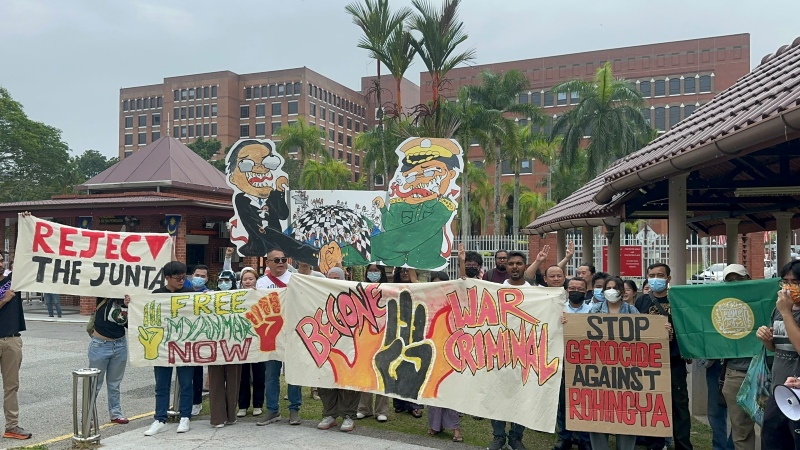
The forthcoming judgment from the International Court of Justice (ICJ) in The Gambia v Myanmar case is a landmark opportunity to advance the Rohingya people’s fight for justice and to strengthen the international obligation to prevent and punish genocide wherever it occurs.
The international community must prepare now for all possible outcomes, say Legal Action Worldwide (Law) and the Special Advisory Council for Myanmar (SAC-M).
A new joint position paper by Law and the SAC-M explores a range of plausible judicial outcomes and their respective legal, diplomatic and operational implications for Myanmar’s military junta and for states around the world.
At its core, the paper is a call for Myanmar’s pro-democracy revolutionary movement, states, international organisations, civil society, donors, and foremost Rohingya communities to prepare now – not after the judgment is delivered – for every plausible outcome.
“The ICJ ruling will be historic for Rohingya survivors and their families around the world,” said Yanghee Lee, a member of the SAC-M.
- Sign up for Aliran's free daily email updates or weekly newsletters or both
- Make a one-off donation to Persatuan Aliran Kesedaran Negara (ALIRAN), Maybank a/c 507246118995 or CIMB a/c 8004240948
- Make a pledge or schedule an auto donation to Aliran every month or every quarter
- Become an Aliran member
“The international community failed to prevent Myanmar military atrocities against the Rohingya nine years ago. It must seize this opportunity to finally secure justice for the Rohingya and begin to reckon with these failings.”
In 2019 The Gambia filed a case against Myanmar at the ICJ for alleged violations of the 1948 Genocide Convention arising from Myanmar’s 2016-17 “clearance operations” against the Rohingya living in Rakhine state.
Public hearings on the merits concluded in January 2026, and the court is now deliberating. A final judgment is anticipated soon.
The ICJ has never found a state directly responsible for the commission of genocide. The strongest possible judgment in this case – a finding against Myanmar under Article III(a) of the Genocide Convention – would carry unprecedented legal, diplomatic and reputational consequences for Myanmar’s military junta.
Such a finding would also carry significant implications for all states, including Myanmar, under international customary law, as set out in the International Law Commission’s Articles on Responsibility of States for Internationally Wrongful Acts (2001).
Other plausible scenarios explored in the paper include findings of partial state responsibility under the Genocide Convention, a breach of the court’s 2020 provisional measures order, a mixed judgment, or a finding that the crime of genocide has not been legally established.
“The ICJ judgment could become one of the most significant international legal decisions on genocide in recent history. But it cannot be the end of the accountability process,” Antonia Mulvey, the executive director of Law, said.
“States must be ready to enforce the judgment, support Rohingya communities, strengthen pressure on those responsible, and pursue every available avenue for justice.”
The paper explains what the judgment can and cannot achieve. It makes clear that the judgment alone will not deliver justice for Rohingya victims and survivors.
It will be the responsibility of states to turn legal findings into concrete diplomatic, political economic, and humanitarian action, in consultation and partnership with Rohingya communities.
It will also be critical that the court’s judgment, regardless of the outcome, is communicated clearly to Rohingya communities in Myanmar, in Bangladesh and around the world, as well as to the Myanmar public.
Without careful engagement, there is a risk of politicisation, division and disillusionment among these communities. This must include contingency planning for a negative outcome.
“The sexual violence and persecutions we suffered at the hands of the Myanmar military were unbearable,” said Salma*, a mother who was part of the Rohingya victims’ delegation that attended the full merits hearings in The Hague in January.
“We want justice, for us and to improve the lives of the next generation. We don’t want anyone else to suffer what we suffered.”
Whichever way the court rules, the international response must be immediate, coordinated, and grounded in the rights of Rohingya victims and survivors.
With a judgment imminent, now is the moment for states to move from solidarity to preparation, and from preparation to action. – SAC-M
AGENDA RAKYAT - Lima perkara utama
- Tegakkan maruah serta kualiti kehidupan rakyat
- Galakkan pembangunan saksama, lestari serta tangani krisis alam sekitar
- Raikan kerencaman dan keterangkuman
- Selamatkan demokrasi dan angkatkan keluhuran undang-undang
- Lawan rasuah dan kronisme