BA Hamzah
Malaysia has spent decades and billions of ringgit trying to build a nation.
Tools like language policy, education and the redistribution of wealth have failed to forge a united Bangsa Malaysia (Malaysian nation).
National unity remains elusive – not because we have not tried but because our politicians have only paid lip service to it.
But the bridge is not too far to cross, if we all care more about the national interest. The ethnic Malays have a proverb: bila sesat, jalan pulang ke pangkal (when you lose your way, return to where you started).
- Sign up for Aliran's free daily email updates or weekly newsletters or both
- Make a one-off donation to Persatuan Aliran Kesedaran Negara (ALIRAN), Maybank a/c 507246118995 or CIMB a/c 8004240948
- Make a pledge or schedule an auto donation to Aliran every month or every quarter
- Become an Aliran member
It is never too late to turn back.
Let us return to where we began. After six decades since the formation of Malaysia, we could return to our old, cherished idea of tanah dan air (land and water).
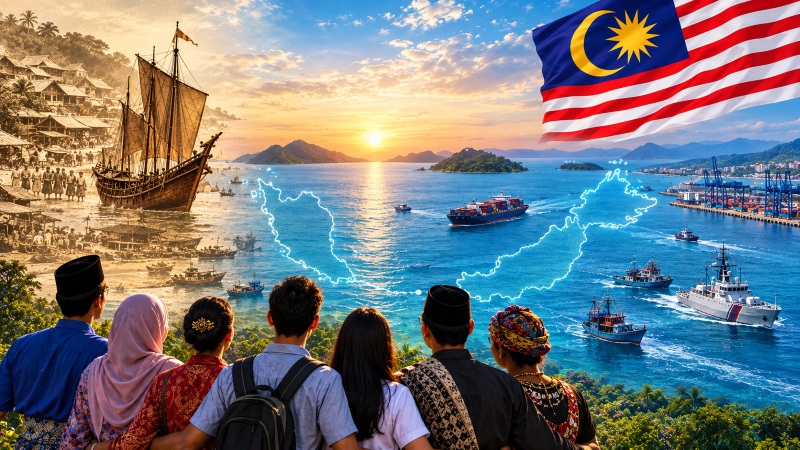
Many civilisations think of a nation as strictly a motherland or fatherland. The Malays have long treated land and sea as one single political, cultural and economic unit – tanah dan air. In the past, we focused on the land and ignored the sea, or laut, our maritime space.
Instead of using the sea to unite us, we let it divide us. It has become a barrier to national unity.
We should recognise the sea as a uniting force. The sea once connected the peoples of the Malay world. But now, it has often become a physical and psychological barrier – separating the peninsula from Sabah and Sarawak, for instance.
Few remember that Malay political power in ancient times was not built on controlling vast tracts of land. It was built around the sea instead.
The ability to control the sea, harbours and trade routes sat at the heart of Malay power. At home, the sea was used as a rallying point for patriotism.
There is a historical irony here. At its height in the 15th Century, Malacca’s power was sea-based. The Strait of Malacca drew in commerce and culture from across the region.
The Undang-undang Laut Melaka (Maritime Laws of Malacca), which set out the rules of trade in Malacca and later in Pahang and Johor, could still provide a foundation. It could help build a new, integrated maritime code for Malaysia – one that brings security, environment, commerce and culture into sharper focus.
A nation by default
Since the 1980s, Malaysia has been a maritime nation by default, not by design. We could have used our straits, harbours and surrounding seas to unite the country, rather than let the sea dominate us.
Years ago, a group tried to persuade the government to make Malaysia a maritime nation. Little came of it beyond lip service and a few knee-jerk moves, such as setting up a coast guard and depositing our maritime baseline coordinates with the UN. The idea died because no one wanted to champion it.
Fortunately, the sea was never politicised. It remains non-communal and culturally neutral.
The sea does not belong to Umno, Pas, the DAP, Pakatan Harapan or any other party. It belongs to the rakyat, the people, as a shared space. Fish, our biggest maritime resource, do not vote. They have no political constituency.
Why the sea matters
Malaysia’s maritime space is around 1.8 times larger than its land area. It supports millions of jobs.
Some estimates put its economic contribution at around 40% of gross domestic product (GDP) (though this figure should be treated with caution). About 90% of our international trade moves by sea.
We need to do more to protect the sea. It is our largest carbon sink and a critical life-support system.
More effective enforcement could save Malaysia over RM2bn a year, currently lost to illegal, unreported and unregulated fishing alone. We should also pass new environmental laws covering such fishing, biopiracy, marine pollution, piracy and sea robbery, along with other maritime crimes.
Canada’s Oceans Act – a single, consolidated law covering security, environment and commerce at sea – offers a useful model.
A similar law here could help Malaysia get the most from its seas and protect them from those who would plunder them.
One sea, one nation
Together, we can turn the sea into a shared national space – one that can rally patriotism and help remake Malaysia as a maritime nation.
In hindsight, we should have looked to Indonesia, South Korea and Portugal, among others, which have each set up a national focal point to manage their oceans.
It is not too late to reunite the peoples of Malaysia, separated as we are by a vast stretch of ocean. We should use the sea to re-anchor our unity, drawing on our geography and our economic and cultural ties to protect the national interest as a maritime nation.
We can do all this, if our politicians work together to remake Malaysia into a proud maritime nation once again.
Politics has divided us for far too long.
BA Hamzah is a former researcher with the Institute of International and Strategic Studies (Isis) and the Maritime Institute of Malaysia (Mima).
AGENDA RAKYAT - Lima perkara utama
- Tegakkan maruah serta kualiti kehidupan rakyat
- Galakkan pembangunan saksama, lestari serta tangani krisis alam sekitar
- Raikan kerencaman dan keterangkuman
- Selamatkan demokrasi dan angkatkan keluhuran undang-undang
- Lawan rasuah dan kronisme