

Malaysia stands at a fiscal crossroads. Should the government improve tax compliance – tightening leakages and enforcing existing laws – or introduce new forms of taxation to close its widening revenue gap?
Maybank Investment Banking Group’s chief economist, Suhaimi Ilias, cautions that the burden of new taxes would unfairly fall upon compliant taxpayers, urging instead a focus on enforcement and compliance.
Beneath this pragmatic argument lies a deeper tension: Malaysia’s fiscal structure is trapped in an ethnocapitalist order sustained by finance-capital dependency.
The challenge therefore is not merely how to collect taxes – but from whom, for what purpose and under whose power.
Mirage of compliance without structural reform
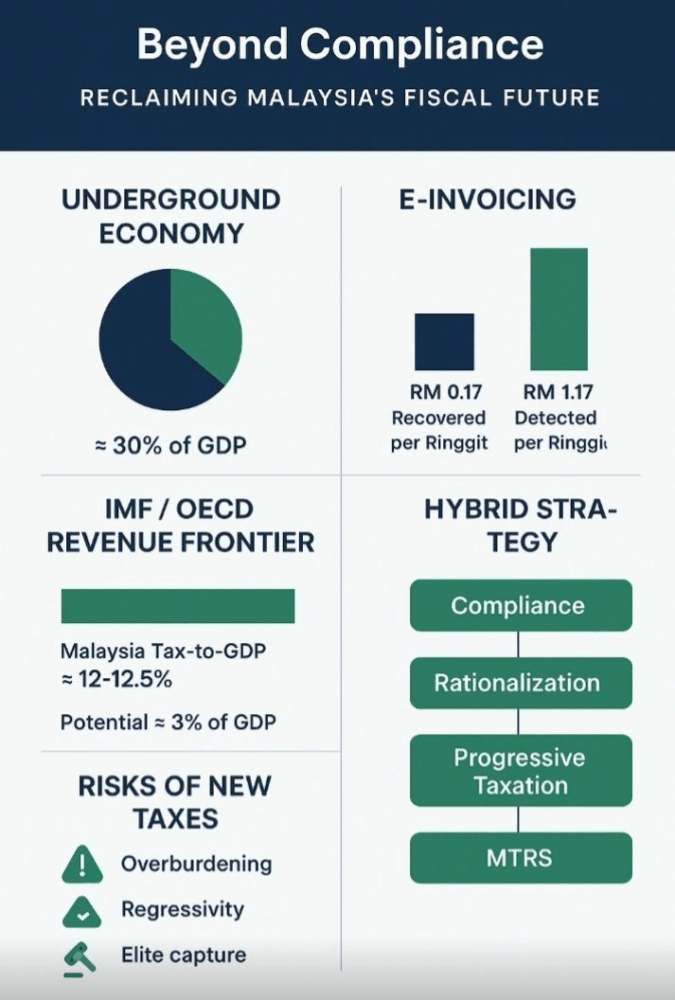
E-invoicing, rolled out from August 2024 onwards, was heralded as the digital fix to revenue leakages. In one analysis of undeclared income from 5,800 taxpayers, the Inland Revenue Board found that for every ringgit detected in undeclared income, it would be able to recover 17 sen in taxes.
- Sign up for Aliran's free daily email updates or weekly newsletters or both
- Make a one-off donation to Persatuan Aliran Kesedaran Negara (ALIRAN), Maybank a/c 507246118995 or CIMB a/c 8004240948
- Make a pledge or schedule an auto donation to Aliran every month or every quarter
- Become an Aliran member
If this figure is applied across Malaysia’s underground economy – roughly 30% of gross domestic product (GDP) – the theoretical yield could reach RM90bn annually.
While impressive on paper, this approach risks becoming a technocratic illusion. Improving compliance in an unequal system simply means auditing the powerless more efficiently. The informal sector, small traders, gig workers and small and medium-size enterprises – already operating on thin margins – become the easiest to monitor, while politically connected companies, state-linked elites, and multinational giants continue enjoying exemptions, profit-shifting, and transfer-pricing loopholes.
As the International Monetary Fund (Malaysia: 2025 Article IV Consultation – Staff Report) notes, Malaysia’s tax-to-GDP ratio of 12.3% in 2024 is well below peer economies, not due to a lack of taxes but due to the quality and equity of their collection. A compliance drive without structural correction risks deepening inequality.
Ethnocapitalism and the architecture of fiscal privilege
Malaysia’s fiscal ecosystem is not neutral – it is built on ethnic patronage and class capture. Through decades of developmentalism, ethnocapitalist clientship has entrenched a class of rent-seeking elites who straddle both state and corporate institutions.
Fiscal privileges – tax holidays, investment incentives and opaque exemptions -become instruments of hegemony, securing political loyalty while perpetuating structural dependency.
As a result, tax reform is often selective. The bottom 40% and middle 40% of households pay consumption-based taxes or face deductions at source, while the top 20% and government-linked entities exploit every available loophole.
When global finance capital enters this equation – through tax incentives for foreign investors – the state’s revenue sovereignty is further eroded.
The outcome: a fiscal regime serving capital accumulation rather than redistributive justice.
Progressive taxation as fiscal decolonisation
To restore fairness and autonomy, Malaysia must view tax reform not as administrative modernisation but as a project of fiscal decolonisation –reclaiming public wealth from elite capture and global monopoly-finance capital.
Three progressive prescriptions emerge.
1. Target wealth, not wages:
- Introduce a comprehensive capital gains tax (CGT) beyond unlisted shares, covering speculative assets, property flipping, and windfall sectors.
- Enforce a windfall profit levy for natural resource and energy sectors during high-price cycles, ensuring extraordinary profits contribute to social development funds.
- Implement a minimum transnational profit tax aligned with the OECD’s global minimum tax framework, to stop profit shifting by multinationals and Big Tech.
2. Rationalise incentives and end ethnic patronage:
- Conduct a full audit of tax exemptions and investment incentives. Malaysia would benefit from rationalising poorly targeted tax incentives.
- Replace opaque discretionary approvals with transparent, rules-based tax incentive frameworks focused on productivity, not patronage.
3. Democratise fiscal governance:
- Create an independent fiscal justice council to review tax equity and publish annual distributional impact reports.
- Expand digital literacy and access so e-invoicing does not become a surveillance tool against the poor but a trust-building mechanism for fair taxation.
Building a medium-term revenue strategy
The IMF (2025) recommends that Malaysia adopt a medium-term revenue strategy to guide tax reforms, setting transparent goals for the tax-to-GDP ratio, compliance rates and incentive rationalisation.
However, a progressive strategy must move beyond revenue targets – it must integrate equity metrics: who benefits, who pays, and whose wealth is shielded.
A credible stragegy would include:
- Transparent reporting of foregone revenues from exemptions
- Periodic equity audits of fiscal policies by class and ethnicity
- Automatic stabilisers – like counter-cyclical corporate tax rates – to cushion inequality during growth cycles
Such measures transform taxation from coercion into citizenship: a shared social compact, not a transactional extraction.
A moral and political economy imperative
The real debate isn’t whether Malaysia should ‘improve compliance’ or ‘introduce new taxes’. It’s whether the nation dares to restructure its fiscal soul – from one serving ethnocapital and foreign finance capital to one empowering productive people and sustainable industries.
Compliance alone polishes the surface of an unjust system; new taxes without reform deepen public cynicism.
True fiscal justice emerges only when tax design confronts entrenched privilege. Every ringgit recovered must not simply fill the Treasury – it must dismantle the structures that made evasion and inequality profitable in the first place.
From compliance to common wealth
A progressive tax agenda for Malaysia must therefore begin with ethical compliance and end with economic emancipation.
The potential recovery from the shadow economy is not just a statistic – it is a moral benchmark of lost social investment.
But the greater theft lies in elite privilege and policy capture.
To break free, Malaysia must couple efficient enforcement with redistributive courage:
- Audit the powerful, not just the powerless
- Tax windfalls, not wages.
- Build compliance through fairness, not fear.
Only then can fiscal reform become nation-building, not burden-shifting.
AGENDA RAKYAT - Lima perkara utama
- Tegakkan maruah serta kualiti kehidupan rakyat
- Galakkan pembangunan saksama, lestari serta tangani krisis alam sekitar
- Raikan kerencaman dan keterangkuman
- Selamatkan demokrasi dan angkatkan keluhuran undang-undang
- Lawan rasuah dan kronisme

Well said C S Loh. The powerless ones need to be shown that e-Invoicing is not a surveillance and bold steps are needed. The current RM500,000 threshold for exemption is archaic as it was brought about when service tax was first introduced on 1 September 1992. So much has changed in 33 years and this must be reflected in the e-Invoicing exemption threshold. There will be confidence won from SME’s etc and this in turn will add on more revenue to collect as many who are thinking of closing shop may defer for 5 years or more. My 2 cents worth view.