A recent BFM radio discussion – Negeri Sembilan: Will the purple wave travel far? – put forward a bold argument.
Analyst Ibrahim Suffian of the Merdeka Center argued that Barisan Nasional’s political survival no longer rests on an independent “blue wave”. Instead, he said, it depends on a “purple wave” – cohabitation with the red of Pakatan Harapan.
The broadcast also argued that Malaysia is not a purely secular state, but a hybrid secular-Islamic one. And it suggested that this hybrid model can only endure if the PH-BN purple alliance holds firm against the ‘green’ advance of the Pas-led PN.
This piece tests each part of that thesis against the record – and against what happened in Negeri Sembilan on 1 August.
Is the blue wave dead?
Three years ago, in the 2023 Negeri Sembilan election, the PH-BN pact won 31 of 36 seats. Pakatan Harapan took 17, Barisan Nasional 14 and Perikatan Nasional won five.
- Sign up for Aliran's free daily email updates or weekly newsletters or both
- Make a one-off donation to Persatuan Aliran Kesedaran Negara (ALIRAN), Maybank a/c 507246118995 or CIMB a/c 8004240948
- Make a pledge or schedule an auto donation to Aliran every month or every quarter
- Become an Aliran member
The result seemed to prove the purple wave thesis. BN could not win the state alone. It needed PH’s urban, ethnic minority vote base to form a government – a ‘unity government’ arrangement, as it was described at the time.
The August 2026 election flipped that picture. BN won 18 seats, Perikatan Nasional took seven and PH fell to 11 – handing the BN-PN alliance a two-thirds supermajority of 25 seats.
This complicates the ‘blue wave is dead’ thesis, but does not disprove it. Three points stand out.
First, BN’s win was not solo. It took 18 seats – exactly half the assembly – but still needed PN’s seven to govern with a majority. At the federal level, BN still depends on PH for its share of power.
The blue wave, understood as BN’s ability to govern alone, remains unproven since 2018.
Second, the 2026 result shows something more interesting: electoral elasticity. BN can ride PH’s coattails, as in 2023, or PN’s, as in 2026 – whichever consolidates ethnic Malay-Muslim votes more effectively. Its survival strategy is not fixed to purple. It is opportunistic (The Business Times, 2 August).
Third, the purple wave was always fragile. As commentator James Chai has observed, the unity government had only “the trappings of a coalition without formalisation”. Umno’s internal faction pushing for a PN partnership was held back by a law to prevent defections – not converted to the PH project.
The 2026 election – triggered by a royal dispute in which 14 Umno assembly members withdrew support from the PH menteri besar exposed that fragility.
So the claim that the blue wave is dead is partly right, but overstated. BN cannot win states alone. But it can, and did, build a winning alliance with PN. Purple is not its only option.
A hybrid secular-Islamic state?
The idea that Malaysia is a hybrid state, rather than a purely secular one, has solid constitutional grounding. Article 3 of the Federal Constitution names Islam as “the religion of the Federation”, while Article 3(4) says this “does not derogate from any other provision of this Constitution”.
The Supreme Court’s 1988 ruling in Che Omar bin Che Soh v Public Prosecutor held that Malaysia remained a secular state, with Article 3 serving a largely ceremonial role.
But the decades since have seen Islamic institutions grow steadily more powerful. The Department of Islamic Development Malaysia (Jakim) has expanded, state Sharia courts have gained ground and Islamic bureaucracy has multiplied.
The Anwar Ibrahim government has continued this trend, placing Jakim officers in every ministry to vet programmes for Sharia compliance (The Star, 3 September 2024).
In 2024 the Federal Court struck down 16 Kelantan Sharia laws on jurisdictional grounds. The ruling provoked an Islamist backlash and pushed Anwar’s government to promise a revival of the Sharia Courts (Criminal Jurisdiction) Act amendments, often called Bill 355 (South China Morning Post, 24 April 2024).
The ‘hybrid state’ label holds up under scrutiny. Malaysia runs a dual legal system: civil law for all citizens, and Sharia law for Muslims on personal and family matters.
Article 160 defines ethnic Malays as constitutionally Muslim, and the MyKad identity card records religious status, allowing the state to enforce official Sunni-Shafi’i Islam.
Yet this hybridity is not balanced. Secular elements – common law courts, parliamentary democracy and the guarantee of religious freedom under Article 11 – persist. But these are increasingly hemmed in by Islamic institutional growth.
The 2024 ‘Mufti Bill’, which would let federal territory muftis issue fatwas (legally binding religious opinions), illustrates this (Global Voices, 24 December 2024). The bill applies only in the federal territories of Kuala Lumpur, Putrajaya and Labuan, and its rulings would have no effect elsewhere.
Facing strong opposition, it never reached its second reading, so remains inoperative. Even so, it signals how far Islamic authority has reached into civil jurisdiction.
Would BN power fuel Islamisation?
History suggests that unchecked BN power would deepen Islamisation to counter Pas – and this claim has strong support.
Under Dr Mahathir Mohamad, from 1981 to 2003, Umno met Pas’ electoral challenge with its own Islamisation drive: expanding Jakim, founding the International Islamic University Malaysia and promoting state-led dakwah (missionary) work.
Historian Andreas Ufen has documented how Mahathir’s government linked Pas to militancy to justify a hard line, even as Umno accelerated its own Islamic expansion.
Abdullah Badawi’s ‘Islam Hadhari’ (civilisational Islam) and Najib Razak’s ‘Global Movement of Moderates’ continued the same pattern – Umno occupying Islamic political space to head off Pas.
When Pas president Hadi Awang tabled RUU355 (Bill 355) in 2016, Umno and BN MPs, including Najib, let the bill pass its first reading. That was to show BN’s willingness to accommodate Pas’ agenda when it suited the party politically.
The pattern is clear. Umno and BN have consistently answered Pas’ green wave not by defending secular institutions, but by competing on Islamic ground.
Malaysia’s ethnic-majoritarian, first-past-the-post system encourages this: over half of the peninsula’s parliamentary seats have Malay-majority electorates. Umno cannot risk being outflanked on Islam.
But the 2026 Negeri Sembilan result adds a new twist. BN no longer needs to out-Islamise Pas. Umno president Zahid Hamidi’s cooperation with PN – formal at state level, while BN stays in the federal unity government – looks like an attempt to have it both ways.
This complicates the Islamisation forecast. BN may not need to outbid Pas if it can instead share power with it, as PN already does with Pas in Kelantan and Terengganu.
The historical pattern still holds, broadly, but it could be overtaken by events if BN-PN cooperation becomes permanent rather than a one-off electoral pact.
Does purple defend secularism?
Here the thesis meets its toughest test. Has the PH-BN federal government actually defended secularism? The record suggests otherwise. It has pursued its own Islamisation agenda – more moderate than Pas would like, but real all the same.
Jakim’s role has grown, with officers placed in every ministry.
The government has pledged to revive Bill 355 to toughen Sharia court penalties. [The proposal remains under consultation and policy consideration.]
It has also also restricted LGBT-related expression, including a ban on Swatch Pride watches and the cancellation of music festivals.
This points to a defensive, reactive posture rather than a principled one. Anwar’s government has repeatedly tried to match Pas on Islamic credentials to hold on to Malay support. PN keeps setting the political agenda, and PH-BN keep responding to it.
That creates a paradox. The purple alliance defends secular institutions partly by eroding them. Its restraint blocks Pas’ most extreme demands – hudud (Islamic criminal punishments) and a full Islamic state – but only by occupying the middle ground of moderate Islamisation, not by asserting secular constitutional principles.
Anwar rejected any move to recognise secularism or LGBT rights that conflict with Islam’s status as the religion of the federation, in his first televised interview as prime minister (New Straits Times, 7 January 2023).
The 2026 result also suggests the purple alliance is a hard sell to voters. By aligning with BN, PH alienated ethnic minority voters uneasy with BN’s more conservative turn, while still failing to hold enough Malay support against the BN-PN’s ‘Malay-Muslim unity’ message.
PH’s election director, Amirudin Shari, blamed the defeat on “identity politics”, pointing to a growing divide between Malay and ethnic minority voters (Focus Malaysia, 3 August 2026).
So the claim that the purple alliance structurally defends secularism is partly true, but troubled. It blocks Pas’ maximalist agenda, but through competitive Islamisation rather than secular defence. And its electoral standing looks shaky after three state election defeats in a row – Sabah in 2025, and Johor and Negeri Sembilan in 2026.
Verdict
The idea that Malaysia’s secular future depends “not on the resurgence of blue, but on the endurance of purple against the encroaching green” is a sophisticated argument. It is also too optimistic.
What it gets right:
- BN cannot govern alone – the independent blue wave belongs to the pre-2018 era.
- Malaysia is constitutionally and institutionally a hybrid secular-Islamic state, not a purely secular one.
- History strongly suggests unchecked BN power would speed up Islamisation to compete with Pas.
- And the Pas-led PN’s green wave is a genuine threat to secular constitutional elements.
What it gets wrong, or understates:
- The purple wave isn’t BN’s only option – the 2026 result shows it can just as easily ally with green.
- The purple alliance moderates Islamisation rather than defending secularism outright. Jakim’s expansion, tighter religious restrictions and Sharia court empowerment have all eroded secular ground even while blocking Pas’ harder line.
- The alliance also looks electorally unsustainable, with three state defeats running, as voters punish PH and BN for contesting each other locally while sharing power nationally.
- And the green advance is no longer only external. It is now built into the system, with BN willing to work with Pas at state level while opposing it federally.
It is fair to call Malaysia’s state constitutionally hybrid, and fair to say BN’s competitive Islamisation is a historical pattern.
But the purple wave thesis overestimates the alliance’s capacity and its will to defend secularism.
Negeri Sembilan points instead to a more fragmented, opportunistic landscape – one where BN shifts between purple and blue-and-green configurations, depending on the electoral maths.
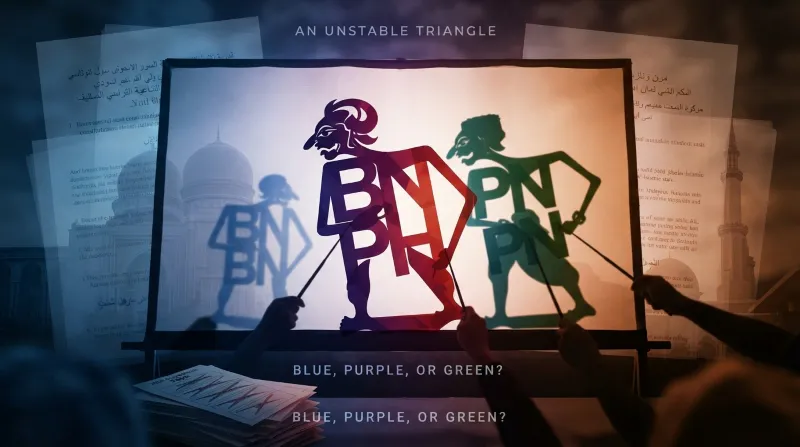
Rather than purple holding the line against green, the likelier path is triangular: blue, purple and green interacting in unstable, shifting alliances.
Malaysia’s secular institutions, such as they are, cannot rely on goodwill between political rivals. What they need is a principled defence of constitutional supremacy, civil law and religious freedom – something neither the purple nor the blue-and-green camp has yet shown much will to pursue.
AGENDA RAKYAT - Lima perkara utama
- Tegakkan maruah serta kualiti kehidupan rakyat
- Galakkan pembangunan saksama, lestari serta tangani krisis alam sekitar
- Raikan kerencaman dan keterangkuman
- Selamatkan demokrasi dan angkatkan keluhuran undang-undang
- Lawan rasuah dan kronisme