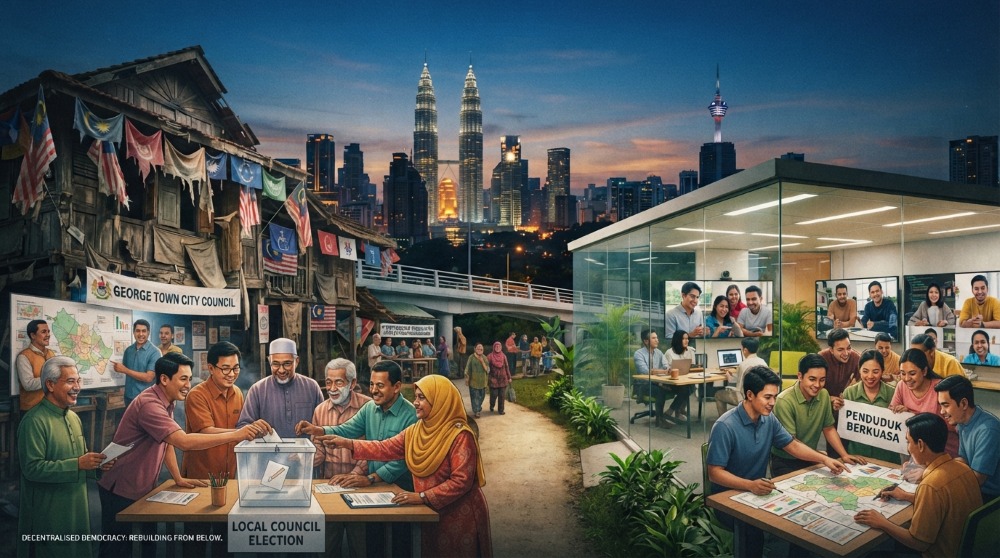
It is the silly season of elections again.
The Johor state election has come and gone. Next up is Negeri Sembilan, followed by Malacca. Then, perhaps early next year, the general election for the whole country.
So much hustle and bustle. The usual break-up of makeshift coalitions is under way. Perikatan Nasional is under threat: Bersatu and Pas are no longer best friends forever. Part of Bersatu has already broken away.
No split from PKR looks imminent, but a few top leaders have resigned and formed a new party, Bersama. It contested the Johor election and was trounced – all its candidates lost their deposits. Before that, several former DAP leaders had said they might quit to join Bersama too.
And the leader nicknamed ‘Mr Keluar Sekejap’ (Mr Step-Out-Briefly) – who once quit Umno – has said he is still keen on becoming prime minister one day. So he has rejoined Umno. No surprise there.
- Sign up for Aliran's free daily email updates or weekly newsletters or both
- Make a one-off donation to Persatuan Aliran Kesedaran Negara (ALIRAN), Maybank a/c 507246118995 or CIMB a/c 8004240948
- Make a pledge or schedule an auto donation to Aliran every month or every quarter
- Become an Aliran member
My little crystal ball predicts that neither the state elections nor the coming general election will solve the problem of a hung parliament, where no single party or coalition wins a majority.
Instead, expect more horse-trading and repeated attempts to cobble together a grander coalition – a ‘Unity 2.0’ government of sorts – just to survive any vote of no confidence.
This means survival and expediency will prevail over any reform agenda again, whatever the parties and their leaders promise on the campaign trail.
Be warned: they will not be able to deliver, because building a majority may mean including people who have spent their political careers opposing the very reforms on offer.
Worse, the grand coalition might have grand names like ‘Unity’ and ‘Madani’, but that does not not disguise the fact that it includes leaders who have faced corruption allegations or charges – as with the appointment of the Umno chief as deputy PM, whose charges were later dropped.
A future Unity 2.0 government could include leaders like the Johor Umno chief, who declared he would not work with the DAP to form the Johor state government – even though both parties are supposed allies in the federal ‘unity government’. With coalition partners like that, who needs enemies?
It could also include people who want to amend the law to allow for the appointment – rather than election – of political leaders in this 21st Century, nearly 70 years into Malaysia’s electoral democracy.
And, of course, the coalition will include politicians who will readily stir up ethnic and religious sentiment to score points, deepening disunity.
Some will want to join the Unity 2.0 government simply to campaign for the release of their convicted former leader. (Reflect on this for a moment: former Prime Minister Najib Razak was found guilty in 2020 of criminal breach of trust and abuse of power for illegally receiving RM42m misappropriated from a unit of 1MDB. He was convicted by nine judges across three levels of the judiciary, all of whom ruled against him unanimously. He was then sentenced to 12 years in prison and fined RM210m. His supporters are pushing for his release – and we may end up working with them in a Unity 2.0 government?)
No wonder reforms have been few and far between under this ‘Madani’ unity government.
Reforms delayed for over 60 years
Umno-Barisan Nasional’s electoral dominance shaped every part of Malaysia’s political system, leaving its mark for over 60 years.
Beyond the two-thirds parliamentary majority that let it amend the 1957 constitution at will, Umno-BN influenced the workings of the entire bureaucracy: the civil service, the army, the police and a judicial system that collapsed the roles of the Attorney General’s Chambers and the public prosecutor.
Umno-BN also influenced public policy, the allocation of public funds, and who won government tenders to implement this or that policy – invariably a crony or two. It also shaped how government worked, not just federally but at state and local level.
It is right to demand leadership changes in the country’s top institutions – the bureaucracy, the judiciary, government-linked companies – just as we demand changes in the government of the day.
But changing personnel is not enough. Sixty years of Umno-BN rule call for a revamp of the whole system, or what people now call the entire Umno-BN ecosystem.
Let’s step back to understand how we ended up in this situation. Essentially, it is because we are still stuck in Old Politics, even though we now have a New Economy and a New Society.
New Economy, New Society
As a scholar-activist studying Malaysian politics, I’ve been waiting a long time for New Politics to arrive.
The economy, meanwhile, has been transformed beyond recognition. Growth and government revenue once rested on commodities – first rubber and tin, then tropical timber and palm oil, then offshore oil and gas.
Today, the economy runs on services and manufacturing, especially electrical and electronics. These sectors contribute most of Malaysia’s revenue and attract the bulk of foreign direct investment.
That economic shift has reshaped Malaysian society too. Fewer people work in agriculture now. More work in manufacturing and services. The ranks of managers, administrators and registered professionals and technicians have grown.
The civil service has expanded to 1.8 million – arguably too large for a population of over 30 million.
In 2016, primary school enrolment stood at 97%, upper secondary at 94%, and post-secondary at 17%. An estimated half a million teachers and administrators worked across 10,000 schools, educating five million students nationwide – a huge leap from what the peninsula inherited from the British at its independence in 1957.
In 1958, we had only a branch campus of the University of Malaya in Pantai Valley (the main campus was in Singapore). By 1980, there were five public universities; by 2015, 27, plus 32 polytechnics and 84 public community colleges. Today, there are also 47 private universities and university colleges, with over half a million students enrolled in tertiary education.
Not surprisingly, the educated, urban middle class now makes up about a third of Malaysia’s population.
Thanks to the New Economic Policy (NEP), this middle class is strikingly multi-ethnic – unlike before, when the educated middle class was largely non-Malay.
One key effect of this new class is that ethnic and other social groups have grown more fragmented too. Instead of one popularly acclaimed leader per ethnic group, there are now many. Meanwhile, social media has given rise to countless spokespeople for any given cause or group.
So, since independence, and after over 50 years of the NEP, Malaysia has built a New Economy and a New Society. But where is the New Politics?
Whither New Politics?
Malaysia’s Old politics, most agree, was dominated by a small group of elites presiding over ethnic-based parties, linked at the top through a multi-ethnic coalition.
All of the BN parties got into business too – banks, media empires, construction conglomerates, education ventures. As long as these parties doubled as systems of patronage that fed members down the pyramid, the elites’ control over the rest was secure.
So, a defining feature of Malaysia’s Old Politics was also patronage and the prevalence of ‘money politics’.
New Politics, one hoped, would be multi-ethnic and inclusive. It would shed money politics and patronage, allow free and fair elections, and open the door to democratic participation.
Above all, one hoped Umno-BN – in power for 60 years – would finally be displaced by an alternative multi-ethnic coalition.
So there was real excitement when the 2018 general election ushered in the Pakatan Harapan coalition led by Dr Mahathir Mohamad. Many hoped for deeper democracy: free and fair elections restored, elected local government brought back, and reform of key institutions – the judiciary, the police, the Malaysian Anti-Corruption Commission, the universities, the entire education system. Coercive laws, one prayed, would be repealed too.
Perhaps there would be more consultation with the people – through parliamentary select committees – before policy was made. Maybe new royal commissions of inquiry would investigate chronic problems, starting with widespread corruption and money politics.
A commission to examine the civil service seemed overdue too, given how much autonomy and professionalism it had lost after 60 years of Umno-BN rule. At the very least, one hoped the civil service would adopt evidence-based policymaking.
Instead, the opposite happened!
The result of the 2018 election was undone by the ‘Sheraton Move’ backdoor coup. Political intrigue and instability followed. Rather than decisions being made transparently, in Parliament or at the ballot box, politicians struck deals among themselves.
Breakaway parties formed overnight. New coalitions with names like ‘Gabungan This’ and ‘Something-Plus’ sprang up. In a single decade, Malaysia changed its prime minister six times.
Thank heavens for the alternative media, where we can voice our dissatisfaction. Because so many institutions have been compromised, there is little other room left to manoeuvre to safeguard our democracy.
Unfortunately, ordinary people, like their leaders, have had to increasingly turn to the Agong to resolve political intrigue and instability.
This is not the New Politics we envisioned when the New Economy and New Society arrived. This version of New Politics has been corrupted.
Corruption and Umno-BN’s collapse
The main cause of Malaysia’s current political predicament is the implosion of Umno.
Before that came the near-disappearance of the MCA, MIC, PPP, Gerakan and the rest of BN’s 14 parties, including those from Sabah and Sarawak.
Umno-BN – or its predecessor, the Alliance – had won every general election since 1957. Now it has collapsed.
That is not to say Umno-BN was ever as central to the system as it seemed; its importance was overstated. It mattered for political stability mainly because so many other institutions had already been undermined or compromised.
The judiciary, the Attorney General’s Chambers, the public prosecutor and their aides, the civil service from the chief secretary down, the police and other law enforcement units, all answerable to the executive, Parliament and so on had all been compromised. They were no longer fully competent, accountable or transparent.
The trigger for Umno-BN’s collapse was unprecedented corruption within the party. A rot had set in at the very top. Former Umno president and former Prime Minister Najib Razak was found guilty in 2020 of criminal breach of trust and abuse of power. Shamelessly, he appealed and re-appealed his conviction. Malaysia had become a kleptocracy par excellence.
To restore democratic momentum, root out corruption at every level, rebuild political stability and maintain economic development, we cannot simply keep holding elections and hoping fresh faces and new party names will change things.
Nor is the answer to restore the old system of stability held together by a single dominant party like Umno-BN, which ruled for six decades. Despite Umno’s recent success in the Johor state election, do not for a moment assume it is on its way back to the top. We must not let that happen!
We need real reform instead – restructuring the political system by decentralising power, revenue and participation downwards.
Global trend towards decentralisation
There is a worldwide trend towards greater decentralisation, in developed and developing countries alike.
Older federations in the West – the US, Canada, Switzerland – did not provide for a third, elected tier of government – local government – in their original constitutions.
But they have since passed laws allowing relatively autonomous local authorities, such as New York City, Greater London and Greater Manchester.
In Spain, greater autonomy has gone to the regions through the creation of Autonomous Communities.
Unlike these older federations, developing countries have usually included provisions for elected local government into their independence constitutions.
South Africa’s 1996 constitution, for example, split power and resources three ways, equally, between the centre, the provinces and local government.
India amended its constitution in 1994 to reserve seats in local, or panchayat, elections for women and for ‘scheduled tribes’.
Ethiopia has four tiers of government: alongside the centre, the state and local government, there is a district-level woreda.
Southeast Asia
Across Southeast Asia, although Malaysia is the only federal country in the region, a process of decentralising power and revenue to local government has taken place.
In the Philippines, after Ferdinand Marcos’s martial law ended in the 1986 People Power Revolution, Filipinos adopted a new constitution in 1987, followed by a Local Government Code in 1991.
Functions in agriculture, health, environment, social welfare and public works were transferred to local governments, whose executives and legislatures were also elected.
Civil society groups, including women’s organisations, gained seats on local government committees overseeing development planning, schools, policing and contracts.
Local government units were also given 40% of internal revenue, up from 20%, along with the right to tax residents – on condition they kept services running and paid the civil servants under their charge.
In Indonesia, no new constitution followed the 1997-98 Reformasi movement, but there were many amendments.
These allowed the shift from military to civilian rule, free and fair elections, and the restoration of civil liberties to assemble, associate and speak freely. The police were separated from the army, and anti-corruption laws were passed.
Two new local government laws followed in 1999.
The first transferred power and functions from the centre to local governments, including metropolitan areas, bypassing some 300 provincial governments. An estimated 10,000 functions and responsibilities were devolved – in public health, education, welfare, land, natural resources, transport, public works and utilities. By 2001, 2.25 million civil servants had been transferred to local government too.
The second rebalanced fiscal arrangements between the centre and the regions. Revenue from natural resources – oil, gas, timber, mining – was shared with local governments, with no ‘one size fits all’ formula.
Local authorities ended up with more revenue than before, and were often allowed to introduce their own taxes and fees to raise revenue. In return, they took on responsibility for the salaries of civil servants in local government, infrastructure and other local functions.
Mega-projects once decided in Jakarta without consulting local governments have been stopped. Local authorities can now reject centrally proposed mega-projects, and some have cancelled old licences the centre had previously issued.
Apparently, this ‘big bag of reforms’ led to a chaotic situation. The reforms were too widespread and too fast. Confusion grew over the roles of provinces, districts (kabupaten) and local government.
So amendments to regional governance laws followed in 2004, returning some powers to the districts. Another law that year required mayors, district chiefs and village heads all to be elected.
In 2014, a further law on village governance required 30% of village officials to be women, to boost women’s participation in decision-making.
In effect, the new laws pushed reform down to local governments, with additional revenue and staff to perform the functions devolved to them.
Local elections became mandatory. Interestingly, they opened the door to newcomers such as Joko Widodo (Jokowi), who won the mayoralty of Solo, then the governorship of Jakarta, on his way to becoming Indonesia’s president.
Malaysia
Malaysia is the only Southeast Asian country that calls itself federal. But its federalism is highly centralised.
In most federations, social functions such as housing, local transport, public health, primary and secondary education, social welfare, labour, the arts, culture and religion sit with the states or local government.
In Malaysia, the centre controls most of these, with only a few shared with the states.
Federal systems typically rely on federal-state commissions where the centre and its constituent units meet to iron out problems – what might be called the five Cs: consult, coordinate, cooperate, resolve conflict and adapt to change. Malaysia has only three major commissions: finance, land and local government. India, by contrast, has over 10.
Malaysia also gave Sabah and Sarawak greater autonomy at the outset, under the Malaysia Agreement 1963 (MA63). But that autonomy has eroded over time. Rebalancing federal-state relations has been a major demand of both states in return for staying in the Madani ‘unity government’. But several of their demands remain unmet.
Penang’s Municipal Council of George Town was the first local authority to hold elections in 1951. Local elections for municipalities, and big and small towns in other states followed. Local council elections were also held in most of the new villages created in the early 1950s.
All were suspended in 1965, during ‘Confrontation’ with Indonesia.
A royal commission chaired by Senator Athi Nahappan then reviewed the workings of the local governments and found that local councils were performing well. It recommended that local elections resume.
But the Local Government Act 1976 abolished all local elections. The government, in effect, rejected its own royal commission’s advice.
Since then, the local governments’ role has also shrunk.
The George Town City Council once ran an island-wide bus service. Adults used it to get to work, and children, including me, rode it to school.
Its health department ran a network of public clinics. Nurses visited new mothers at home. Health department inspectors checked markets and public spaces to control pests.
The council also cleaned roads and drains and, collected rubbish and solid waste. It treated sewage before releasing the treated water back into rivers and drains.
From the 1970s, following the New Economic Policy and a push towards privatisation, many of these services were taken from local government and tendered to bumiputra individuals and companies or to federal bodies. Water supply, for instance, is now regulated federally.
It is time to reverse that centralisation and privatisation of those public utilities. Local governments can run these services more efficiently than Putrajaya or the private sector.
Rebuilding democracy from below
Why is local government matter so important? Simply put, it can capture the interest and energy of ordinary people, including women.
Local government is about clean markets and green, open spaces in neighbourhoods. It is about fighting local crime and having a say in how schools and health services are run. Firefighting, clean roads and drains, and the fight against corruption can also be handled at the local level. Local government can even foster improved relations between ethnic groups at the local level.
Above all, decentralised local government provides the local community more avenues to participate in decisions that shape everyday life and livelihoods.
Fewer people now care about the jostling for power in Washington, Westminster, the Japanese Diet or Putrajaya. Local election turnouts are rising in many places even as those for national elections fall. (Alas, Malaysia has had no local elections to measure after they were abolished in 1976.)
Consider the excitement around the recent mayoral race in New York, won by Zohran Mamdani, or the equivalent contest in Boston, won by Michelle Wu, a lawyer, pianist and daughter of immigrant parents.
In Britain, Greater Manchester’s Andy Burnham has just become the country’s new Prime Minister.
And in Indonesia, Jokowi – a furniture-shop owner with no political background – created much excitement during his campaign to win the mayoralty of Solo, then the Jakarta governorship, before emerging as Indonesia’s most compelling political figure since Reformasi.
If we want to offer people hope, build participatory democracy, and get clean, accountable, transparent government, we need to consolidate local government and rebuild from the bottom up.
At a time when public trust in those who once promised reforms has worn thin – not least because of the compromises forced by hung parliaments – we should push for decentralisation to the local government level.
We should use this period of ‘instability’ to decentralise. Perhaps work with Sabah and Sarawak.
It is worth distinguishing decentralisation to the local level from the question of restoring local elections. If both happen together, that is a bonus.
But given how reluctant most parties in the unity government are about reviving local elections, the two do not need to be tied together. Decentralise first; push for local elections later.
With decentralisation, we can push towards further democratisation and other reforms. Without it, we are stuck: no democratisation, no reform, no political stability.
Francis Loh
Co-editor, Aliran newsletter
23 July 2026
An earlier version of this piece was presented at an Interstate Forum on State-Federal Relations, organised by the Penang State Assembly’s Select Committee on State-Federal Relations and Penang Institute, on 11 June 2026. Present were the Penang chief minister and representatives of the state governments of Perlis, Selangor, Kelantan, Terengganu, Sabah, Sarawak and Penang – an unusual gathering of leaders from both the Madani unity government and the opposition.
AGENDA RAKYAT - Lima perkara utama
- Tegakkan maruah serta kualiti kehidupan rakyat
- Galakkan pembangunan saksama, lestari serta tangani krisis alam sekitar
- Raikan kerencaman dan keterangkuman
- Selamatkan demokrasi dan angkatkan keluhuran undang-undang
- Lawan rasuah dan kronisme