

Lim Teck Ghee
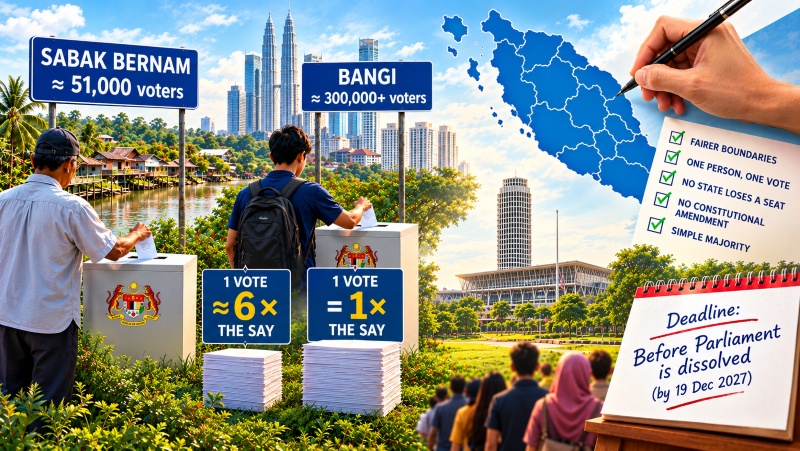
In Selangor, a voter in Sabak Bernam has roughly six times the say in who goes to Parliament as a voter in Bangi.
Across the country, the largest constituency has about 10 times as many voters as the smallest. That is not one person, one vote.
It can be fixed before the next general election, without amending the Federal Constitution and without any state losing a seat.
The window is open now. The eight-year constitutional freeze on redrawing boundaries in the peninsula ended in March 2026. The Sabah and Sarawak freezes have also lapsed.
But time is short. Every step must be completed before Parliament is dissolved for the next general election, due by early 2028. Otherwise, the next election will be fought on the 2018 map.
The problem and the fix
The problem: some voters’ ballots count six times more than others’, even within the same state.
- Sign up for Aliran's free daily email updates or weekly newsletters or both
- Make a one-off donation to Persatuan Aliran Kesedaran Negara (ALIRAN), Maybank a/c 507246118995 or CIMB a/c 8004240948
- Make a regular pledge or periodic auto-donation to Aliran
- Become an Aliran member
The fix: redraw boundaries so that no constituency is more than one-third above or below its state’s average number of voters.
What it needs: a simple majority in the House of Representatives. No constitutional amendment is required and no state loses a seat.
The deadline: the Electoral Commission’s report must be approved before Parliament is dissolved. That will happen automatically on 19 December 2027 at the very latest.
Why the gap matters
Bangi, in Selangor, has more than 300,000 voters. Sabak Bernam, in the same state, has about 51,000. So a vote cast in Sabak Bernam is worth roughly six times one cast in Bangi.
Population growth, urban migration and the Undi 18 reforms added millions of new voters. The reforms brought in automatic registration and lowered the minimum voting age from 21 to 18. Most new voters live in fast-growing urban and suburban seats such as Bangi and Damansara.
The 2018 boundaries were not drawn for this electorate. The result is a map where your postcode decides how much your vote is worth.
This matters to everyone in Malaysia. Every voter’s ballot should carry roughly the same weight.
Lopsided boundaries can let parties win majorities that do not reflect how people voted. They have long fed suspicion of gerrymandering. Clear, published rules make manipulation much harder.
One MP cannot properly serve 300,000 constituents. Overrepresented areas also attract a disproportionate share of political attention and public money.
A transparent, data-driven review would rebuild confidence in the Electoral Commission. It could also give young and first-time voters a reason to turn out.
The one-third rule
Section 2(c) of the Thirteenth Schedule to the Federal Constitution says the number of electors in each constituency within a state ought to be approximately equal. But it allows some extra weight for rural areas that are harder to reach.
This plan gives that principle a measurable target. No state gains or loses seats. Perlis keeps three, Pahang keeps 14 and Selangor keeps 22.
Calculate each state’s average number of voters per seat.
Redraw boundaries so that every seat falls within one-third (±33%) of that average. Aim for ±25% wherever geography allows.
Rural weighting stays, but within a defined limit.
Take Selangor. Its 22 parliamentary seats average about 167,000 voters each. Under the one-third rule, every seat would need to fall between roughly 111,000 and 222,000 voters.
Bangi, with more than 300,000 voters, is about 80% above the state average. It would have to shrink.
Sabak Bernam, with about 51,000, is about 69% below the average. It would have to grow.
Similar adjustments across the state would bring every Selangor seat into a defensible range.
Legal and achievable
Redrawing boundaries within each state needs only a simple majority in the House of Representatives to approve the commission’s report. The 2018 report was passed this way.
Changing the number of seats allocated to each state means amending Article 46. That needs a two-thirds majority (148 of 222 MPs). This plan leaves Article 46 untouched.
The timing is lawful. Article 113 allows a review once eight years have passed since the last one. It requires the review to be completed within two years. The freeze in the peninsula ended in March 2026.
It has been done quickly before. The previous review for the peninsula review, which began in 2016, went from start to House approval in roughly 18 months.
The arithmetic works, the Constitution allows it, and the timeline is viable. What is missing is the decision to start.
Sabah and Sarawak are a separate track. The federal government has agreed in principle to restore Sabah and Sarawak to one-third of seats in the House of Representatives, in line with the Malaysia Agreement 1963. Talks with the commission have begun.
That is a separate track: adding seats requires amending Article 46 by a two-thirds majority, as well as wide consultation.
The two reforms should run in parallel. Fixing the gaps within each state does not depend on the MA63 talks. It must not be delayed while those talks continue.
Timetable and next steps
The schedule is tight but achievable.
From now until December 2026, the Electoral Commission formally notifies the Speaker and the prime minister.
The first proposed maps are gazetted and put on public display for one month.
From January to March 2027, the first round of local inquiries hears objections.
From April to June 2027, the commission revises the maps where justified. A second one-month display follows if revisions are made.
From July to September 2027, a second round of local inquiries is held. The commission then submits its final report to the prime minister.
In October and November 2027, the report is tabled at the Budget sitting and passed by a simple majority.
Before dissolution, the order giving effect to the new boundaries is made and gazetted.
Parliament dissolves automatically on 19 December 2027 if it is not dissolved earlier. This is the hard stop.
It all depends on the commission starting before the end of 2026. Parliament also must not be dissolved before the report is passed.
Some will say this is too rushed. The Constitution allows two years. This plan uses about 18 months, matching the last review for the peninsula. It keeps every public display and inquiry step required by law.
What about rural voters? Rural weighting remains, as the Constitution intends. The one-third rule simply caps it, so that the weighting cannot become a six-to-one distortion.
Does this fix the gaps between states? Not fully, and we should say so plainly. Imbalances between states need an Article 46 amendment and a two-thirds majority. This plan fixes the worst distortions now, with the votes that exist today, as a first step.
Who benefits politically? Voters do, and so does the nation. Some safe seats may become competitive, which is why incumbents of every party may object. A published, uniform rule applied to every state is the best guarantee of neutrality.
So what needs to happen?
The commission should formally begin the review before the end of 2026. It should also publish the target variance and the data for every proposed seat.
The prime minister should commit to tabling the final report promptly and not dissolving Parliament before it is decided.
MPs and political parties should pledge publicly to support a fair realignment within each state, whatever its effect on their own seat.
Civil society, the media and voters should follow the display periods and file objections where boundaries are unfair. They should also ask their respective MPs where they stand.
A fairer map before the next general election is within reach. All it takes is the political will to begin.
Note: Voter figures are based on the 2022 electoral roll.
Dr Lim Teck Ghee is a Malaysian economic historian and policy analyst.
The views expressed in Aliran's media statements and the NGO statements we have endorsed reflect Aliran's official stand. Views and opinions expressed in other pieces published here do not necessarily reflect Aliran's official position.
- Tegakkan maruah serta kualiti kehidupan rakyat
- Galakkan pembangunan saksama, lestari serta tangani krisis alam sekitar
- Raikan kerencaman dan keterangkuman
- Selamatkan demokrasi dan angkatkan keluhuran undang-undang
- Lawan rasuah dan kronisme
